
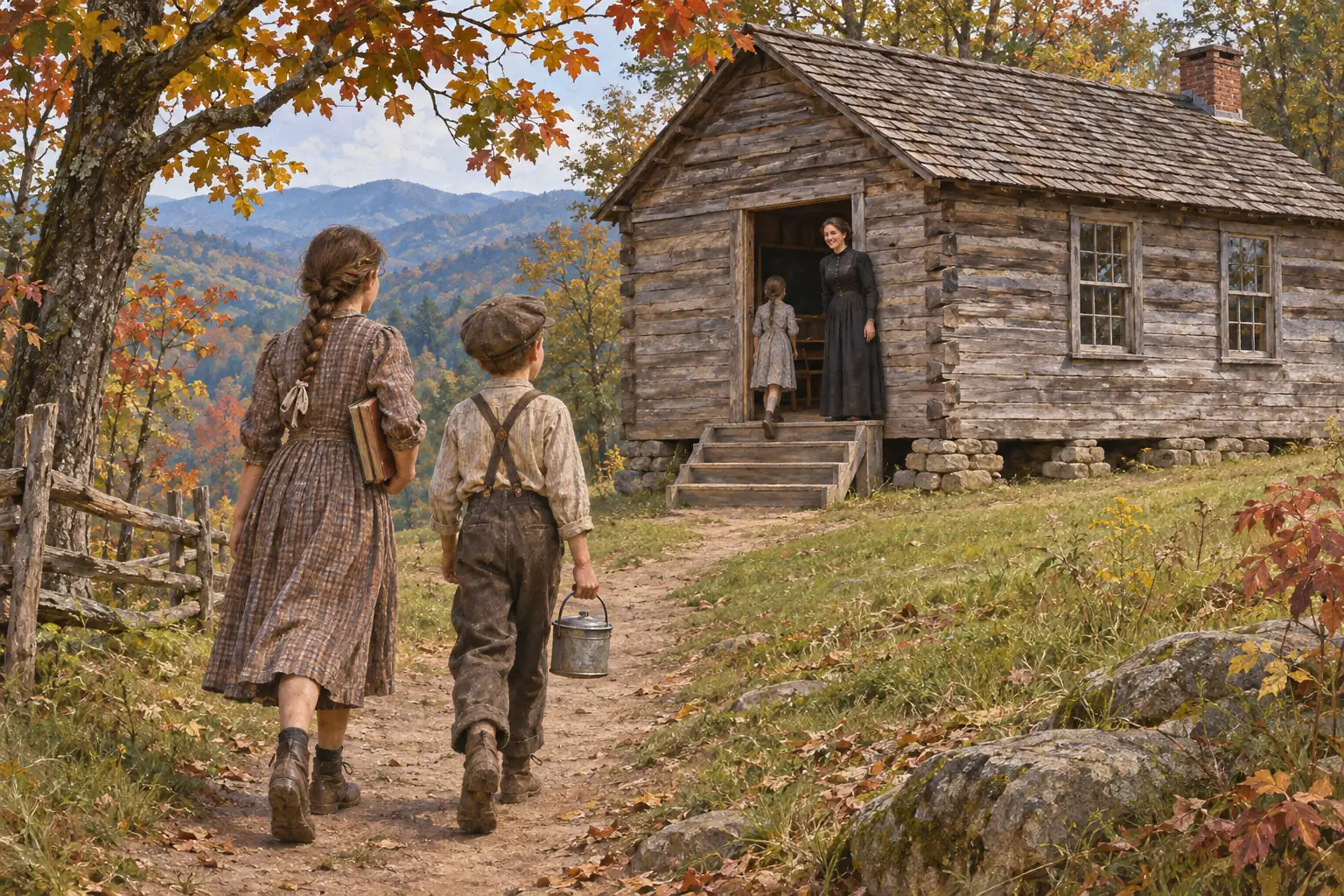
How did mountain children go to school when homes were scattered across steep country? Many walked to a small local school; some rode horseback. Children of different ages could share one room, and terms often lasted only a few months. Others learned at home or attended lessons at night when daytime work kept them away.
Getting an education depended on more than reaching a building. A community needed a teacher, money or other support, and time when children could attend. The examples below come mainly from the 1800s and early 1900s, with some memories extending into the following decades. They show how much school life varied across Appalachia.
First the Community Needed a School
Before a child could take a seat, someone had to arrange a place to learn. The National Park Service’s historic resource study describes subscription schools in the Smokies: families contributed toward a teacher and supplied a building. These arrangements helped provide instruction before free public schools reached many communities.
Little Greenbrier School in Tennessee offers a concrete example. Built in the early 1880s, it stood on land donated by Gilbert Abbott. Another neighbor, Ephraim Ogle, supplied poplar logs. The building’s National Register nomination names John Walker and other residents among those who helped raise it.
Those contributions turned land, timber, and labor into a classroom. The school also served as a church, so a single building could meet several local needs.
Buildings changed as communities developed. In North Carolina’s Cataloochee Valley, Beech Grove School was built in 1901 with two rooms. Mountain education did not remain frozen in the familiar picture of one teacher inside a tiny log cabin.
The Walk Could Decide Who Attended
Travel was one of the clearest barriers. Little Greenbrier’s historic nomination describes children walking or riding horses along narrow, muddy routes. The journey could consume time and strength before lessons even began.
A 1918 U.S. Children’s Bureau report shows what distance meant for particular families. Its mountain survey covered three townships in one North Carolina county, with a white population in the sample. It should not be treated as a description of every Appalachian child.
The investigators met an eleven-year-old who wanted to attend school but had received only eleven months of schooling. From his family’s remote mountaintop home, the round trip would have been six miles. They also recorded a mother teaching her nine-year-old at home because the walk was too far.
Another mother described children crossing a swift creek when the footbridge was out of place. They sometimes returned wet to the waist. Her objection was practical: requiring attendance did not provide a safe way to get there.
Distance also shaped ordinary routines. Jess Gibbons recalled that children living farther from Hensley Settlement’s school brought lunch, while he often went home to eat. A school day could look quite different depending on which household a child left that morning.
School Followed a Local Calendar
Some mountain children attended school during winter because farm work demanded less of their time then. The Park Service describes early Smoky Mountain terms lasting two to four months. Parents might pay about a dollar per child each month, sometimes providing produce instead of cash. A teacher could board with a local family.
Cataloochee’s three schools normally held classes from November through January, according to the park’s community history. Additional funding could extend the term. The school calendar reflected available money as well as work at home.
Winter was not the best season everywhere. At Brushy Mountain School in Kentucky’s Hensley Settlement, the term ran from July until January. The school then closed during difficult winter travel and remained closed through spring and early summer planting.
These schedules make sense only when tied to their own communities. Moving school into a quieter farming season helped in one place; dangerous travel could make that same season unsuitable somewhere else.
Our account of how pioneers survived winter explores the household demands surrounding those cold-weather terms. Here, the consequence for education is clear: a school year could be much shorter than a calendar year, and its dates were not the same across the mountains.
What Children Learned in a One-Room School
A one-room school brought children of different ages together. The Park Service’s historic resource study describes early Smokies classrooms with a teacher’s desk, benches for pupils, and a blackboard. Reading, writing, and arithmetic formed the core of instruction.
Sharing a room did not mean every child had reached the same lesson. A beginner learning letters and an older pupil doing arithmetic needed different instruction. The arrangement required a teacher to work with several levels of learning in the same space.
Little Greenbrier’s surviving furnishings make that setting easier to picture. Its historic nomination records handmade desks and a blackboard formed from nine wooden planks painted black. These were working classroom tools made from available materials.
Lessons could extend beyond the basic three subjects. In Cataloochee, children also studied spelling, geography, and grammar. Schools followed North Carolina’s prescribed curriculum.
Friday afternoons brought a public measure of progress. Parents came to hear spelling bees, recitations, or singing. A child’s week of learning became something the family could hear and see. Those gatherings are evidence of parents taking an interest in school, even when a term was short.
Teachers Were Part of Community Life
The teacher needed support as well as a place to stand. A household that provided board was helping keep instruction available, just as a family contributing money or produce was doing. School depended partly on arrangements made outside the classroom.
Teachers could also be familiar local people. Stella Hensley, who taught for several years, remembered wanting to become a schoolteacher and feeling frightened at first. Once she settled into the work, she enjoyed it. The National Park Service preserves her recollection alongside the history of Brushy Mountain School.
Her memory brings the teacher out from behind the desk. Teaching was a job someone had to learn to do, with its own hopes and uncertainty. A small school’s history includes the person trying to teach as well as the children trying to learn.
Booker T. Washington Found Lessons After Work
For Black families after emancipation, opening a school could mean creating an opportunity that had previously been denied. Booker T. Washington described that effort in Malden, West Virginia, in his autobiography, Up from Slavery.
Local Black families hired an educated former soldier from Ohio to teach. Each family agreed to pay toward his support, and he stayed with different households in turn. Washington remembered looking forward to the teacher’s visits, when families tried to provide their best food.
Yet a nearby school did not guarantee that he could attend. His stepfather initially kept him at work in the salt industry. Washington could see children passing on their way to lessons while he remained at his job.
His mother supported his wish to learn. He eventually arranged lessons with the teacher at night, after work. Later opportunities to attend during the day were limited and irregular.
This was education fitted around a child’s working hours. A school could exist within sight while still being out of reach.
Cherokee Children Faced a Different School Experience
Cherokee schooling cannot simply be folded into the story of settler communities building local classrooms. Jerry Wolfe, born in 1924 in western North Carolina, remembered attending the Cherokee boarding school. His account is preserved by the Center for Cultural Preservation.
The interview’s index describes his memories of strict routines, marching, and being forbidden to speak his own language. His mother had also attended boarding school and taught him English.
For these children, schooling could bring pressure to leave their language outside the classroom. That is a different experience from families choosing a local teacher or arranging a short term around the harvest.
Wolfe’s later life adds a meaningful turn to the story. The Cherokee One Feather records that he visited schools to teach the Cherokee language and share Cherokee stories. Knowledge that his boarding school had restricted became knowledge he helped pass on to younger generations.
What It Took to Keep Learning
A preserved schoolhouse tells only part of the story. Its walls cannot show every missed day, a creek that blocked the route, or the arrangements that allowed a teacher to stay. The surviving records help put those people and decisions back into the building.
Families supplied materials, paid teachers, and made room for lessons. Children found opportunities in local classrooms, at home, or after work. Their efforts deserve recognition alongside the limits they faced. Wanting an education and being able to get one were separate questions.
Does your family have a school photograph, report card, teacher’s name, or a memory of the route children traveled? You can share it through Redneckosity’s contact form. Include the community and approximate year if you know them. A name on the back of a photograph can give us a useful starting point for further research.
Strong Backs. Red Necks. Deep Roots.

Explore more stories about mountain work, family, and survival in Appalachian Mountain Life.
Sources and Further Reading
- National Park Service — Great Smoky Mountains National Park Historic Resource Study, Volume 1
- National Park Service — Little Greenbrier School National Register nomination
- National Park Service — Little Greenbrier Schoolhouse
- National Park Service — Beech Grove School
- Frances Sage Bradley and Margaretta A. Williamson — Rural Children in Selected Counties of North Carolina, 1918, pages 80–81
- National Park Service — Gettin’ By in Winter, Lessons Learned
- National Park Service — History of Cataloochee
- National Park Service — Brushy Mountain Schoolhouse, including Jess Gibbons and Stella Hensley’s recollections
- Booker T. Washington — Up from Slavery, Chapter II, Boyhood Days
- Center for Cultural Preservation — Jerry Wolfe oral history, indexed school recollections
- The Cherokee One Feather — Dr. Jeremiah Jerry Wolfe obituary, March 15, 2018
Dating note: The Park Service’s visitor overview gives Little Greenbrier’s construction year as 1881; its National Register nomination gives 1882. This article uses “the early 1880s.”