How did neighbors help pioneers keep a household going in Appalachia? They joined building crews, gathered and husked corn, helped finish quilts, shared food and repair skills, and took over essential work when illness or death struck a family. Help could be a favor returned later, an exchange of different skills, or a response to an immediate need.
The clearest picture comes from particular people and places. These examples center on the 1800s and early 1900s, with later interviews preserving memories of earlier life. They show several ways mountain households supported one another, without suggesting that every community worked alike or every family could count on the same help.
Why Could One Household Need So Many Hands?
Some jobs demanded more people at once than a household could spare. Others required a skill or a working space that a neighbor had. A building needed to go up, a crop needed attention, or a family needed meals while its usual worker was sick.
There was a social side, too. The National Park Service describes corn husking, house and barn raising, and sorghum making as occasions for neighbors to work and visit in North Carolina’s Cataloochee Valley. People could catch up with one another while accomplishing something useful.
That combination explains why a work gathering mattered. Visiting was part of its appeal, but the finished job had lasting value. A conversation ended when people went home; a building or a gathered crop continued serving the household.
What Was a Barn Raising?
A barn raising brought people together to help put up a farm building. It concentrated labor on a job with heavy parts to handle and several tasks to coordinate. Cataloochee’s history records both barn raisings and house raisings among its shared activities.
The phrase does not tell us that every barn was finished in one day. Preparing materials, raising the structure, and completing the building were different parts of the work. What matters here is the extra labor a household could bring together.
Help with a home could also answer a crisis. In Tennessee’s Cades Cove, Matilda Shields and her young son were abandoned by her husband during a visit to family. Her brothers built a small cabin for them in 1881. The Park Service describes it as rough construction done quickly because she needed shelter.
Matilda later married Henry Whitehead, who built a larger house beside it. The small cabin remains part of the Whitehead Place. Its story gives family assistance a visible shape: relatives supplied labor that helped a mother and child establish a home.
What Happened at a Corn-Husking Bee?
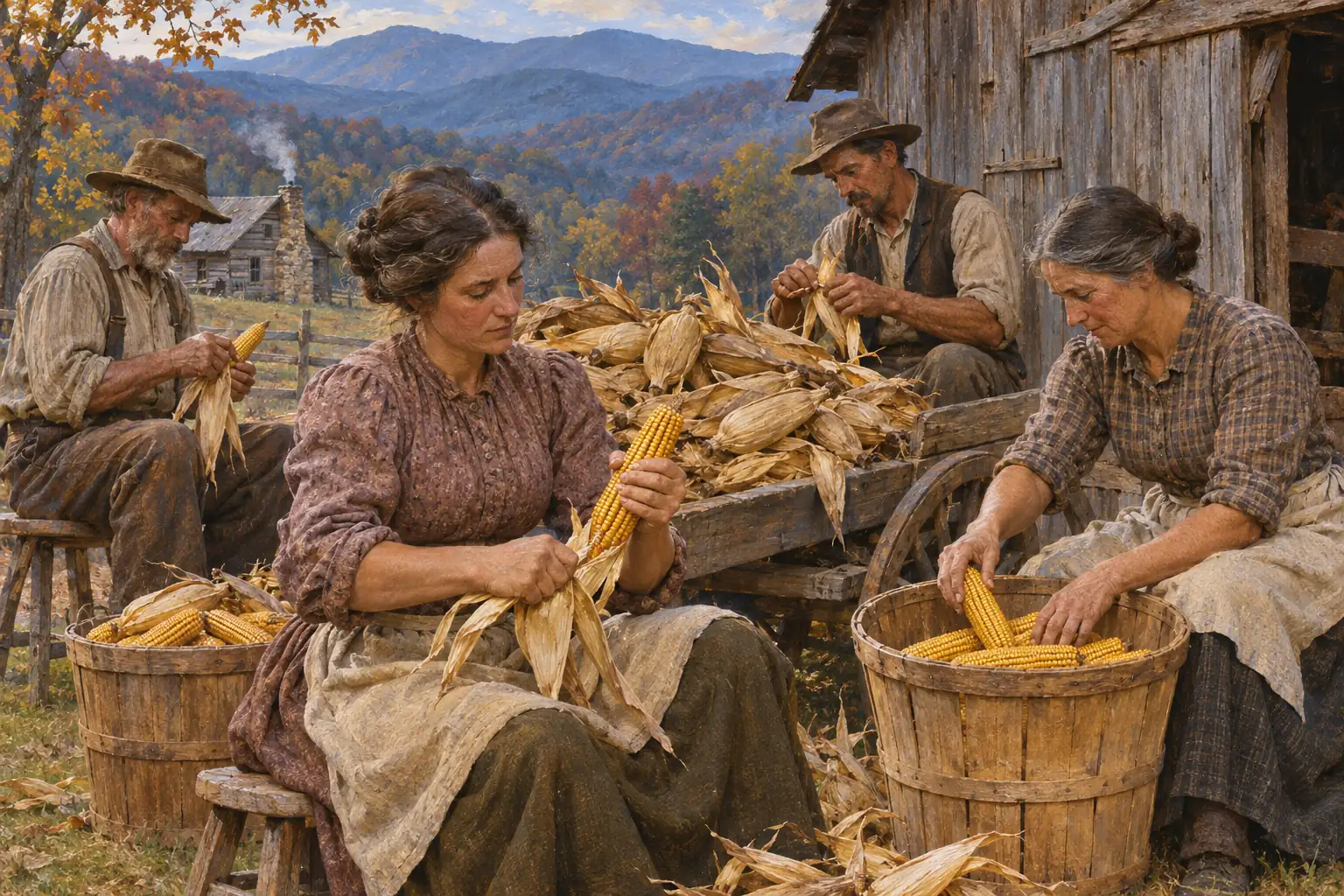
A corn-husking bee, also called a cornshucking, gathered people to remove the leafy coverings from harvested ears. Husking exposed the corn; it was different from shelling, which removed kernels from the cob. Many hands could work through a pile that would take one person much longer.
North Carolina Historic Sites describes these gatherings as both work and social occasions. Its account concerns the northwest Piedmont, while the Park Service separately documents corn husking in the mountain community of Cataloochee. Similar activities crossed regional boundaries, even when local customs differed.
The gathering also created work around the main task. People had to arrange the corn, feed the workers, and see that the crop reached storage. Calling it a party can hide those responsibilities. The practical result was a household further along with a large seasonal job.
How Did People Return a Neighbor’s Help?
People did not always repay assistance with the same thing they received. Food could answer one family’s immediate shortage, while labor answered another family’s later need.
Folklorist Jane Woodside recorded one example in a Tennessee farmer’s recollections, published in Now & Then in 1988. The article called him Ivan White, a pseudonym used to protect his privacy. He remembered his family sharing flour with sharecropping neighbors who had no wheat of their own and temporarily could not afford flour from the store.
In return, his family could call on those neighbors for help. Flour and work moved between households at different times. The arrangement depended on a continuing relationship rather than an identical exchange made on the spot.
His memory describes one community as he recalled it. It does not prove that all neighbors agreed, that every favor was returned, or that people with fewer resources had the same choices as landowners. It does show how producing food for one’s own household could fit alongside reliance on other people.
What Was a Quilting Bee?
A quilting bee brought people together to work on a quilt. As the Blue Ridge National Heritage Area explains, someone might piece the cloth top separately, then gather with others to stitch the layers together. The work produced useful bedding and gave participants time to talk.
The group did not have to be large. Donna Choate, a Black quiltmaker born in Grayson County, Virginia, in 1909, recalled her mother’s small gatherings during interviews for the Library of Congress’s 1978 Blue Ridge Parkway Folklife Project. Her mother might have three or four women come to work on a quilt or two in a day.
Donna’s own routine differed. She generally worked alone, using a large frame supported on chair backs. The same family history therefore preserves both group work and individual work.
That difference matters when picturing mountain life. A quilt does not automatically tell us that a roomful of neighbors made it. Donna’s memories show that shared quilting was one way to finish a necessary job, rather than a rule followed by every woman or every generation.
A Neighbor’s Skills Could Keep Tools Working
At Hensley Settlement in Kentucky, Willie Gibbons offered another kind of help. Before a blacksmith shop existed on the mountain, residents traveled elsewhere for repairs. Around the 1920s, Willie added a shop to his carpentry shed. It became a place the neighborhood used.
His son Jess remembered people bringing plows and mattocks to be sharpened. Others came to watch the work. Sometimes neighbors used the shop to make their own repairs; when they could not manage a job, they asked Willie to help.
This was cooperation built around skill and access to a place to work. A neighbor might know what was wrong with a tool but need equipment or experienced hands to put it right. The account also shows people doing part of a job themselves before asking for assistance.
Willie’s shop broadens the picture beyond large gatherings. A repair involving two people could matter to a farm just as much as a bigger crew working through a harvest.
When Illness Interrupted the Harvest
Berta Webb was a young teenager when her father, John Goad, lay seriously ill. Corn stood gathered in shocks in the fields, still waiting to be husked and carried to the corncrib. Her account appears in Keith Robert Webb’s study of labor and exchange in Carroll County, Virginia, from the 1880s through the 1930s.
Neighbors came to help, with much of the work done by neighbors’ children. Berta remembered the fields being finished by four that afternoon. Her mother cooked dinner for the workers, and other women helped her. The assistance reached both the corn and the kitchen: bringing in a crew also meant feeding it.
Berta’s recollection makes the need plain. The crop could not wait for the household to return to its usual routine. People from outside the family supplied work at the moment it was missing.
Everyday needs continued through such disruptions. Meals, fuel, and care for animals still required attention. Our account of how pioneers survived winter follows those household demands into the cold season, when having food stored was only part of keeping a home going.
How Did Neighbors Help After a Death?
In Cades Cove, a church bell could announce a death. The Park Service describes an initial ringing to draw attention, followed by a pause and a stroke for each year of the person’s life. People who knew who had been ill could often recognize whose death the bell announced.
The response involved practical work. Men dug the grave and made a coffin if one was needed. Women prepared the body and coffin for burial. These are the roles recorded in this community’s history, rather than a rule for every Appalachian funeral.
Both men and women also helped the bereaved household with meals, crops, and care of young children. Their work reached beyond the burial itself. A family facing a death still had people to feed and responsibilities that could not simply be set aside.
Remembering the Work Behind Neighborliness
These accounts leave us with specific acts to remember: a small cabin built in a crisis, food shared with a family short of cash, a place to mend a tool, and help with a crop when sickness interrupted the work. They show why family effort and help from others belonged in the same story.
They also invite a closer look at who did the helping. The person cooking for a crew contributed labor, too. So did the person caring for someone else’s children while a family faced a loss. The quieter jobs deserve a place beside the barn raising.
Does your family remember neighbors trading work or helping after an illness or death? Share the story through Redneckosity’s contact form. Names, a community, an approximate decade, and any surviving letter or photograph can help us connect a family memory with the historical record.
Strong Backs. Red Necks. Deep Roots.

Explore more stories about mountain work, family, and survival in Appalachian Mountain Life.
Sources and Further Reading
- National Park Service: History of Cataloochee
- National Park Service: Whitehead Place
- North Carolina Historic Sites: Cornshucking History
- Jane Woodside: Ivan White, originally published in Now & Then (1988), republished by Appalachian Places
- Blue Ridge National Heritage Area: Quilting
- Library of Congress: Blue Ridge Quilters—Donna Choate
- National Park Service: Willie Gibbons Farm and Blacksmith Shop
- Keith Robert Webb: Labor and Social Barter in an Appalachian Community: Carroll County, Virginia, 1880s–1930s (Virginia Tech, 1994; especially pp. 43, 48–49)
- National Park Service: History of Cades Cove