
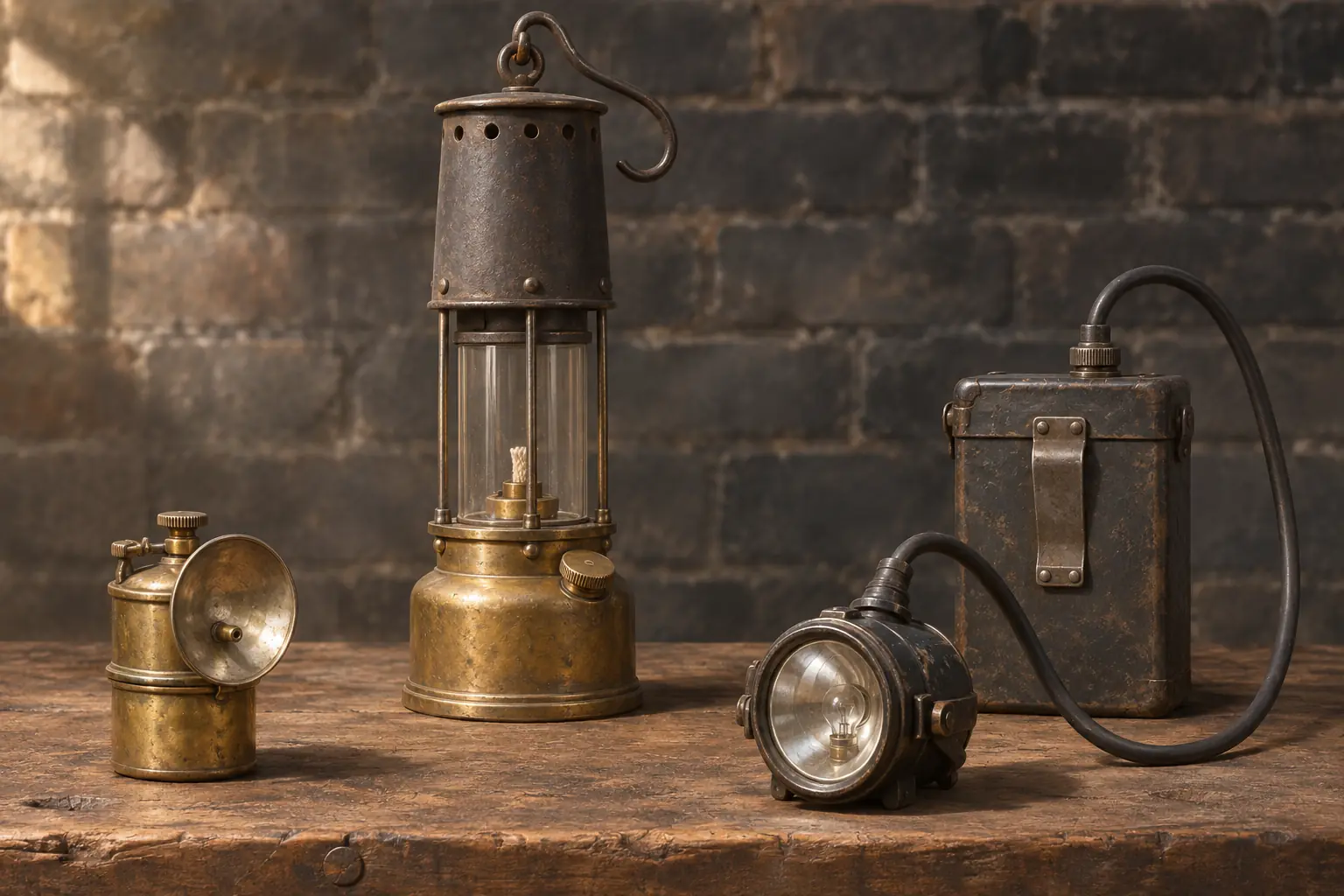
Coal mining lamps gave miners the light they needed to work, but an exposed flame could also ignite gas underground. That problem shaped generations of equipment, from small oil-wick lamps to flame-safety lamps and battery-powered cap lights. Each design tells us something about the work, the dangers, and the choices miners faced.
These lamps did not follow one neat timetable. Older and newer types overlapped, and a lamp used to light a working place could serve a different purpose from one carried to check mine air. The important questions are how each lamp made light, where that light went, and what hazards remained.
Coal Mining Lamps at a Glance
The four types below help explain the main differences. A reflector on a carbide lamp directed its light; it did not enclose the flame or make the lamp a flame-safety lamp.
| Lamp type | What mattered underground |
|---|---|
| Oil-wick cap lamp | A small, wearable light with a bare flame. Smoke and soot added to its drawbacks. |
| Flame-safety lamp | A protected flame designed to reduce the risk of igniting mine gas. Some also served as gas-testing instruments. |
| Carbide lamp | A brighter acetylene flame, often with a reflector. The flame remained exposed. |
| Electric cap lamp | A battery supplied light without a burning fuel flame. Electrical safety, battery weight, and charging still mattered. |
Oil-Wick Lamps Put a Light on the Miner’s Cap
An oil-wick cap lamp could look like a tiny metal teapot. Its body held fuel, a wick ran through the spout, and a hook attached the lamp to a miner’s cap. The Smithsonian dates the spread of this type to the mid-1800s and records its continued use into the 1920s.
Moving the light onto the cap helped keep a miner’s hands available for work. That mattered during the cutting, loading, and hauling described in coal mining jobs in the 1900s. Light could travel with the worker instead of staying beside a candle fixed to a timber.
The convenience came with discomfort. Smoky fuel could irritate the eyes and leave soot on a miner’s face. More seriously, the little flame remained open to the surrounding air. In a mine containing a flammable gas mixture, a useful work light could become an ignition source.
Flame-Safety Lamps Tackled a Different Problem
In early nineteenth-century Britain, William Reid Clanny, George Stephenson, and Humphry Davy worked on ways to provide light in mines containing firedamp. That historical name usually referred to flammable gas associated with methane.
Davy’s 1815 design surrounded the flame with fine metal gauze. The mesh allowed air through while cooling a flame trying to pass outward, helping prevent ignition of the gas outside. The Science Museum Group preserves early examples of this work.
Later miners’ safety lamps combined features such as glass around the flame, gauze above it, and a protective metal bonnet. Some became instruments for trained workers to assess mine air. Their use for gas testing helps explain why flame lamps remained relevant after electric lighting arrived.
Protection came with tradeoffs. The Smithsonian describes complaints about the lamps’ bulk and weak light. For workers whose earnings depended on the amount of coal loaded, poor visibility could also affect pay. Some miners worried that confidence in a lamp would draw attention away from ventilation and other unsafe conditions.
The name described a safety purpose. It did not mean that carrying the lamp made the whole mine safe.
Carbide Mining Lamps Were Brighter, but Still Had a Flame
Carbide lamps produced acetylene gas from a reaction between calcium carbide and water. Burning that gas supplied a bright light. Small versions fitted a cap, while larger versions could be carried or hung.
The Smithsonian credits Frederick Baldwin with an early carbide mining-lamp patent granted in 1900. Many manufacturers followed. A metal reflector behind the flame helped direct the light toward the work, and the cleaner-burning flame offered relief from the smoky oil-wick lamp.
Better light did not remove the central danger: the flame was exposed. Carbide lamps could still ignite flammable mine gas. They also needed attention during a shift. Fuel supply, clogged burner tips, and a flame extinguished by moving air could interrupt the light.
A shiny reflector can make an old carbide lamp resemble an electric headlamp in a photograph. The light source is the key difference. One burns gas at a nozzle; the other uses electricity inside a lamp head.
Electric Cap Lamps Changed What Miners Carried
An electric cap lamp separated the light from its power supply. In a common early arrangement, the lamp sat on the cap or helmet, a cord ran toward the miner’s back, and a battery case rested on the belt. The battery added weight, but the worker no longer needed a burning fuel flame beside the forehead.
The Smithsonian’s account follows the work of Mine Safety Appliances founders John T. Ryan Sr. and George H. Deike with Thomas Edison. The Edison design it describes used a rechargeable battery capable of supplying about twelve hours of light. That figure describes the equipment’s capacity, rather than a universal length for a miner’s shift.
Electricity brought its own design problems. A NIOSH history of federal mining research describes early tests of broken bulbs and hot filaments that could ignite methane-air mixtures. Removing an open flame was a major improvement, but lamps still needed engineering and testing for the underground environment.
Adoption also took time. That NIOSH history reports that open carbide lights remained widely used among American miners in 1935. The arrival of an approved electric lamp did not mean every mine or worker immediately changed equipment.
The Lamphouse Connected the Light to the Shift
At Kaymoor in West Virginia’s New River Gorge, the National Park Service describes miners collecting headlamps at the lamphouse before a shift and returning them afterward. As electric lamps came into use, charging became part of that support work.
The lamphouse places the equipment in an everyday routine. A miner’s light depended on work done at the surface as well as on the lamp carried underground. Picking it up, returning it, and having it ready for another shift were parts of the mine’s working day.
The surviving building also has its own history. Park Service research notes that a 1930 insurance map showed it being used entirely as an office. Even the place associated with the lamps changed as the operation changed.
What Old Caps and Photographs Can Tell Us
A soft cloth cap in an old mining photograph was often mainly a lamp carrier. The Smithsonian’s collection shows brackets made to hold oil-wick, carbide, and electric lamps. Some brackets were sold separately, allowing a miner to keep a cap while changing the light mounted on it.
That overlap makes the cap alone a poor guide to the lamp’s age. A cloth cap does not automatically mean an oil lamp, and a hard helmet does not automatically mean electric light. The museum records carbide lamps used with protective helmets, too.
Personal details can be just as revealing as the equipment. One Smithsonian cap belonged to John Miller of Nesquehoning, Pennsylvania. It carries union buttons and a note identifying it as his first mining cap before a safety helmet. The object connects changes in headgear with a particular worker and his union membership.
When looking at a family photograph, start with what is visible: a small spouted reservoir, a reflector and burner, an enclosed hand lamp, or a cable leading from the headlamp. A known mine, date, or name gives those details stronger context.
A Small Light Carried a Large Responsibility
The history of coal mining lamps brings the demands of underground work into focus. Miners needed light they could carry, see by, and depend on. Inventors and manufacturers worked to improve it, while workers lived with the weight, smoke, upkeep, and risks of the equipment available to them.
Does your family have a mining lamp or a photograph showing one in use? Share the mine, town, worker’s name, and any known date through Redneckosity’s contact form. Those details can help connect an everyday object to the life behind it.
Strong Backs. Red Necks. Deep Roots.

Explore more stories about mountain work, family, and survival in Coal Mining Lives & Labor.
Sources and Further Reading
- Smithsonian National Museum of American History — Mining Lights and Hats
- Smithsonian National Museum of American History — Oil-Wick Cap Lamps
- Smithsonian National Museum of American History — Safety Lamps
- Science Museum Group — Davy Lamps, 1815
- Smithsonian National Museum of American History — Carbide Lamps
- Smithsonian National Museum of American History — Electric Lamps
- Michael R. Yenchek and Gerald T. Homce, NIOSH — U.S. Bureau of Mines/NIOSH Mining Electrical Safety Research, especially printed page 47 (PDF)
- National Park Service — Kaymoor Mine Walking Tour, Lamphouse section
- Smithsonian National Museum of American History — Soft Caps, including John Miller’s cap