
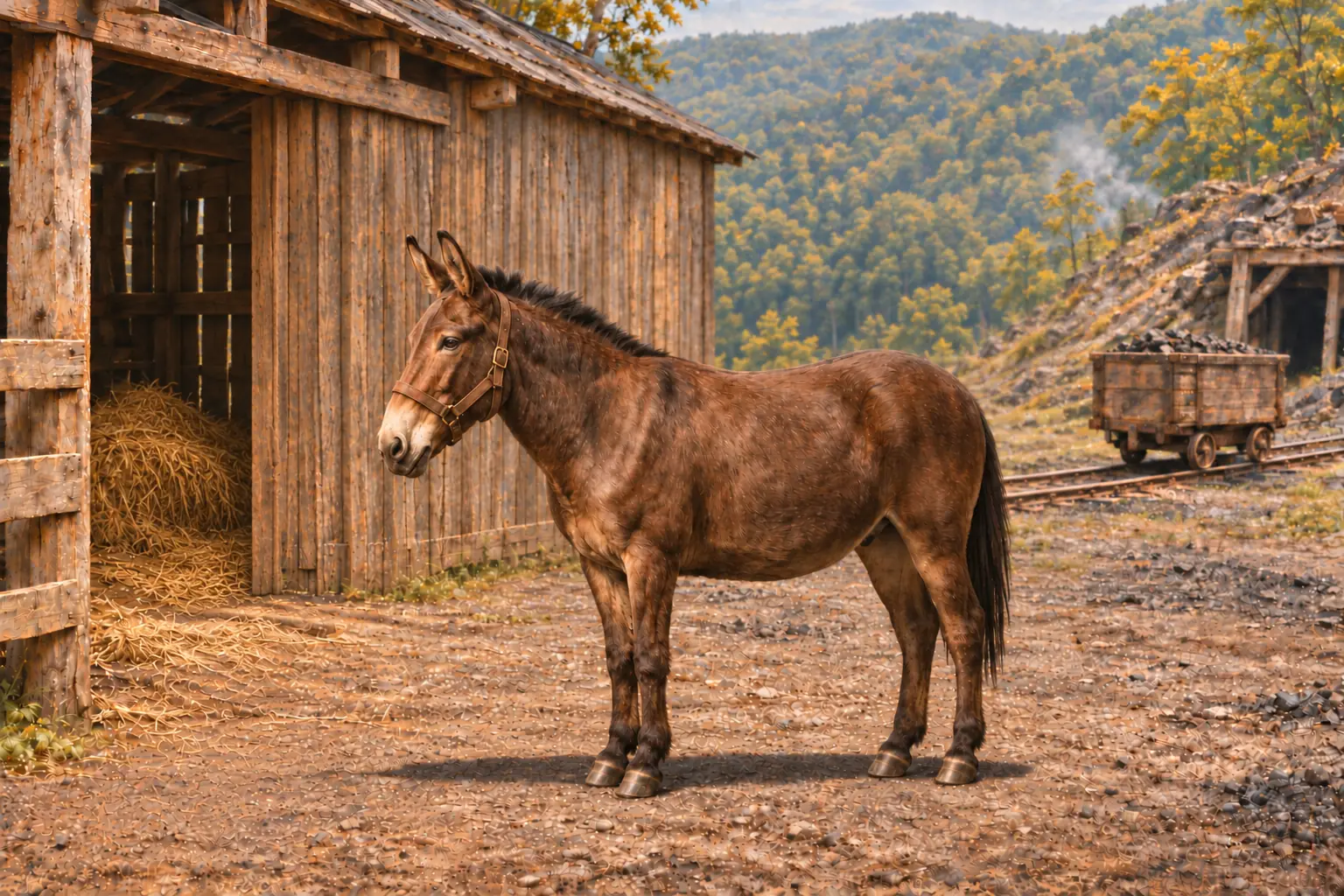
Coal mine mules hauled loaded cars through underground passages and helped keep empty cars moving back to the miners. Their strength mattered, but so did the driver handling the trip. Getting coal out of a mine depended on animals, people, track, and enough room for all three to pass.
The work also reached beyond the tunnel entrance. Someone had to feed the animals, tend their stalls, and look after them when hauling stopped. Records from West Virginia and Pennsylvania show how much that care could involve—and why no single story describes every mine mule’s life.
Why Were Mules Used in Coal Mines?
Mules supplied pulling power where miners needed to move heavy loads on rails. They were part of a larger world of working animals used on farms, in logging camps, and around industrial sites. Coal operators put that animal power to work underground as well as outside the mine.
Size mattered. Scot E. Long’s account in the West Virginia Encyclopedia describes large mules working in high coal seams or hauling heavy loads outside. Smaller mules worked in lower seams, where there was less room beneath the roof. Horses and Shetland ponies also hauled coal.
That variety is easy to miss when every old photograph gets labeled “pit ponies.” A mine’s available space helped shape the animals it used. There was no single animal suited to every underground passage.
What Did a Mule Driver Do?
In West Virginia’s hand-loading mines, drivers collected loaded cars from the rooms where miners worked and delivered empty ones. They brought groups of loaded cars to the main entries, where the coal could continue toward the surface. The mule was one link in a longer haulage system.
The driver also had to watch the route and the animal. Rules adopted in Pennsylvania’s Wyoming and Lackawanna coal fields in 1881 assigned duties involving damaged track, space for cars to pass, and protection from runaway cars. The driver boss was responsible for regular feeding and watering, rest on steep grades, and preventing needless abuse.
Those rules describe what operators required, not proof that every driver or boss followed them. They do show how much could go wrong. A bad track or uncontrolled car threatened both people and animals.
Haulage belonged alongside cutting, loading, and timbering among the coal mining jobs in the 1900s. Filling a car was only part of getting coal out.
Bob Forren Remembered the Care Between Trips
In a 1980 oral history preserved by the National Park Service, West Virginia miner Robert “Bob” Forren recalled bringing his mule out of the mine, washing it at a company-provided place, and taking it to the barn. The driver removed the harness and bridle, put on a halter, and led the animal to its assigned stall.
A stable boss provided grain and hay. In the morning, the driver harnessed the mule again. Forren also remembered carrying a small bag of corn or oats underground so the animal could eat during a midday pause.
Sundays brought exercise in an open lot before the mules returned to the barn. That detail alone challenges the idea that every mine mule spent its entire working life below ground.
Forren recalled sharp reprimands for hurting mules and suggested they received better treatment than men, while allowing that this comparison might be exaggerated. His memories were not all gentle: he also described two accidents in which mules he was driving were killed. Care and danger existed in the same working life.
The People Beside the Mules
The animals’ story belongs to labor history, too. The National Park Service’s account of African American miners in southern West Virginia notes that Black workers often served as mule drivers and brakemen. They brought loaded cars to the mainline, where cars were assembled into trains for the trip to the headhouse.
There, coal was weighed and credited to the miner who had loaded it. Haulage connected work at the coal face to the payment record. The driver and brakeman could be less visible in a photograph of a miner with a pick, but their jobs helped move that miner’s earnings toward the scale.
Young workers appear in the record as well. Lewis Hine’s September 1908 photograph at the Maryland Coal Company’s mine near Grafton, West Virginia, shows boys with mules and coal cars. Its caption says a boy with a mule was hesitant to be photographed; another boy explained that he feared being made to go to school.
That explanation comes from the caption, not from a statement we can hear the boy make. Even with that limit, the photograph brings the subject close: the work of tending and driving animals could fall to children.
Did Mine Mules Always Live Underground?
No. The answer depends on the mine. Some animals returned to surface barns, while others were housed below ground.
A Library of Congress photograph by Sheldon Dick documents an underground mule stable at the Maple Hill mine in Shenandoah, Pennsylvania. The catalog dates it tentatively to 1938, and its caption places the stable 700 feet below the surface. The image shows a miner and mules in that underground setting.
This is evidence of a particular stable, not a rule for all coalfields. A photograph of animals below ground cannot tell us what every animal elsewhere experienced. To understand an old family story about mine mules, the mine’s name, location, and working years matter as much as the animal’s job.
Mine Mules, Pit Ponies, and the Blindness Story
Pit ponies are especially familiar from British mining history. Their work offers useful comparisons, but a British pony’s routine should not be pasted onto a West Virginia mule’s life.
The National Coal Mining Museum for England addresses several common claims in its handout on pit-pony myths. It explains that many collieries brought ponies to the surface during holidays, strikes, or lockouts, while some kept them underground with people assigned to their care.
The museum also rejects the claim that working in darkness inevitably made ponies blind. It reports no higher recorded rate of blindness than among other working horses and notes that blind ponies were not allowed to work in the pits.
That does not mean underground work was harmless or every animal was treated well. It means a dramatic story needs evidence. Housing, feeding, injuries, and treatment deserve attention without adding an automatic blindness claim that the museum’s account does not support.
Electric Motors Did Not Replace Every Mule at Once
There was no single day when animal haulage ended everywhere. Mining historian Paul H. Rakes notes that many West Virginia mines used compressed-air, steam, or electric locomotives for mainline hauling by 1900. Yet mules remained an important part of the process into the 1920s.
A mine could therefore use powered haulage on its main route while animals still gathered cars from working areas. A photograph of a mine locomotive does not, by itself, prove that the operation had stopped using mules.
Kaymoor miner Clifford Davis remembered a building that showed the change. In his 1980 interview, he described a large wooden mule barn later converted into a motor repair shop. A concrete pit allowed workers to reach beneath the motors.
The building’s new purpose makes the transition easy to picture. The place that had housed animals became a place to maintain machines. Both required care, space, and workers whose labor continued after a load of coal had passed.
Remembering mine mules means remembering that whole system: the animal pulling, the driver watching, the stable boss feeding, and the workers waiting for an empty car. Coal moved because all those jobs met along the track.
Strong Backs. Red Necks. Deep Roots.

Explore more stories about mountain work, family, and survival in Coal Mining Lives & Labor.
Sources and Further Reading
- Scot E. Long, West Virginia Encyclopedia: Draft Animals
- Paul H. Rakes, West Virginia Encyclopedia: Mining Methods in the Hand-Loading Era
- Temple University Press: Pennsylvania mine rules adopted December 24, 1881, Appendix II in From the Molly Maguires to the United Mine Workers
- National Park Service: Robert “Bob” Forren oral history, September 24–25, 1980, Part 1
- National Park Service: African American Coal Miners, Helen, West Virginia
- Library of Congress: Lewis Hine, Tipple Boy and Drivers, near Grafton, West Virginia, September 1908
- Library of Congress: Sheldon Dick, mule stable in the Maple Hill mine, Shenandoah, Pennsylvania, tentatively dated 1938
- National Coal Mining Museum for England: Pit Ponies, Myths & Misconceptions (PDF hosted by ENTER CIC)
- National Park Service: Mining Oral History Project, including Clifford Davis’s December 16, 1980 interview