
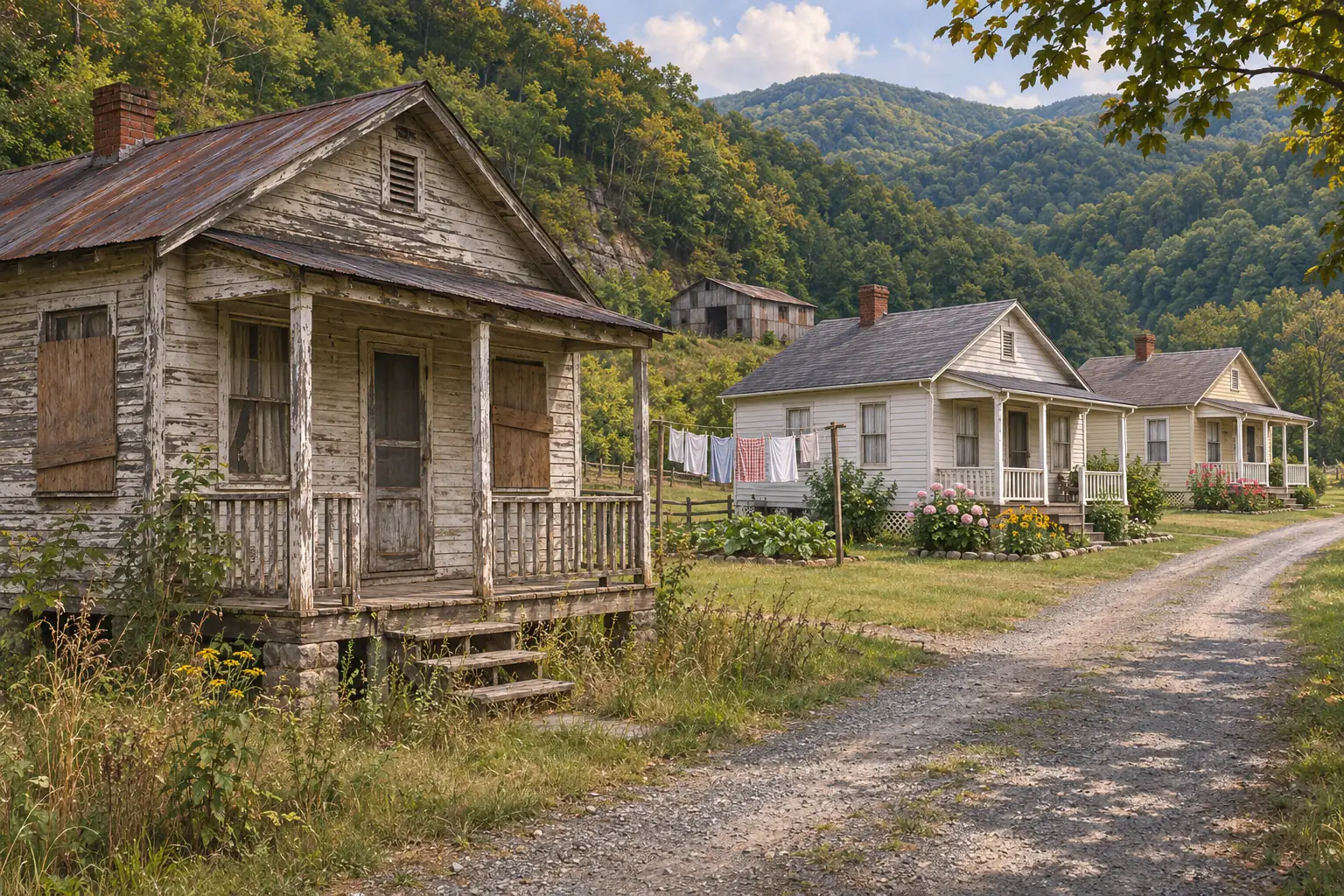
Why did coal towns decline? Mines closed, coal seams ran low, machines reduced the number of jobs, and customers changed the fuels they bought. When families left for work, stores and other local businesses lost customers too. But the outcome varied: some camps became ruins, while others survived as communities beyond company ownership.
Nuttallburg, West Virginia, and Derby, Virginia, show that difference. At Nuttallburg, mining ended and much of the town disappeared. At Derby, the company sold buildings, and residents kept a community going. Understanding coal town decline means asking what happened to both the mine and the homes around it.
A Town Could Depend on One Payroll
A coal camp often tied a family’s job, house, shopping, and daily services to one company. The Library of Virginia describes companies that owned stores, schools, hospitals, and housing. A mine shutdown could therefore reach far beyond the men who worked underground.
Coalfield communities were not all company towns. Some were independent towns serving surrounding mines. Their merchants and other workers still depended heavily on what mining families could spend.
The National Coal Heritage Area Commission describes population loss affecting these service towns as well as company camps. Losing mining jobs could weaken a larger area, even where the company did not own every front porch.
Some Mines Ran Short of Workable Coal
Coal seams did not last forever. The Library of Virginia notes that by the 1950s, many Southwest Virginia seams opened more than fifty years earlier had been mined out. A town built for one operation could outlive the work that brought its residents there.
At Kaymoor in West Virginia, several problems came together. According to the National Park Service, the mine was running short of coal and had fallen behind in equipment. Catching up would cost more than the remaining coal could justify. Attempts to reach additional reserves ran into older mine workings.
That matters because “the coal ran out” and “the company would not invest” were not always separate explanations. The amount of coal left helped determine whether new equipment or mine openings made economic sense.
Coal Lost Some Customers and Gained Others
A mine also needed buyers. A 1961 Bureau of Labor Statistics study of the US bituminous coal industry traced major changes after World War II. Railroads replaced coal-burning steam locomotives with diesels. Homes and businesses increasingly used oil and natural gas. Factories changed how they obtained heat and power.
Electric utilities bought more coal during the same period. Coal use was changing, not simply disappearing everywhere. A growing power market did not mean every older mine could keep its customers or remain competitive.
At the same time, coal mining mechanization allowed more work to be done with fewer miners. The BLS study records sharply falling employment alongside the spread of labor-saving equipment. A town could lose paychecks even while coal continued coming out of nearby mines.
Why Nuttallburg Became a Place of Remains
Nuttallburg had weathered changes in ownership before its final decline. Henry Ford’s company improved the operation during the 1920s, but his larger plan depended on controlling the railroad that carried the coal. He could not secure that control and sold his mining interests in 1928.
That was not the end of Nuttallburg. The National Park Service records three later owners. As the market for New River coal weakened, the mines increasingly served local needs. Production finally stopped in 1958.
The surviving conveyor, tipple, and foundations tell only part of the story. Nuttallburg had also been a place of houses, schools, churches, and neighbors. Its industrial remains mark a lost community as well as a closed workplace.
Railroads and Roads Changed a Town’s Chances
Thurmond shows how coalfield decline could reach railroad work. It grew as a shipping and service center, with hotels, banks, stores, and a busy rail yard.
The National Park Service describes several blows: the Great Depression, major fires, mine closures, growing automobile travel, and the railroad’s switch to diesels in the 1950s. Steam engines needed frequent supplies of coal and water, along with maintenance. Diesel engines no longer needed the same services, leaving jobs and facilities behind.
Access mattered in smaller camps too. Kaymoor Bottom never had a road. The Park Service connects that isolation to residents’ inability to stay after the mine closed. Beginning in 1955, people were moved out, and houses were sold for dismantling and rebuilding elsewhere.
Elsewhere, the Coal Heritage commission notes that highways bypassed established towns. Better roads could connect a region while leaving a particular business district farther from the traffic it needed.
Families Faced Unequal Choices About Leaving
For families in company housing, losing work could also mean losing their home. The National Park Service’s account of African American coal camp life explains that Black miners were often among the first to lose jobs during the changes of the 1950s. Without employment or company housing, families searched elsewhere for work.
That account helps explain why migration was more than a simple preference for city life. A family might have deep roots in a camp and still have no practical way to remain there.
The Coal Heritage commission records thousands of unemployed miners leaving West Virginia in the 1950s and 1960s. As households departed, some buildings stood empty and deteriorated. Other buildings were removed. The landscape that survived depended partly on what owners and residents did after mining ended.
Some Towns Survived the Company’s Departure
Ending company ownership did not always mean abandoning the town. At Nellis, West Virginia, the Coal Heritage commission reports that the company sold the town to a real estate firm after the mine closed in the 1950s. The firm then sold houses to miners.
Derby offers another path. Its National Register nomination, prepared in 2002, records the gradual sale of company buildings in the early 1960s. Important gathering places, including the store and theater, had disappeared. Yet many houses remained occupied and well maintained when the nomination was written.
Residents had formed the Derby Historical Society to support preservation and improvements. The nomination describes work toward better sewer service and a church that remained a center of the community.
Those details matter. Survival involved houses people could keep using and residents willing to work on shared needs. It did not require the town to return to its busiest mining years.
The Mine’s Ending Was Not Always the Town’s Ending
There was no single closing day for Appalachian coal town life. Nuttallburg lost its mining operation and much of its built community. Thurmond lost much of the railroad business that supported it. Derby’s residents carried on after company buildings changed hands.
To understand a particular town, look beyond an idle mine entrance. Ask whether people could keep their houses, reach work elsewhere, and maintain the places they shared. The company’s reason for being there could end long before the residents’ reasons did.
Strong Backs. Red Necks. Deep Roots.

Explore more stories about mountain work, family, and survival in Coal Mining Lives & Labor.
Sources and Further Reading
- National Park Service: Nuttallburg
- National Park Service: Kaymoor — After the Coal Town
- National Park Service: Thurmond
- National Park Service: African American Life in a Coal Camp — Nuttallburg
- Library of Virginia: Virginia’s Coal Towns
- National Coal Heritage Area Commission: End of an Era
- US Bureau of Labor Statistics: Technological Change and Productivity in the Bituminous Coal Industry, 1920–60 (1961), via FRASER
- Gibson Worsham: Derby Historic District National Register Nomination (prepared 2002), especially Section 8, page 49