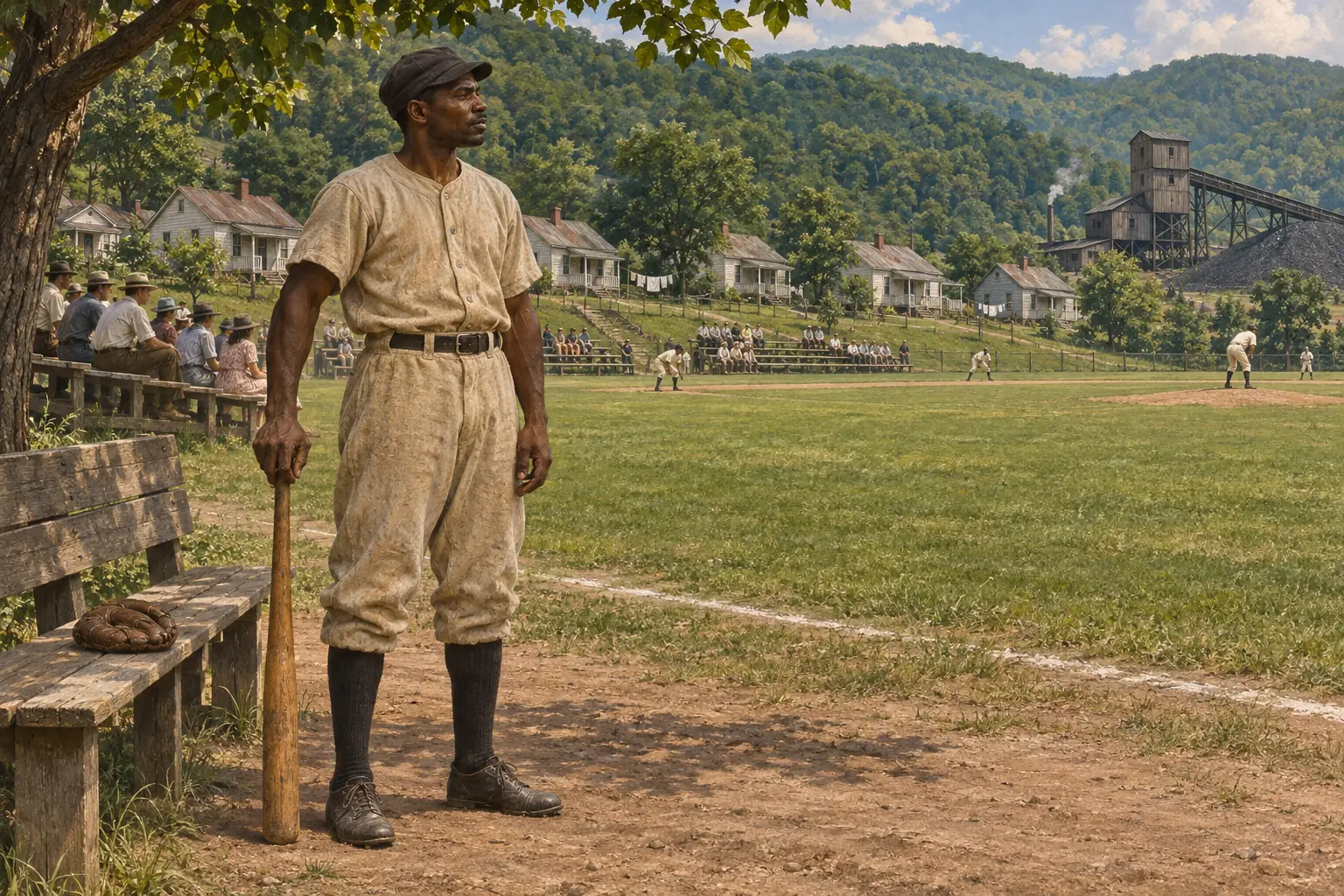
Coal camp baseball gave mining communities a game to gather around, a nearby rival to beat, and players to cheer for outside the mine. Companies sponsored teams and sometimes hired men for their baseball skills. For workers and their families, the games offered competition, friendship, and a Sunday afternoon worth remembering.
For some players, the route ran from a mining town to professional baseball and back again. Grover Lewis followed that path before helping keep the game alive in West Virginia. His story belongs to a larger history of coalfield sport, especially during the first half of the 1900s, when a town’s ball team could become part of its identity.
A Ball Field Was Valuable Ground
In a narrow mountain valley, a level place large enough for baseball was no small thing. Gene Worthington’s account for the National Coal Heritage Area Commission points to the space given to ball fields as evidence of the game’s importance.
People remembered what happened around the field as well as on it. In a June 1, 1990 oral history interview, Tom Blankenship recalled his father taking him to Sunday games at Red Jacket. His memories included pop, candy, hot dogs, and the people who turned out to watch.
That childhood view adds something a score cannot. A game meant an outing with his father. The crowd and the refreshments were part of the occasion, not just background to the players.
Baseball belonged within the social life of coal mining company towns. A place built to produce coal could also become a place where neighbors followed a team’s fortunes together.
A Good Arm Could Help a Man Get Hired
Coal operators had their own reasons to support baseball. A winning team brought pride and bragging rights. Worthington describes companies recruiting good players and giving some of them comfortable jobs above ground.
Miner Chan Forren remembered that connection clearly. In his November 1, 1980 interview, he said, “If you was a good ballplayer, you’d get a job anywhere.” He recalled companies buying uniforms and sponsoring teams in the New River Gorge.
His statement captures the value he placed on baseball skill; it is not a promise that every player could find work at every mine. It does show that a player’s ability might matter to a superintendent for reasons beyond coal production.
The financial choice could be surprising. Historian Stan Bumgardner told West Virginia Public Broadcasting that some players could earn more working for a coal company than playing minor-league baseball. Moving into professional ball did not automatically mean leaving money worries behind.
Coal Camp Baseball Had More Than One Kind of Schedule
There was no single league covering every coal town. Worthington describes county competition, United Mine Workers leagues, and Black teams with their own network of games. Raleigh County alone had several kinds of competition during the 1930s.
Forren remembered a less formal arrangement around Elverton. A team with an open Sunday would contact a neighboring town along the railroad and arrange a game. One team would travel to the other.
That distinction matters when reading old photographs or family notes. A uniform does not establish that a team belonged to a professional league. Some clubs played organized league schedules; others arranged local contests as opponents became available.
Separate Teams Could Still Meet on the Field
Baseball’s popularity did not erase segregation. The National Park Service describes coal camps with separate Black and white teams. Sunday games were major social occasions within Black communities, just as schools, churches, and clubs had important roles there.
In a November 7, 1980 interview, former miner Dometrius Woodson recalled Raleigh County’s Black teams and white teams as separate rosters. He named the New River Giants and Raleigh Clippers among the clubs he remembered.
Woodson also recalled Black teams playing white opponents and both Black and white spectators attending games. Those memories describe contact across racial lines, but not integrated teams or equal treatment throughout the town.
It helps to keep those questions separate: who played together, who played against one another, and who came to watch? A crowded ballpark could bring people into the same place while other boundaries remained.
Grover Lewis Took His Game Away and Brought It Back
Paul J. Nyden’s account in the West Virginia Encyclopedia traces Grover Lewis from an Alabama mining family through Black coalfield teams in Alabama and Fairmont, West Virginia. Lewis went on to play third base for the Homestead Grays near Pittsburgh.
A broken ankle shortened his professional career. He returned to West Virginia, worked in the mines, and played for and managed the Raleigh Clippers.
His return was not the end of his baseball story. It put his experience back into a coalfield team. A player could leave for a larger stage and still have an important role in the communities where mining and baseball overlapped.
Woodson remembered his uncles David, Robert, and Harvey Toney playing with Lewis. He identified their positions as pitcher, first baseman, and catcher or third baseman. In that account, coalfield baseball becomes a history of named relatives and teammates, not merely a list of clubs.
The Clippers Built a New Field in 1949
The Raleigh Clippers’ history continued after World War II. Margaret M. Gripshover’s researched biography of pitcher Harry Kincannon, published by the Society for American Baseball Research, describes a new Clippers ballpark at Stanaford in 1949.
The roster included fifteen men who worked in or around the mines. Players, including Kincannon, were called on to help build the field. Grover Lewis served as booking manager, helping arrange the club’s games.
Kincannon had played for the Pittsburgh Crawfords and other Black professional teams before returning to West Virginia. In 1949, he was still pitching for the Clippers. That season’s opponents included the Homestead Grays.
A new ballpark required work before anyone could enjoy a game there. This episode gives community pride a practical form: players helped create the place where their neighbors would watch them play.
Even as the region changed after the war, the Clippers were preparing for another season.
What Was Lost When the Teams Faded?
Coalfield baseball depended on people having reasons to stay in the coalfields. In West Virginia Public Broadcasting’s account, Bumgardner connects the decline of the game with falling mine employment. Losing workers also meant losing players, neighbors, and potential spectators.
Nyden records that the Raleigh County League was gone by the mid-1950s.
For a former resident, the loss could be more personal than the disappearance of a league. A Sunday gathering no longer happened. A familiar name no longer appeared in a lineup. A place remembered for noise and excitement became quiet.
If an old family photograph shows a ball team, the names on the back deserve as much care as the picture. The players might have been miners, relatives, neighbors, or former professionals. Knowing the town and the season can help connect those lives.
Coal camp baseball reminds us that miners had talents and loyalties beyond their jobs. The company might supply the uniforms, but it could not supply every friendship, rivalry, or memory made in them.
Strong Backs. Red Necks. Deep Roots.
Explore more stories about mountain work, family, and survival in Coal Mining Lives & Labor.
Sources and Further Reading
- Gene Worthington, National Coal Heritage Area Commission: Coal Camp Baseball, company sponsorship, playing fields, and leagues
- West Virginia Archives and History: Matewan Oral History Project, Tom Blankenship interview, June 1, 1990
- National Park Service: Mining Oral History Project, Chan Forren interview, November 1, 1980
- National Park Service: African American Life in a Coal Camp—Nuttallburg, community recreation and separate teams
- National Park Service: Dometrius Woodson oral history, November 7, 1980, teams, spectators, and the Toney family
- Paul J. Nyden, West Virginia Encyclopedia: Coalfield Baseball, Grover Lewis and the changing coalfield game
- Margaret M. Gripshover, Society for American Baseball Research: Harry Kincannon, including the Raleigh Clippers’ 1949 season and ballpark
- West Virginia Public Broadcasting: Baseball as Transcendence, September 14, 2018, including historian Stan Bumgardner’s coalfield baseball discussion