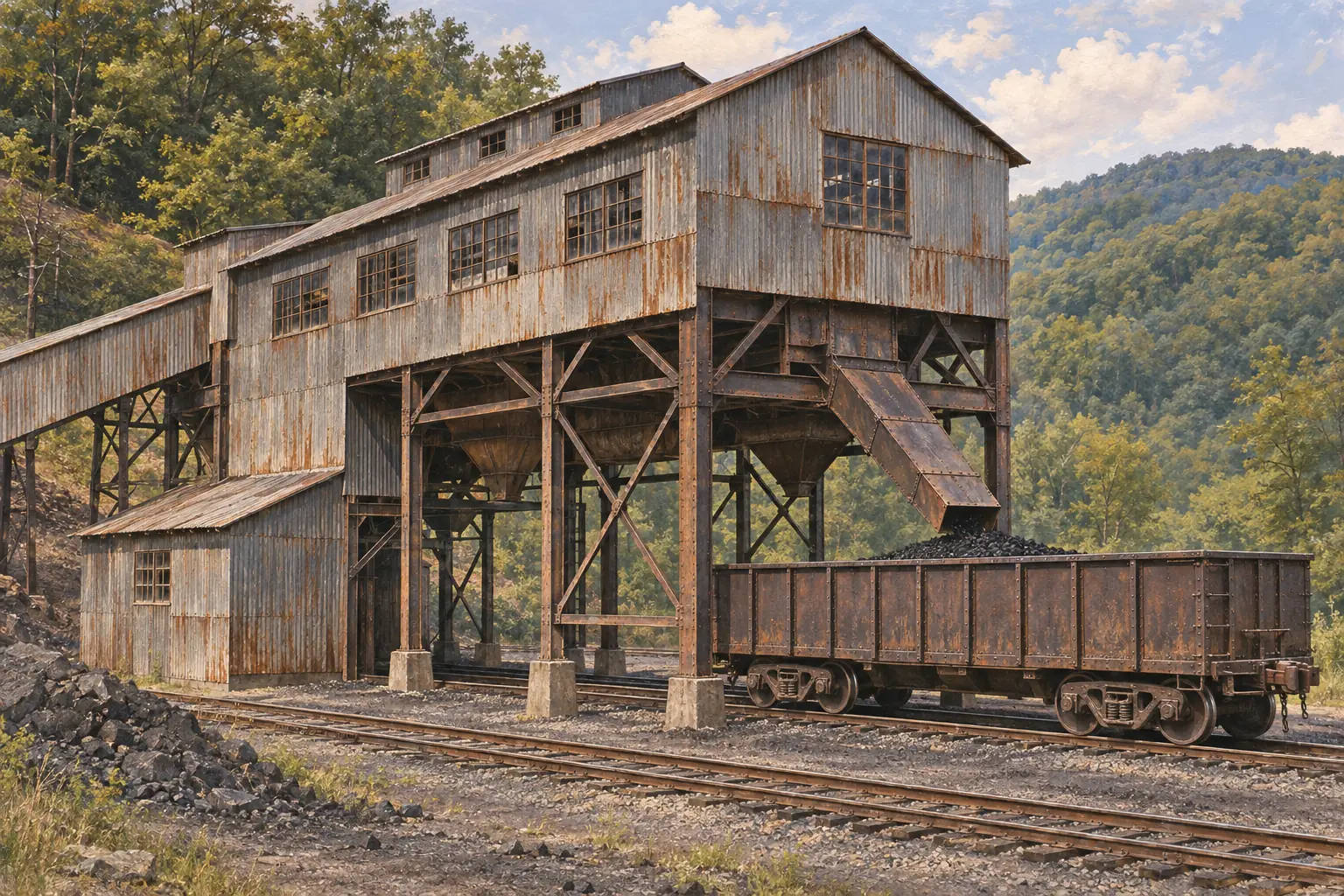
A coal mine tipple prepared coal for shipment after it came out of the mine. At Blue Heron in southeastern Kentucky, loaded mine cars arrived above the railroad, screens separated the coal by size, and chutes delivered it into waiting railcars. The work above ground turned a mixed load into coal that buyers could use.
Blue Heron’s mechanized plant began operating in the late 1930s. It offers a clear way to follow that work, but its equipment did not describe every Appalachian tipple. The mine, terrain, market, and year all shaped what happened between the underground workings and the railroad.
What Is a Coal Tipple?
A tipple was a surface facility for handling coal on its way to market. Depending on the operation, that could include unloading mine cars, removing unwanted material, sorting coal into sizes, breaking larger pieces, and loading transportation cars.
The tipple was one part of the mine complex. At Nuttallburg, West Virginia, the mine entrance stood high above the railroad. A conveyor carried coal down the slope to the processing area. The National Park Service describes coal being sized and sorted in the tipple, then loaded into railroad cars beneath it.
That arrangement explains why old photographs often show a tall building straddling tracks. The height provided room for coal to move through equipment and drop into cars below. It also helps distinguish two easily confused vehicles: small cars carrying coal out of the mine and larger railroad cars carrying the finished loads away.
Following a Load Through Blue Heron
The Stearns Coal and Lumber Company built Blue Heron around Mine 18, beside the Big South Fork River. The operation received coal from more than one mine opening. Its tram network reached along both sides of the river, bringing loads toward a common processing point.
The Park Service’s account of the tipple and a 1982 engineering study describe these main stages:
- Mine cars unloaded from below. Doors in the bottoms released the coal into a hopper, a large receiving bin. Blue Heron’s main hopper held 120 tons.
- A feeder carried coal onward. A 76-foot apron feeder moved the material toward the main screens, connecting the receiving area with the sorting equipment.
- Shakers and screens separated sizes. Pieces small enough to pass through an opening fell through; larger pieces continued along. Different screens separated different sizes.
- A crusher reduced larger coal when needed. Crushed material could return for further sorting or move toward a loading track. Crushing and screening were different jobs: one changed a piece’s size, while the other separated pieces by size.
- Workers checked coal before loading. Picking tables allowed men to remove unwanted material by hand. Loading booms and chutes directed the prepared coal into railroad cars.
The building held a connected set of machines, inspection points, and routes. Keeping coal moving through them required people as well as electric motors.
Why the Size of the Coal Mattered
Names such as block, egg, nut, and stoker described market sizes. Buyers could specify the size they wanted. Blue Heron’s equipment could send different sizes toward different loading tracks.
The engineering study connects its crusher with growing demand for stoker coal, used in mechanical firing equipment. A customer seeking smaller pieces created a reason to crush coal that might otherwise have remained larger.
That does not mean breaking coal was always desirable. At Nuttallburg, the Sewell seam produced coal that broke easily. The Park Service explains that transporting it intact was a challenge; the conveyor installed during Henry Ford’s ownership was designed to handle it more gently.
One operation might protect pieces during the trip down a steep hillside, while another used a crusher to prepare a particular product. Following the buyer’s needs helps explain both choices.
The People Behind the Sorting Machinery
Blue Heron’s picking tables are a useful reminder that mechanization did not eliminate handwork. The engineering study describes men cleaning coal as it moved past them ahead of the loading booms. A separate inspection arrangement also allowed incoming coal to be examined.
A worker’s recollection from another coalfield makes that labor more personal. In a November 1980 interview, Chan Forren said he began working at Elverton, West Virginia, in July 1936, when he was sixteen. His first job was removing slate and other unwanted material at the lower tipple.
Forren remembered moving to work dumping mine cars at the upper tipple and later taking jobs underground. By the time of the interview, he was again working as a tipple operator, at Layland. His account describes one career across several tasks, rather than a single job held unchanged.
Repairs belonged in the picture too. Blue Heron’s repair shop stood beside a spur from the tram line. Cars and engines could roll into the shop for work. The Park Service’s community guide describes machinery being repaired there daily.
These surface jobs connected with the broader work of Appalachian coal mining. Getting coal out of the seam was only one stage. Someone still had to inspect it, keep equipment usable, and prepare it to leave the valley.
From the Loading Chute to the Railroad
After sorting, Blue Heron’s coal entered railroad cars beneath the tipple. The community guide calls these cars gons, short for gondolas. They were the next link in a journey that extended far beyond the mine.
The Kentucky and Tennessee Railway carried the loads to Stearns. There, traffic connected with the Southern Railway for shipment to markets that included Cincinnati and Chattanooga. The local mine’s production depended on those wider connections.
The tipple therefore joined two transportation systems. Mine trams brought raw coal in. The railroad took prepared coal out. A photograph of the building alone can hide that larger network of tracks, repair work, and destinations.
The Noise and Dirt Reached the Houses
The screening operation was also part of life at home. The Park Service’s account of residents’ impressions describes mixed feelings about Blue Heron. Some people saw the wooded setting and the prospect of good mining work. Others disliked the isolation, limited transportation, and dirt and noise from the tipple.
Some preferred other Stearns camps. Fidelity appealed to residents who wanted a mountain setting without the same industrial rattle nearby. People living beside the machinery did not all experience the place in the same way.
That difference matters when looking at an attractive old industrial photograph. A tipple could signal work and income while also making the surrounding neighborhood a difficult place to live.
What an Old Tipple Can Tell Us
Blue Heron’s mining operation ended in December 1962. When the community was interpreted as an outdoor museum in the 1980s, open metal frames marked former buildings, and recorded memories helped tell the residents’ stories.
Those voices add something that a diagram of screens and chutes cannot. The tipple belonged to a working community: people earned their pay around it, repaired the equipment that supplied it, and lived within earshot.
When looking at a family photograph of a coal mine tipple, start with its setting. Can you see a mine-car track, a hillside conveyor, loading chutes, or railroad cars below? Those details can help identify the work shown. A mine name and a date are more useful than assuming every tall coal building worked alike.
Did someone in your family pick slate, dump mine cars, or work around a tipple? Share the job, place, and any known dates through Redneckosity’s contact form. A few specific details can help connect a family memory with the historical record.
Strong Backs. Red Necks. Deep Roots.

Explore more stories about mountain work, family, and survival in Coal Mining Lives & Labor.
Sources and Further Reading
- National Park Service — The Tipple, Blue Heron
- National Park Service — A Guide to the Blue Heron Community, printed pages 6–8 (PDF)
- Steven K. Hutchinson, Ellen A. Dugan, and Richard S. Levy — Inventory and Evaluation of Architectural and Engineering Resources of the Big South Fork, report for the U.S. Army Corps of Engineers (1982), printed pages 162–163 (PDF)
- National Park Service — New River Gorge Mining Oral Histories, Chan Forren interview, November 1, 1980
- National Park Service — Exploring Nuttallburg
- National Park Service — Impressions and Attitudes, Blue Heron
- National Park Service — Blue Heron
- Lynn Thornton, National Park Service — Some “Tips” About Tipples, Big South Fork Visitor Guide (2004), page 7 (PDF)