
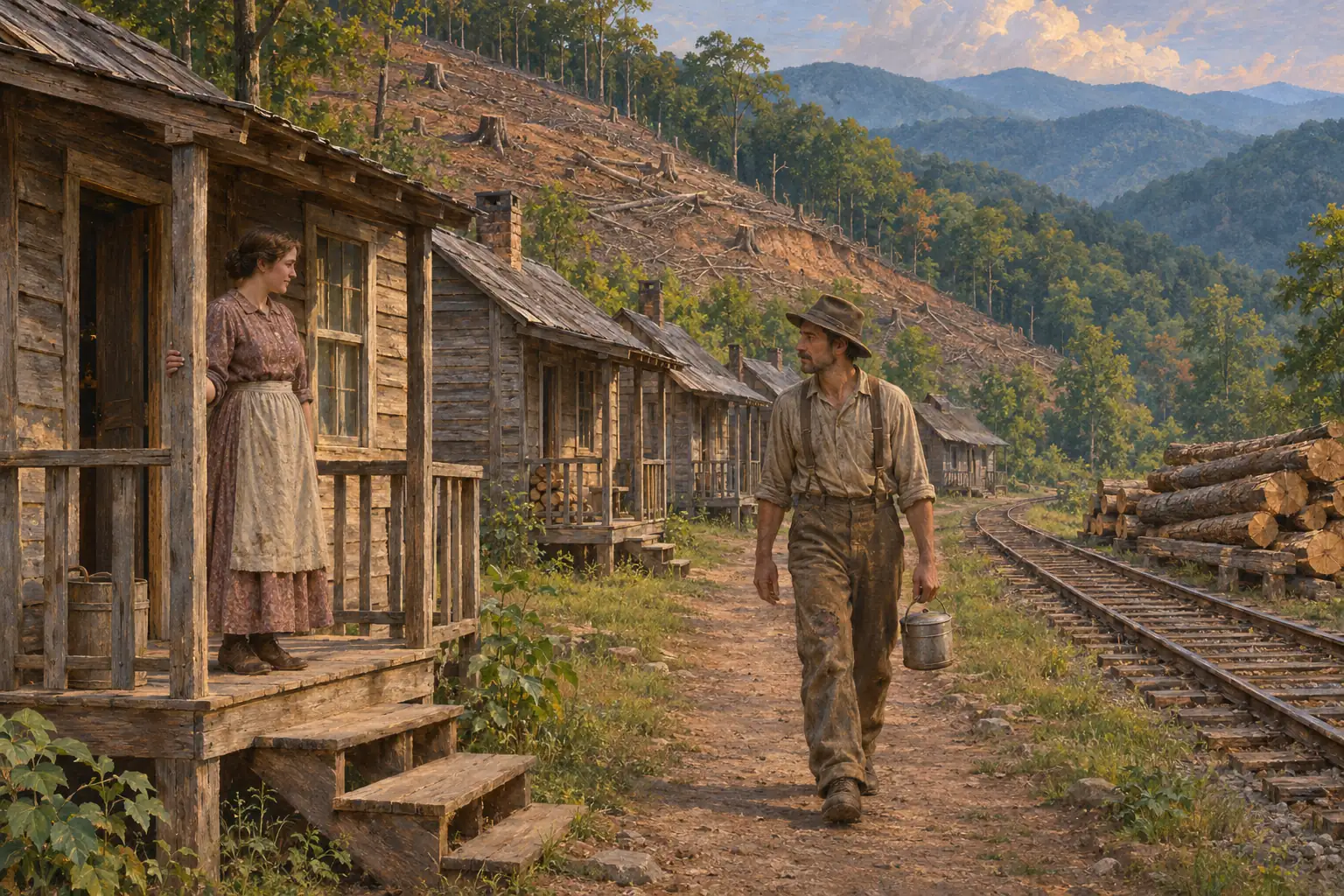
How did logging change Appalachia? Large timber companies brought more wage jobs, railroads, sawmills, and logging camps into mountain communities. Families gained new ways to earn money, but they also faced dangerous work, time apart, changes in land ownership, and jobs that could disappear when the timber ran out. Heavy cutting and the fires that often followed damaged forests, soils, and streams.
The biggest industrial changes came during the late 1800s and early 1900s, though their timing varied across Appalachia. A farmer might take a logging job and keep the homeplace. Another household might move into a mill town. For both, the question reached beyond how many trees a crew could cut: what would this new work make possible, and what would it cost?
Mountain Forests Were Already Part of a Working Landscape
Logging companies did not arrive in an empty forest without a history. Cherokee and other Indigenous peoples had long lived in and used Appalachian landscapes. By the industrial timber boom, many mountain valleys also held farms, mills, churches, stores, and roads. Families cut wood for buildings, fences, fuel, and sale.
The National Park Service’s history of the Smokies describes an economy that already combined farming with trips to mills and stores. Households produced much of what they needed, but they also traded and bought goods. Industrial logging greatly expanded wage work and the purchase of manufactured supplies; it did not introduce money or outside connections for the first time.
The important change was scale. A company supplying distant lumber markets could remove timber far faster than a household cutting firewood or a small sawmill serving nearby farms.
Railroads Made Large Logging Operations Possible
Rails connected forests to mills and buyers. They carried heavy loads through valleys where moving every log by animal power would have limited production. Logging railroads added a new layer to the older routes used for mountain travel.
In Tennessee, W. B. Townsend and his fellow investors chartered the Little River Lumber Company and Little River Railroad in 1901. Their operations helped build Townsend and supported logging settlements at Elkmont and Tremont. The same railroad also carried visitors into the Smokies, helping a tourist economy grow alongside the lumber business.
New transportation came with new control over land. A Forest Service history describes timber companies buying entire properties, timber rights, or selected trees. Some owners welcomed the money. Other families faced disputed titles, unfair dealings, or legal costs they could not meet. Selling timber could provide needed cash, but selling the land also changed who could decide its future use.
A Logging Paycheck Could Help Keep a Farm Going
The shift from farm work to wage work was often gradual. Some men spent weeks or months at logging camps while keeping a family farm. The household could depend on both the harvest and the paycheck, with work at home continuing during the wage earner’s absence.
George Turner offers a documented example of these overlapping livelihoods. National Park Service researchers identify him as a Black resident of the Smokies who worked in both farming and timber. His 1918 World War I draft registration places him in logging work for Mitchell Ownbey at Elkmont.
George and his wife, Mary, usually called Birdie, married in 1907 and had nine children. The records do not give us a household budget or tell us exactly how they divided each day’s work. They do show why calling George simply a farmer or simply a logger would leave out part of the family’s livelihood. A wage job could belong to the history of a homeplace without replacing it.
Small independent operations continued, too. In a recollection reproduced in the Forest Service history, Elbert Herald described logging with his father in Leslie County, Kentucky, during the 1920s. They brought logs to the river and sold them to buyers. With poor markets for farm crops, timber offered a way to get money. Their experience helps explain why families sought logging income without all becoming company-town residents.
Some Families Moved With the Work
Distance shaped camp life. Historian Roy B. Clarkson describes West Virginia woods crews working miles from a mill or town. Men might remain in camp for a week or much longer before a trip into town. A job could mean sleeping near the cutting site instead of returning home each evening.
Other workers brought their households along. The Little River Railroad Museum describes families living in small buildings called set-off houses. These could travel on railroad flatcars and be placed near the work. Rows of them formed settlements known as string towns.
That is a striking way to think about a move: the house itself could follow the railroad. It offered shelter near a job, but its location depended on where the company needed workers. Keeping a family together did not necessarily mean staying in one place.
Feeding the Crew Was Work, Too
A camp needed more than sawyers. Food had to reach the workers, meals had to be cooked, and dining spaces had to be cleaned. Clarkson notes that log trains carried food into West Virginia camps. The railroad that hauled timber out also helped keep people supplied.
West Virginia University’s Watts Museum describes cooks starting before dawn and working into the night. Assistants prepared food, washed dishes, and scrubbed tables. Their work made the next day’s cutting possible.
The industry’s dependence on this work is easy to miss when the story centers on axes and locomotives. A crew could not keep working hard without meals. Nor did moving closer to a logging job remove a family’s need for cooking, washing, clothing, and care. Industrial employment changed the setting of household work without making that work disappear.
Opportunity Was Not Shared Equally
Appalachian logging crews included local residents, Black workers recruited from the South, and immigrants from Italy and other European countries. The Watts Museum documents segregated crews and bunkhouses. Employment brought people into the same industry without giving them equal treatment.
Cass, West Virginia, makes the differences visible. The company built orderly housing for skilled workers and managers, while Black workers were relegated to poorer housing in East Cass. Living near the same sawmill did not mean living under the same conditions.
Skill, race, job, and housing all mattered. So did whether a worker still had land or family support elsewhere. A household with another source of food or income faced a different situation from one depending entirely on the next stretch of paid work.
An Injury Could Change a Household Overnight
Industrial logging offered employment with serious physical risks. Sawmill blades and moving machinery could cost workers fingers or limbs. Logging trains carried heavy loads on steep grades, and workers in the woods faced moving logs, cables, and rough ground.
The Watts Museum records the death of George Lough, an employee of the Bemis Lumber Company in Randolph County, West Virginia. In 1907, a skidder cable snapped while he was working with it and killed him. His name gives a human scale to the general phrase dangerous work.
For a family depending on an injured worker, the consequences could include lost earnings as well as the work of providing care. A fatal accident meant a death to grieve and practical decisions about how to continue. A record of timber production tells us little about that burden unless we also look for the people who carried it.
The Damage Lasted Beyond the Cutting
Heavy logging changed more than the view from a porch. Susan L. Yarnell’s Forest Service history links the industrial boom to increased erosion, fire, and flooding. Forest clearing also contributed to siltier, warmer streams and declining native trout populations. Those changes affected the land and water surrounding mountain homes.
Fire could multiply the damage. The U.S. Fish and Wildlife Service describes how logging in high-elevation Southern Appalachian spruce-fir forests left large amounts of dry branches and other debris. Sparks from trains or lightning could ignite this material. Severe fires then destroyed young trees and the organic soil layer needed for new growth.
Those particular forests had naturally experienced fire infrequently. After intense cutting and burning, spruce and fir could struggle to return. A hillside growing green again was not necessarily recovering the same forest that had stood there before. The agency’s restoration work shows how the effects of early twentieth-century logging have extended across generations.
This history also helps explain why conservation became a public concern. Protecting forests and watersheds gained urgency as people saw the consequences of rapid timber removal. The resulting changes in land management became another major chapter in mountain life.
Cades Cove shows how creating a national park could disperse an established farming community.
What Happened When the Timber Ran Out?
The jobs depended on a supply of trees worth cutting. When that supply shrank, workers and towns had to adjust. Logging continued in Appalachia, but the great original-forest boom could not keep every mill and camp busy indefinitely.
Cass grew to more than 2,000 people by 1920, according to the West Virginia Encyclopedia. As the original forests were depleted, the town declined. A later owner cut second-growth timber, extending the mill’s life until 1960. That longer timeline matters: a boom town could lose ground gradually rather than vanish the day its first timber tract was exhausted.
Cass also found a different future. West Virginia acquired part of its logging railroad in 1962 for a state park, and company houses were later adapted as visitor cabins. The remains of an industry became part of a new livelihood. Elsewhere, former camps left much less behind.
In the Smokies, the National Park Service dates Little River Lumber Company’s final timber cutting in the Tremont area to 1939. Such endings left families with the question that had drawn many into logging in the first place: where would the next income come from?
Logging helped households buy necessities and make plans. It also tied many of those plans to decisions about land, timber, and jobs that families could not fully control. Remembering both the wages and the uncertainty gives the people behind the old camp photographs more than a place in a picturesque past. It gives their choices weight.
Does your family have a logging-camp photograph, a mill pay record, or a story about moving with the work? We’d welcome it through Redneckosity’s contact form. A name, place, and approximate date can help connect a family memory with the historical record.
Strong Backs. Red Necks. Deep Roots.

Explore more stories about mountain work, family, and survival in Appalachian Mountain Life.
Sources and Further Reading
- National Park Service — People of the Great Smoky Mountains
- Little River Railroad Museum — Company and Community History
- USDA Forest Service — Mountaineers and Rangers, Chapter 1 (archived edition)
- National Park Service — The Turner Family
- West Virginia Encyclopedia — Timbering and Logging, by Roy B. Clarkson
- West Virginia University, Watts Museum — Timber/Timbre: Community
- West Virginia University, Watts Museum — Timber/Timbre: Danger
- USDA Forest Service — The Southern Appalachians: A History of the Landscape, by Susan L. Yarnell (PDF)
- U.S. Fish and Wildlife Service — Red Spruce Restoration in Southern Appalachia
- West Virginia Encyclopedia — Cass, by Roy B. Clarkson
- National Park Service — Smoky Mountain Timeline