
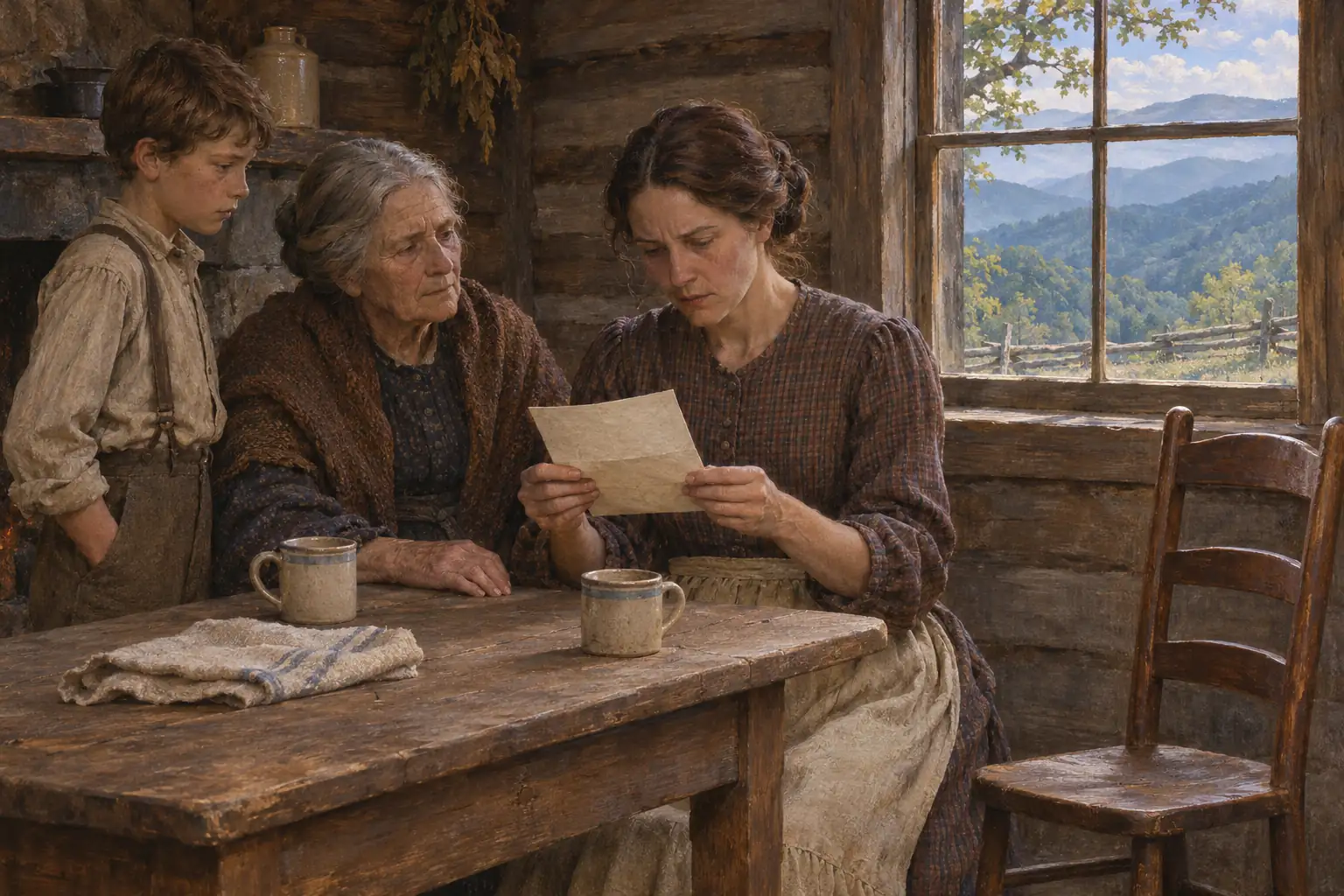
How did the Civil War affect Appalachian families? It took people away from home, divided relatives and neighbors, stripped households of food and livestock, and forced some families to flee. Women and other relatives carried more work, while raids and killings brought danger beyond the battlefields. For enslaved families, the war also brought the possibility—and eventually the reality—of freedom.
The war of 1861–1865 reached different households in different ways. A Unionist family in Cades Cove, a Confederate household in Knoxville, a Cherokee family in western North Carolina, and an enslaved family in Virginia did not face identical choices. Their records help us understand what war changed inside homes as well as on military maps.
Why Were Appalachian Communities Divided?
Living in a Confederate state did not automatically make someone a Confederate supporter. East Tennessee contained strong Unionist communities, while people across the Smokies held differing views about secession, or leaving the United States. The National Park Service describes divisions reaching into churches, neighborhoods, and families.
Slavery was central to the national crisis and the creation of the Confederacy. Individual loyalties, however, also reflected attachment to the United States, local relationships, economic interests, and fears about what war would bring. Those personal motives help explain decisions without removing slavery from the larger story.
Nor did support for the Union necessarily mean opposition to slavery. The University of Tennessee’s McClung Museum notes that both Unionists and Confederates enslaved people in Knoxville. An enslaved person’s hopes could differ sharply from those of a white neighbor who opposed secession.
These divisions mattered at close range. Someone whose political views were familiar to neighbors could become a target when an armed group arrived. A family’s safety depended partly on who controlled the area and how that group treated people considered enemies.
Who Kept the Household Going?
When someone left for military service, the household still needed crops, meals, fuel, and care for animals. Women already did demanding work before the war. Absence could add responsibility for jobs that had previously been shared.
One family memory puts a person behind that change. In Carroll County, Virginia, Melissia Webb kept the farm going while her husband, Isaac, served in the Confederate Army. Their granddaughter Berta later remembered sitting at Melissia’s feet and hearing her describe those years.
As Berta recalled, her grandmother “done the plowin’ and raised their corn.” Historian Keith Robert Webb preserved the account in his study of Carroll County labor and family life. It is a memory passed between generations, rather than a diary written during the war, but it records the work the family remembered as essential.
The demands of home also pulled some soldiers back. Thomas’s Legion, a Confederate force that included Cherokee and white men, served in the mountain region. The Park Service records that some men deserted because their farms and families needed labor and protection from raiders.
Military service and household survival could therefore compete directly. A man’s departure from his unit might reflect a family emergency as well as his feelings about the war. It would be misleading to give every soldier, or every Cherokee family, the same motive.
When the War Took Food and Livestock
Mountain farms could attract armed men because of what they produced. The Smokies’ official historical timeline records raiders from both sides taking food, livestock, and other supplies. The McClung Museum also identifies East Tennessee’s crops and livestock, along with its railroad and industry, as resources that made the region valuable to armies.
For a household, losing provisions meant losing the work already invested in them. Food taken from storage was food unavailable for the next meal or the coming season. Taking an animal could also remove a source of food, transport, or farm labor. These were practical consequences of the seizures, beyond the value of the stolen goods.
Some families tried to protect what they could conceal. The Park Service’s educational account of the Smokies describes women hiding hams in their skirts and children standing watch. Such precautions show how danger entered ordinary routines. Preparing food or watching a road could become part of protecting the household.
Should a Family Stay or Leave?
Staying offered a chance to protect a home and its contents. Leaving might offer safety while putting property at risk. Neither choice guaranteed that a family could avoid loss.
Elizabeth Baker Crozier’s experience shows how that decision could unfold in a town. During the 1863 siege of Knoxville, she remained at home after her husband and older children had left. According to the University of Tennessee’s account of her journal, she hoped to protect the property.
She could not. Her journal describes Union troops plundering and burning her home, along with damage to the homes of friends and neighbors. She eventually fled, rejoined her family months later, and returned to Knoxville to rebuild. The university’s archival description also notes her recollections of kindness from others as the family tried to establish a home again.
A rural family could face a similar decision for different immediate reasons. Elijah Oliver left Cades Cove for nearby Tuckaleechee Cove to escape attacks by Confederate supporters and groups from North Carolina. His move was a wartime search for safety within the mountain region.
These accounts show people responding to particular threats. They also remind us that Appalachian wartime life included towns as well as remote farms, and that civilians could suffer at the hands of either army.
A Church Could Lose Its Place in Daily Life
War disrupted places where neighbors normally gathered. Cades Cove’s Primitive Baptist congregation stopped meeting during the conflict. Its records explained the danger in the congregation’s own words: “we was union people and the Rebels was too strong here in Cades Cove.”
The statement is more than a declaration of political loyalty. The Park Service describes the church as a place that kept families informed and supported community responsibilities. When meetings stopped, residents lost part of that shared life.
The church’s cemetery also preserves evidence of the violence. Russell Gregory, whom Confederate soldiers from North Carolina killed, is buried there. A familiar community gathering place became a keeper of the war’s losses as well as its religious history.
Shelton Laurel Left Families Seeking Relief
One of the starkest examples of civilian danger occurred in Madison County, North Carolina, in early 1863. At Shelton Laurel, Confederate troops killed thirteen men and boys suspected of Unionist sympathies. Women in the area were also assaulted.
The violence followed raids on Marshall by Unionists who said Confederate authorities had denied them salt and other provisions. The North Carolina historical marker program notes uncertainty about the precise date of the killings. Six of those killed bore the Shelton surname.
The surviving families then faced the work of staying alive. On May 29, 1863, widows of the murdered men petitioned Governor Zebulon Vance for relief. The State Archives’ account of their application says they reported the loss of provisions as well as the killing of their men.
The women needed material support while officials argued over responsibility. The State Archives’ account says it is not known whether they ever received relief from the Confederate government. The petition preserves their effort to obtain help, while leaving its outcome uncertain.
What Did Emancipation Change for Families?
For enslaved people, the end of the war meant more than hoping a household could return to its previous routine. Slavery itself had controlled their labor and choices. Freedom opened a different future, even when earning a living remained difficult.
Booker T. Washington’s family gives one documented example. He spent his early childhood enslaved on the Burroughs farm in Franklin County, Virginia. His mother, Jane, worked as a cook, and the family’s cabin also served as the farm’s kitchen.
In April 1865, Washington and the other enslaved people there heard a reading of the Emancipation Proclamation. Later that year, Jane traveled with Booker and his siblings, John and Amanda, to Malden, West Virginia, to join her husband, Washington Ferguson.
The move brought family reunion and a new home, but paid work was still necessary. Booker worked in Malden’s salt and coal industries. His family’s experience shows why emancipation belongs at the center of the civilian story: the change was profound, while the need to find shelter and income continued.
Recovery Meant More Than Returning Home
Some displaced families returned to familiar communities. Elijah Oliver and his family came back to Cades Cove after the war and bought property for a farmstead in 1865. Their return was one family’s beginning again, rather than proof that the entire community recovered at once.
Others had to rebuild a household around a permanent absence. Lydia Kear Whaley lost her husband, a Union soldier, in 1864 and raised two daughters. Berea College’s Loyal Jones Appalachian Center records that she received a military widow’s pension beginning in 1867. Her later livelihood combined that support with her own work.
Our account of Appalachian women’s work follows Whaley’s skills and community roles in greater depth. Here, her experience shows that recovery could involve government support as well as family ties and individual labor.
Political wounds also outlasted the fighting. Historian Noel Fisher’s study of East Tennessee follows partisan conflict into Reconstruction, the period after the war. Rebuilding a house or planting another crop did not automatically restore trust between people who had threatened, driven out, or harmed one another.
The War Stayed in Family Memory
The evidence survives in different forms: a grandmother’s account of plowing, a church record explaining why worship stopped, a displaced woman’s journal, and widows asking for help. Each records a different part of the war’s reach.
Together, they show why a family history needs more than an ancestor’s regiment. It also needs the people who kept the home going, sought freedom, left for safety, cared for survivors, and tried to build a life afterward.
Does your family have a Civil War letter, pension record, or story about a wartime move? We welcome leads through Redneckosity’s contact form. A name, community, approximate date, and information about where the record came from can help us compare family memory with surviving evidence.
Strong Backs. Red Necks. Deep Roots.

Explore more stories about mountain work, family, and survival in Appalachian Mountain Life.
Sources and Further Reading
- National Park Service: Civil War Journal—Divided Loyalties
- National Park Service: Slavery as a Cause of the Civil War
- University of Tennessee, McClung Museum: Why Knoxville?
- Keith Robert Webb: Labor and Social Barter in an Appalachian Community: Carroll County, Virginia, 1880s–1930s (Virginia Tech, 1994; p. 44)
- National Park Service: Civil War Journal—Thomas’s Legion
- National Park Service: Smoky Mountain Timeline
- National Park Service: Civil War in the Smokies
- University of Tennessee Libraries: Civil War—Women’s Suffrage research guide, including Elizabeth Baker Crozier
- University of Tennessee Special Collections: Elizabeth Baker Crozier Journal, 1863–1864 (collection description)
- National Park Service: Elijah Oliver Place
- National Park Service: Primitive Baptist Church
- North Carolina Department of Natural and Cultural Resources: Shelton Laurel Massacre historical marker essay
- North Carolina State Archives: “…killing our men and property”—the widows’ May 29, 1863 relief petition
- National Park Service: Virginia—Booker T. Washington
- National Park Service: Washington Timeline
- Berea College, Loyal Jones Appalachian Center: Lydia Kear Whaley
- Noel C. Fisher: War at Every Door—Partisan Politics and Guerrilla Violence in East Tennessee, 1860–1869 (UNC Press overview and further reading)