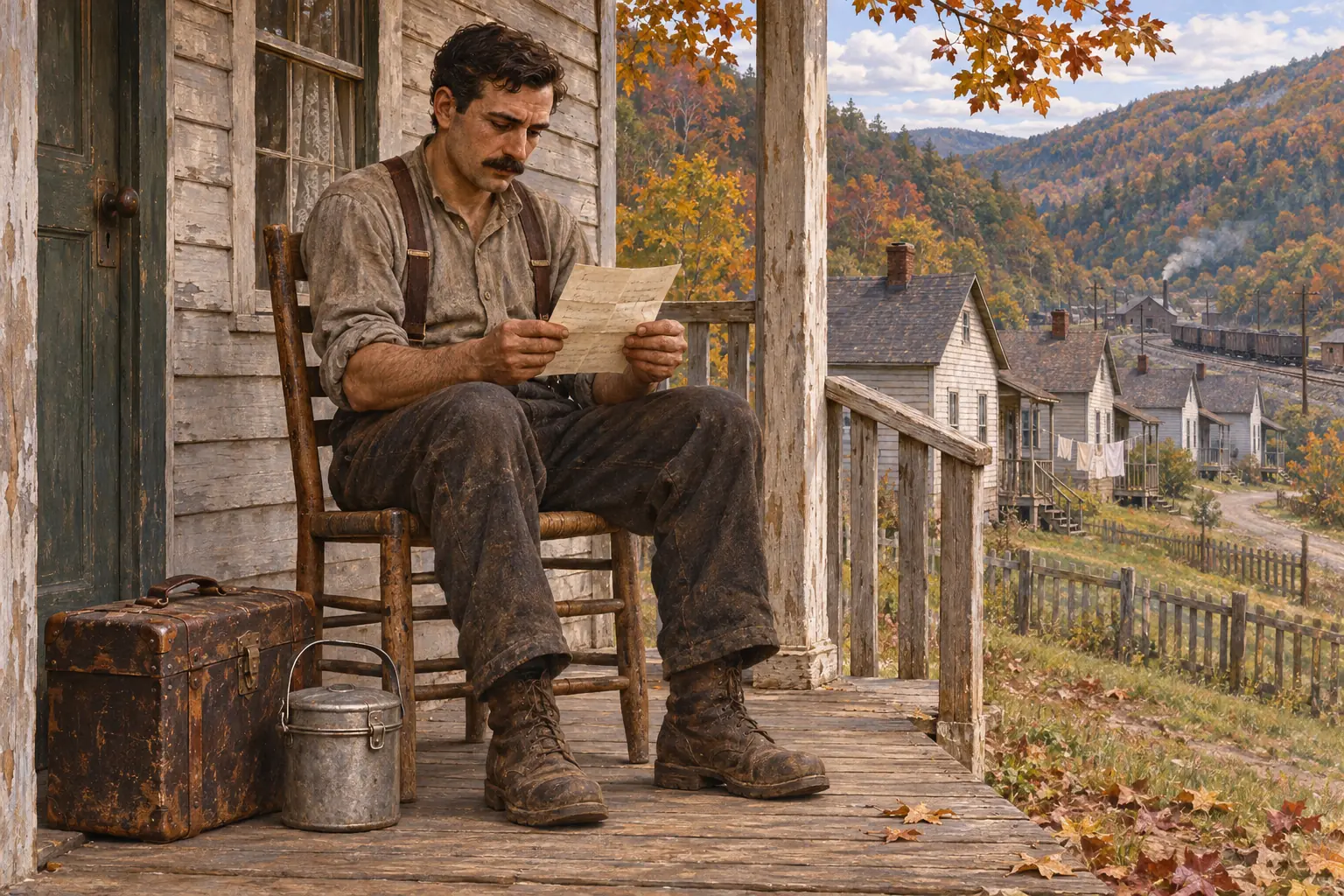
Immigrant coal miners came to Appalachia for work, but a job offer was only the beginning of starting over. Some followed relatives or neighbors. Others answered recruiters. They brought different languages, skills, and plans, then faced the task of finding a place to live and people they could count on.
In the Thomas area of West Virginia, those lives included Patsy Balassone, an immigrant from Italy, and his wife Julia, the daughter of Italian immigrants. Their memories preserve a family history within a mining town’s history. This account follows newcomers from abroad, mainly in West Virginia and Southwest Virginia during the late 1800s and early 1900s. Their experiences were varied, even within the same community.
Why Immigrant Coal Miners Came to Appalachia
Growing mines needed more workers than nearby communities could supply. The National Coal Heritage Area Commission describes companies recruiting in Europe as well as elsewhere in the United States. In 1907, West Virginia appointed John Nugent superintendent of immigration, with coal companies paying his salary.
Recruitment also reached Southwest Virginia. The Library of Virginia records mining and railroad companies seeking workers from Italy, Hungary, and Poland. The expansion of Appalachian coal mining connected mountain settlements with places far beyond the region.
Conditions at home mattered, too. Historian Fred A. Barkey notes that some Sicilians who came to West Virginia were leaving a struggling sulfur-mining industry. Many Italian arrivals came from Campania, Calabria, and Sicily. Calling them all simply Italian can hide the towns and regions that shaped their lives.
Family connections could make a distant destination feel less unknown. Friends of Blackwater’s Early Mining Voices project identifies an uncle as the connection that helped bring young Patsy Greco from Italy to Thomas. A familiar person could matter as much as a company’s promise.
Newcomers Brought Different Skills and Expectations
Not every immigrant arrived knowing nothing about mining. Welsh coal miners offer a useful comparison. The University of North Carolina Press’s overview of Ronald L. Lewis’s study describes skilled miners recruited from Wales by American companies. They brought experience as well as their language, churches, music, and societies.
That history concerns Welsh migration across American coalfields, not a single Appalachian town. It helps explain why one account of an inexperienced newcomer cannot represent everyone who crossed the Atlantic.
Experience did not guarantee the same opportunities. Barkey describes Italian miners commonly doing pick-and-shovel work while American-born and northern European miners more often operated machinery and earned better pay. He also records Italians working as carpenters, blacksmiths, shoemakers, and business owners. A birthplace did not define all the work a person could do.
A Bed and a Meal Could Make a New Start Possible
A newcomer needed shelter before a town could become home. In Southwest Virginia, the Library of Virginia describes early camps with boarding houses serving largely unmarried men. Family houses became more common after the 1910s as companies recruited married workers.
One West Virginia household shows how mine work and boarding-house work fitted together. Ukrainian immigrant Nick Gurski began working in Boone County mines in the 1920s. His wife Mary ran the Nellis boarding house for foreign-born miners. Their sons and grandsons later worked in mining, according to the National Coal Heritage Area Commission.
That account places Mary inside the history of immigration, not at its edge. Providing rooms and meals was part of what allowed other workers to live near their jobs. A coal company’s hiring record alone would miss much of that work.
Housing could also mark divisions. Southwest Virginia camps were often separated by class, ethnicity, and race. Sharing an employer did not mean that every household received the same welcome or lived under the same conditions.
A Shared Language Did Not Always Mean Nearby Friends
Moving toward family could still mean moving away from a wider circle of friends. Language barriers and isolated camps made it harder for some newcomers to build another one.
Scholar Nancy Caronia, drawing on Joan Saverino’s historical research, recounts Anna Guarascio’s move from Calabria to the north-central West Virginia coalfields in 1915. Guarascio joined her husband with their two young children. Back in San Giovanni in Fiore, she had been a respected embroidery teacher.
The move reunited a household but left her separated from the people who knew her skills and standing. Caronia describes how meeting another Italian immigrant woman brought a lasting friendship, with the two families growing close.
It is a small story with a large consequence. Finding work and finding companionship were different needs. For a family starting over, both mattered.
Churches and Cultural Life Gave Communities Roots
Churches offered one way to gather. In Southwest Virginia, coal companies sometimes made land available for Catholic and Protestant congregations. The relationship between a congregation and an employer could also be close in financial terms.
The Center for Migration Studies preserves records of Our Lady of Pompei in Monongah, West Virginia. Its collection guide describes Scalabrinian priests serving the Italian mining community. One priest, Giuseppe D’Andrea, had a brother working in the mines.
The guide also describes parishioner lists sent to the coal company. Contributions were deducted from workers’ pay and credited to the parish, which rented company space. Those records connect worship, family ties, and company control within one community.
Culture did not stand still after arrival. Lewis’s study of Welsh Americans traces the fading of some Welsh institutions within a generation as a new identity developed. Keeping a tradition, changing it, or passing only part of it to children could all belong to the same family’s history.
Patsy Balassone Remembered Recruits Who Refused to Stay
Immigrant miners were not all on one side of labor disputes. In his June 12, 1967 interview, Patsy Balassone recalled workers meeting secretly in Thomas to organize during World War I. His memories place an Italian immigrant among the workers building a union.
He also recalled the company bringing replacement workers from Buffalo during the 1922 strike. Many were Italian. In his account, they said they had been misled about the jobs and left after learning why they had been recruited. Local miners collected money to help pay their train fares home.
This is Balassone’s recollection, recorded decades after the events. It does not explain every recruit’s decision. It does show why an immigrant’s arrival should not automatically be treated as support for the employer in a strike. Workers could reconsider, refuse a job, and help one another.
Building a Life Did Not Always Mean Staying Forever
Some newcomers remained, while others moved on. Barkey’s account of West Virginia Italians includes both paths. Leaving a mining town did not erase the years a family had spent there, any more than staying meant every hope had been fulfilled.
For descendants, the useful questions reach beyond which mine employed an ancestor. Who was already there when they arrived? Did someone offer a room? Which church or club held their gatherings? What language did they use at home? Did children remember the same place as warmly as their parents did?
A letter, boarding-house account, church record, or named family photograph can help answer those questions. Preserve the town names and relationships attached to them. The history of immigrant coal miners includes the coal they dug, but also the help they gave, the friendships they made, and the lives they built around the work.
Strong Backs. Red Necks. Deep Roots.

Explore more stories about mountain work, family, and survival in Coal Mining Lives & Labor.
Sources and Further Reading
- Friends of Blackwater: Early Mining Voices, project background and profiles of the Balassones and Patsy Greco
- National Coal Heritage Area Commission: Coal Miners, recruitment and the Gurski household
- Vince Brooks, Library of Virginia: Virginia’s Coal Towns, recruitment, housing, and community institutions
- Fred A. Barkey, West Virginia Encyclopedia: Italians, migration, work, and settlement
- University of North Carolina Press: overview of Ronald L. Lewis’s Welsh Americans: A History of Assimilation in the Coalfields
- Nancy Caronia, Journal of Working-Class Studies: Refusing the Sentimental Italian Immigration Story in Denise Giardina’s Storming Heaven, historical discussion of Anna Guarascio on printed page 8 (PDF)
- Center for Migration Studies: Our Lady of Pompei, Monongah, collection CMS.048, finding aid, printed pages 5 and 10 (PDF)
- Friends of Blackwater: Early Mining Voices interview excerpts on strikes and unions, Patsy Balassone, June 12, 1967, pages 1–2 (PDF)