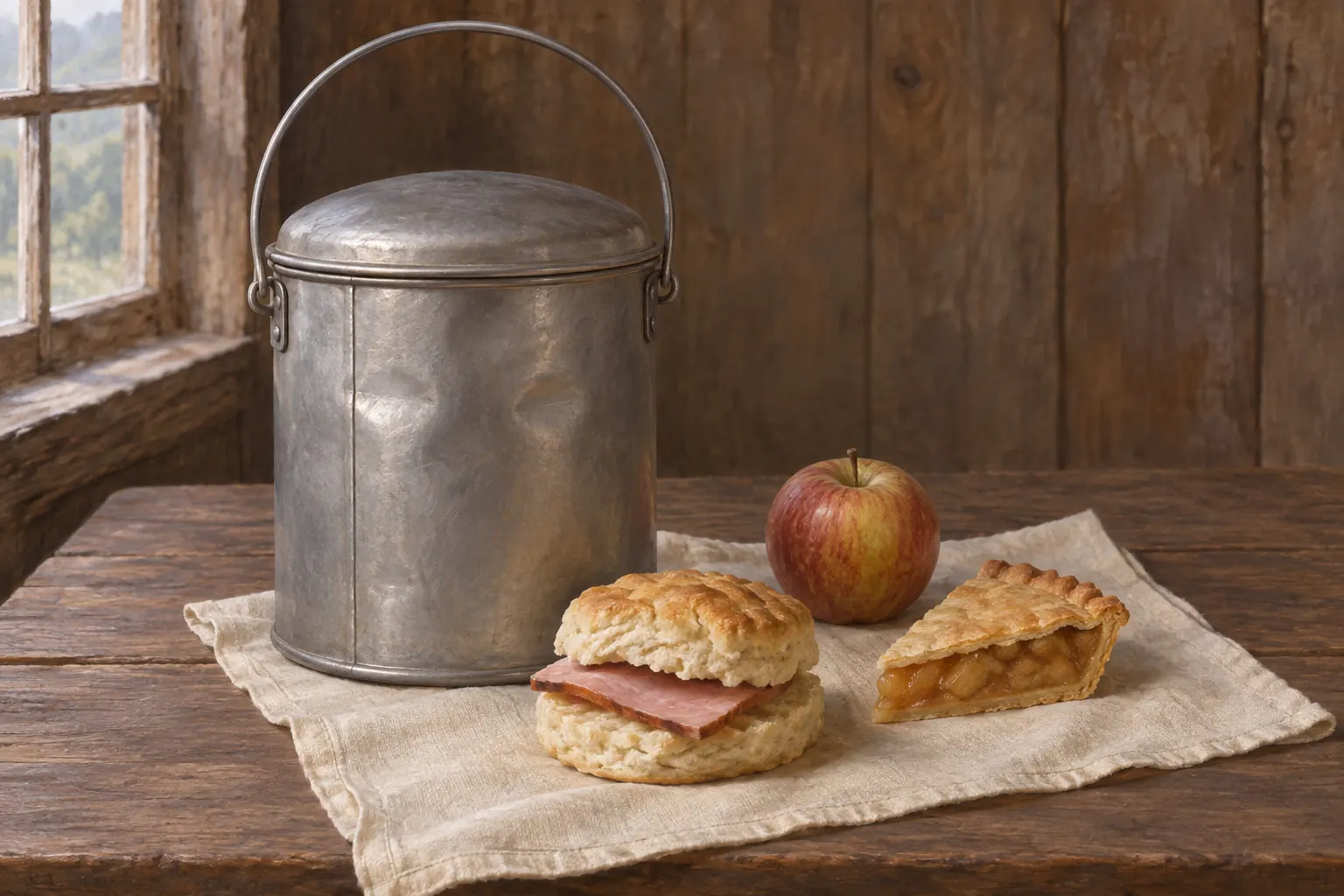
What did coal miners eat? Packed meals could include sandwiches, biscuits, fruit, cake, or pie. Some early lunch pails held cornbread and milk or biscuits with meat. The answer changed with the place, the period, and what a household could afford.
A miner’s lunch bucket also tells a family story. Someone had to find the food, prepare it, and have it ready for the shift. When the bucket came home, children sometimes hurried to see what was left. Museum objects and coalfield memories help us follow that daily trip from the kitchen to the mine and back.
What Went Into a Coal Miner’s Lunch Bucket?
The Kentucky Coal Museum’s education curriculum gives several examples of foods carried to work:
- Sandwiches or biscuits.
- Fruit, cake, or pie.
- Milk and cornbread in some early pails.
- Biscuits with ham, bacon, or sausage.
Those examples describe choices, not one standard meal. A biscuit and a piece of fruit tell us something about how food traveled. They cannot tell us what every miner ate on every shift.
The Pail Carried Water Too
The same Kentucky curriculum describes round or square metal buckets with drinking water in the lower part and food above it. A close-fitting lid helped keep mice and rats out. The container had a job beyond carrying something to eat.
A surviving pail at the Smithsonian’s National Museum of American History belonged to Walter Rothacker, who used it in the mines around Minersville, Pennsylvania, in the mid-1900s. The museum dates its manufacture to 1930. Its collection record explains that miners’ pails often had separate compartments for water and enough food for more than one meal.
That object gives the lunch-bucket story a named owner and a place. It also reminds us to look closely at a family keepsake. If a bucket still has its inserts, photograph them along with the outside. A missing inner container can make an old pail much harder to understand.
Lunch Did Not Always Come at Noon
Calling it a lunch bucket can be misleading. A history of McIntyre, Pennsylvania, describes miners working different shifts around the clock. Depending on the shift, the meal carried from home might be breakfast, dinner, or lunch.
That account also notes that leftovers from the previous evening’s meal often went into the pail. Work food and household food overlapped. What remained after supper could become part of the next day’s packing.
The varied demands of coal mining jobs in the 1900s help explain why the bucket belonged with a miner’s everyday equipment. When recording a family memory, ask which shift the person worked. “He took his dinner” may describe a very different hour from the one you first imagine.
The Work Behind a Packed Meal
At Blue Heron, Kentucky, preparing a miner’s food was part of a much longer day of household labor. The National Park Service’s account of women’s lives describes packing food and water, getting children ready for school, and washing clothing and household items marked by coal dust.
The miner’s shift helped set the household schedule. Food had to be ready when he left. Cooking and cleaning continued after he returned, and fresh laundry could need washing again if dust from the tipple settled on it.
These chores put a familiar object in a wider setting. A packed pail was the result of work already done at home. In many of the households described in coal-camp histories, wives carried that responsibility. The person holding the bucket in a photograph was not necessarily the only person whose work it represented.
Money and Gardens Shaped the Food
In a 1980 oral-history interview preserved by the National Park Service, miner Robert “Bob” Forren recalled lean meals in West Virginia coal camps during the late 1920s. He remembered oatmeal, fried potatoes, and coffee at breakfast. Sometimes there was fatback for the working miner, with too little meat for the children.
Forren also recalled frequent meals of beans, bean soup, and cornbread. In his account, cornmeal cost less than flour. Families who could do so raised vegetables or kept a pig to add to what they bought at the company store.
Even a garden could take extra effort. Forren said the company decided where families could plant, and a plot was not always beside the house. He remembered miners tending crops after their mine work and evening meal.
These are memories of household meals and food supplies, rather than a list of one day’s bucket contents. They show why income and access to land mattered when a family decided what could go to work.
Where Pepperoni Rolls Fit
Pepperoni rolls belong in this story through a particular West Virginia tradition. They are soft bread rolls with pepperoni baked inside, associated especially with the state’s northern Italian immigrant communities.
The West Virginia Encyclopedia credits Fairmont baker Giuseppe “Joseph” Argiro with creating the roll in 1927. A former miner and founder of Country Club Bakery, Argiro remembered coworkers eating bread and pepperoni and brought the two together in one baked item.
The roll could be carried and eaten by hand. Other bakers developed versions of their own, helping it become a familiar regional food.
That history explains an important local tradition. It does not make the pepperoni roll the standard lunch for all Appalachian miners, or place it in buckets from decades before its documented Fairmont origin story. A family from northern West Virginia may remember a different work meal from a family in eastern Kentucky.
Why Children Remembered the Leftovers
For Wanda Sorrell, the memorable part of the bucket’s journey was its return. In a 2025 National Park Service interview, she recalled living in Brooklyn, a coal community in West Virginia’s New River Gorge, from 1960 to 1971.
Her father worked in the mines. When he came home, the children raced to his lunch bucket to see whether anything remained. Sorrell remembered the leftovers as a treat; to her, the food “tasted different” after spending a shift in the mine.
She also remembered her father walking uphill in his work clothes, carrying his dinner bucket. That small scene connects the object to a person and a daily routine. A museum can preserve a pail’s metal shell. Family memories help explain why children watched for it coming home.
If your family kept a miner’s bucket, write down whose it was, where that person worked, and who packed it. Record the remembered foods as specifically as you can. A biscuit, a piece of pie, or a leftover sandwich can be the beginning of a family history worth keeping.
Strong Backs. Red Necks. Deep Roots.

Explore more stories about mountain work, family, and survival in Coal Mining Lives & Labor.
Sources and Further Reading
- Kentucky Coal Museum: Coal Education Curriculum, lunch buckets and packed foods, pages 19 and 180 (PDF)
- Smithsonian National Museum of American History: Miner’s Lunch Pail, owned by Walter Rothacker
- McIntyre, Pennsylvania, The Everyday Life of a Coal Mining Company Town: Miner’s Lunch Bucket
- National Park Service: Women’s Life at Blue Heron
- National Park Service: Mining Oral Histories, Robert Forren interviews, 1980
- The West Virginia Encyclopedia: Pepperoni Rolls, by Rachelle Bott Beckner
- National Park Service: Wanda Sorrell oral-history interview, June 10, 2025