How did mountain people make money? In Appalachian communities during the 1800s and early 1900s, many families sold or traded extra crops, livestock, fruit, and gathered plants. Others earned money by making shoes, running mills or stores, teaching, or doing paid work away from the farm. As visitors and new industries arrived, some households found other ways to earn. Cash was useful, but it was not the only way to settle a bill.
That last detail matters. A mountain family might grow the food on its table yet still need coffee, salt, cloth, shoes, or nails. What counted was turning something the household could produce or do into something it could not. The story is less about a mythical cabin with no money than about a network of farmers, shopkeepers, skilled neighbors, and buyers far beyond the mountains.
A Dozen Eggs Could Become a Pound of Coffee
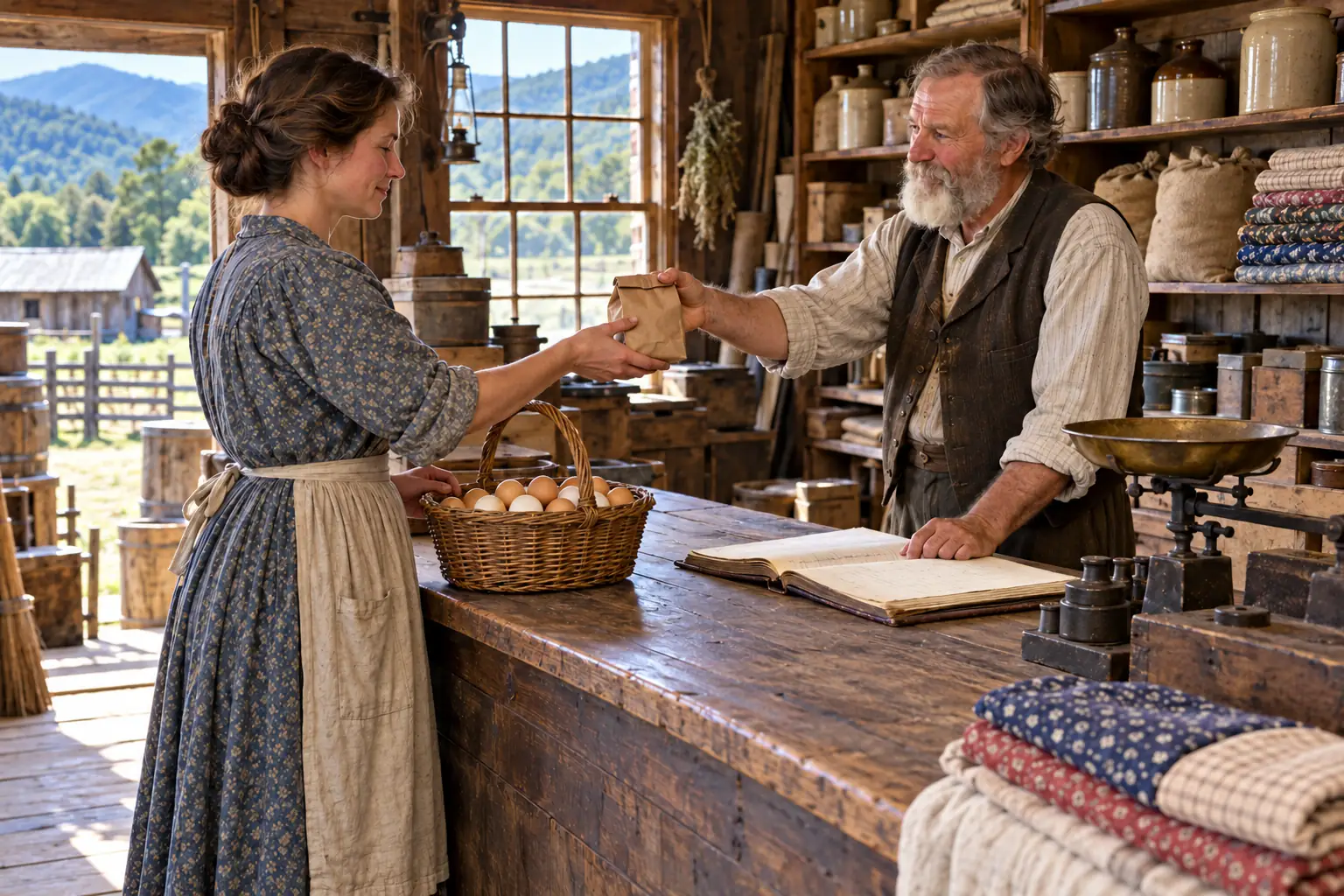
In Little Cataloochee, North Carolina, Will Messer ran a general store where neighbors brought eggs and honey to exchange for supplies. The National Park Service records a telling example from 1900: a dozen eggs, valued at 16 cents, could be traded for a pound of coffee. A family did not have to hand over coins to get something it needed. Its chickens had helped pay the bill.
Messer also extended credit. According to the Park Service, he sometimes carried a neighbor’s account for up to twelve months. In other words, a customer might take something home now and settle up later. That arrangement depended on trust, the storekeeper’s ability to wait, and the family’s chance of producing something to repay the debt.
This is a snapshot from one store, not the price of eggs everywhere in Appalachia. Still, it shows the larger pattern. A household’s produce could stand in for money, while the general store connected people to supplies they could not easily make themselves.
Making a Living Was More Than Bringing Home Cash
We often picture income as wages paid every week or two. Farm households had another kind of economy working beside the cash one. Growing corn, raising a hog, keeping chickens, or making clothing supplied things the family otherwise would have needed to buy. That work had value even when no money changed hands.
But producing food at home did not make money unnecessary. The Park Service lists staples and useful goods sold in mountain stores: salt, coffee, flour, cloth, cooking utensils, and nails, among other things. A family might have plenty of dried beans and no spare cash for a pair of shoes. Surplus food or a paid job could bridge that gap.
The amount of cash a family needed varied with its land, equipment, household size, and the distance to a buyer. Some people owned farms, some worked for others, and many mixed farming with other work. A self-sufficient household was not a household cut off from everyone else. It still needed neighbors, merchants, and roads.
Farm Surplus Had to Find a Buyer
Eggs, honey, produce, fruit, and sometimes animals offered ways to earn or trade after the family met its own needs. What they could spare depended on the harvest, the number of mouths at home, and how well a product would travel. Selling every useful thing was no bargain if the household then had to buy it back.
The Cades Cove store run by Leason Gregg gives a concrete example of how produce reached a larger market. Opened in the 1870s, the store bought goods from local farmers. Gregg traveled about forty miles to Knoxville each week to trade and brought back merchandise for his customers. The store stood near a gristmill, making it a place to shop, exchange news, and meet people while grain was ground.
Apples are a good example of a crop that could become easier to sell by being lighter to carry. The Park Service explains that a bushel of fresh apples, weighing roughly fifty pounds, could be dried down to about seven pounds. Drying preserved fruit for the household and gave a farmer something less bulky to take to a buyer. Cataloochee had residents who grew apples commercially, so orchards were not always planted only for the family table.
Sorghum was another useful mountain crop. The tall cane could be crushed in a mill, and its juice boiled into a thick sweet syrup often called sorghum molasses. Park records describe neighbors coming together to make it. It could sweeten food without a trip to the store. That was a household saving, even when the syrup was not sold for cash. Growing a useful crop and earning a cash profit from it were two different things.
Ginseng Linked a Mountain Hollow to Distant Markets
American ginseng tells a different kind of money story. It was not an orchard crop or a field of corn. The root came from wooded slopes, and buyers valued it enough to move it through a long chain of trade. In the Library of Congress’s history of ginseng gathering on West Virginia’s Coal River, one store owner stands out: R. E. Barrett.
Barrett began accepting ginseng in exchange for merchandise at his Dry Creek store in 1871. His great-grandson, Bob Daniel, later described people coming out of the hollows in the fall with roots to sell. They could leave with shoes, salt, and other necessities. Barrett then sold the roots on to brokers or exporters, including buyers linked to New York. The root’s journey was long, even if the family’s trip to the store was not.
The same chain helped explain why ginseng mattered to households with little cash. A family that depended on the forest for food and fuel might also find a plant that buyers wanted. But the work involved finding, gathering, and carrying the roots, and income depended on access, demand, and what a merchant would pay. It was never a guaranteed payday for every family.
Other plants entered trade, too. The National Park Service says Caroline Brinegar and her children gathered roots and herbs such as bloodroot, mayapple, and black snakeroot, which they sold to drug merchants in Jefferson and Boone, North Carolina. Those sales belonged to the household economy just as surely as the produce from its farm. This is a historical account of plant trade, not advice to collect or use wild plants today.
A Cobbler’s Bench Could Earn Real Cash
The Brinegar family left a wonderfully specific record of paid work. Martin and Caroline Brinegar built their cabin in the Blue Ridge Mountains of North Carolina in the 1880s. They farmed and raised animals, but Martin also made shoes for customers. According to the Park Service, he earned about a dollar for a pair, with the price changing according to the shoe’s size.
That one-dollar figure is a record of a particular trade, not an average wage for the mountains or a number we can compare directly with a modern price tag. It does show how useful a practiced skill could be. A neighbor needed shoes; Martin knew how to make them. Work done at home could reach beyond the family and bring in cash.
Cataloochee had other small businesses, including a blacksmith shop, a gristmill, and commercial apple growing. A miller could provide a service that spared neighbors from grinding grain themselves. A blacksmith repaired or made metal items that farm work wore out. Such trades required tools, materials, customers, and steady effort. They were not shortcuts around hard work.
Even teaching could be paid in more than one form. For the mid-1800s Smokies, the National Park Service describes parents paying roughly one dollar per student each month, either in money or produce, to support a teacher. The teacher often boarded with a local family. That small detail shows a community paying for needed work even when coins were scarce.
Barter, Credit, and Cash Were Not the Same Thing
Barter meant exchanging goods or work directly: eggs for coffee, perhaps, or a service for a share of what was produced. Cash made it easier to buy from someone who did not want what you had. Store credit solved a different problem. It let a customer take supplies first and pay later, when a crop came in, or another source of income arrived.
Those arrangements could overlap. A family might pay part of a store account with produce and part with money. A merchant might need to wait months to be paid, while the family was counting on a future harvest. Poor weather or an illness could make that promise much harder to keep. Credit helped a community function, but it did not erase the obligation.
That is why the general store was more than a room full of goods. Its owner had to find buyers for local products, bring in items from outside, and judge whom to trust with credit. The store’s success depended on the work of the surrounding farms, just as those farms depended on access to the store.
Tourists Paid for a Different Kind of Mountain Work
By the turn of the twentieth century, some communities could earn money from people who came to enjoy the mountains rather than farm them. In Cataloochee, residents recognized the opportunity. The Park Service says they stocked streams with rainbow trout for visiting anglers and charged travelers for room and board in family homes.
Room and board was not money for doing nothing. Guests meant meals to prepare, rooms to keep ready, and time taken from other work. Nor did every Appalachian household live beside a place people wanted to visit. But for some families, hospitality brought in cash without requiring them to ship a crop down a rough road.
A later example comes from the Walker sisters in Little Greenbrier Cove. After their property became part of Great Smoky Mountains National Park, they could remain under a lifetime lease but had to adjust to new rules. Visitors came to see their homestead, and the sisters sold handmade toys, crocheted items, fried apple pies, and poems. That was a different era and situation from early Cataloochee tourism, but it shows how households adapted familiar skills to new customers.
Wage Jobs Changed the Balance
Not all money was made at home or through a country store. During the early 1900s, large timber operations expanded in the Smokies. The Park Service describes logging towns appearing quickly and residents taking paid work as manufactured goods and store-bought food became more common. Some families continued farming while also relying on wages.
A wage meant a more direct payment for labor, but it could also mean new dependence on employers, work schedules, and the price of store goods. Company stores sometimes took the place of older general stores. Where a family once traded produce to a local merchant, a worker might now spend a paycheck at a company commissary.
This change did not happen all at once or in exactly the same way across Appalachia. The large logging industry deserves its own history. For this question, the point is simpler: the household’s mix of farm goods, trade, and paid labor changed as new employers and markets reached the mountains.
Not Everyone Had the Same Chance to Earn
There was never just one mountain economy. Cherokee communities farmed, hunted, and traded long before the arrival of European-American settlers. Later trade with newcomers brought different goods and opportunities, but land seizures and forced removal in the 1830s disrupted Cherokee homes, property, and livelihoods. Their economic history cannot be folded into a story that begins with a white settler’s store.
The region also included free and enslaved Black people. National Park Service research on western North Carolina shows that slavery shaped farm wealth and work in the mountains as well as the lowlands. Enslaved workers produced value that enslavers claimed; the people doing the work did not control those earnings. The image of every mountain household as a small, independent farm hides that unequal economy.
Women and children contributed labor that did not always appear as wages. Caroline Brinegar and her children gathered saleable plants, while the Park Service records children in the Sugarlands bringing nuts and berries to a store for cash. Others produced food, clothing, and household goods mainly for home use. Landownership, race, age, opportunity, and family need all shaped what someone could sell—and who received the benefit.
The Small Transactions Tell the Bigger Story
A dozen eggs turned into coffee. A pair of shoes brought a cobbler about a dollar. Dried apples weighed less on the road to a buyer. Ginseng from a hillside moved through a store to a distant market. Visitors paid for beds and meals. These were different ways of turning work and local resources into something a household needed.
The answer is not that mountain people had no money, or that everyone lived by barter. People made, saved, traded, borrowed, and earned in combinations that changed by place and time. The most useful question is not just what a family produced, but how it reached the people willing to pay for it.
Do you have an old store ledger, a family story about selling dried apples, a shoemaker’s tool, or a memory of trading eggs for supplies? We’d love to hear what you know through Redneckosity’s contact form. A name, place, and approximate year can help turn a family memory into a story worth checking against the records.
Strong Backs. Red Necks. Deep Roots.

Explore more stories about mountain work, family, and survival in Appalachian Mountain Life.
Sources and Further Reading
- National Park Service — General Stores in the Great Smokies
- National Park Service — History of Cataloochee
- National Park Service — Brinegar Family
- National Park Service — Mountain Orchards
- Library of Congress — American Ginseng and the Idea of the Commons: Historical Background
- National Park Service — Gettin’ By in Winter
- National Park Service — Cades Cove History
- National Park Service — Cultural Landscapes by Bicycle (Sorghum Mill)
- National Park Service — People of the Great Smoky Mountains
- National Park Service — The Walker Sisters
- National Park Service — Cherokee History
- National Park Service — Chattel Slavery in the Appalachians of North Carolina
- National Park Service — African American History on the Parkway