
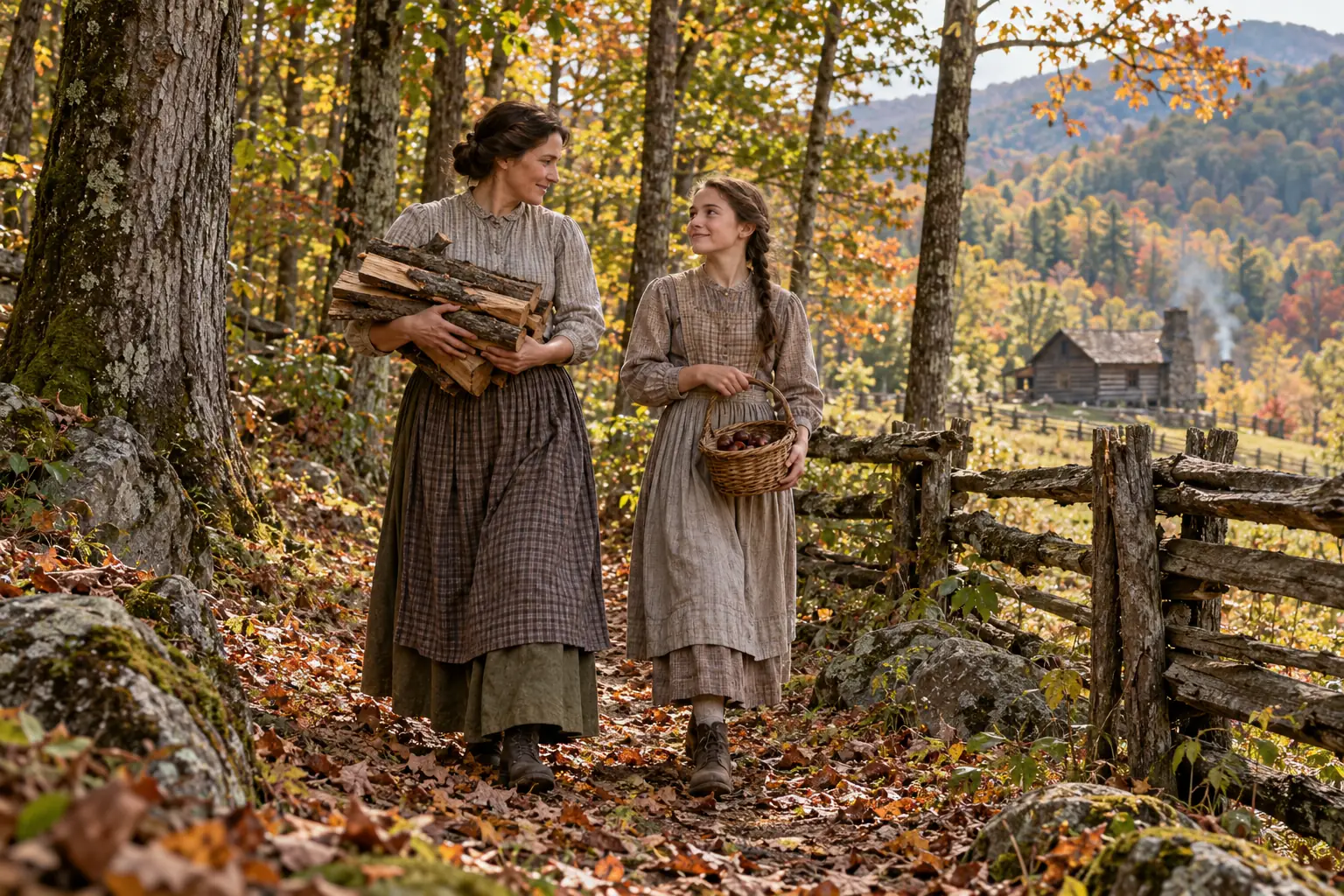
How did mountain families use the forest? In much of Appalachia during the 1800s and early 1900s, the woods supplied firewood, building material, wild food, game, grazing ground, and useful plants. They also held trails, remembered gathering places, and knowledge passed from one generation to the next. A family’s farm could be small, but the land that helped sustain it often reached far beyond the cleared fields.
That did not mean every mountain household lived the same way or could freely use every wooded hillside. The answer depended on place, season, property, local custom, and who had the right to enter the land. The best way to understand the forest’s importance is to look at what people did there—and what changed when they could no longer do it.
A Mountain Home Did Not End at the Fence
Consider the Walker family in Little Greenbrier Cove, Tennessee. Their home, now preserved in Great Smoky Mountains National Park, stood among orchards, fields, and wooded slopes. John Walker’s log house was built of tulip-poplar timber, and the property included a barn, corncrib, smokehouse, and other working buildings. He also made chairs, tools, and looms. The homestead was not simply a house beside a forest. Wood from the land helped make the home and the things inside it.
After John died in 1921, his unmarried daughters carried on the farm. The National Park Service describes the sisters raising food and animals, weaving cloth, keeping a garden of plants used in home remedies, and collecting plants from the forest as well. They sometimes dyed yarn with berries or bark. That is a striking range of work from one household: building, eating, clothing, and caring for family all drew on the land in different ways.
The Walkers were one family in one Tennessee cove, not a stand-in for everyone in Appalachia. Their story does show something easy to miss in an old photograph of a cabin: much of the household’s work happened outside the picture.
Trees Meant Warmth, Shelter, and Everyday Tools
Before a pile of split wood became a warm room or a hot cooking fire, somebody had to cut it, haul it, stack it, and keep it dry enough to burn. Fuel was not an occasional errand. It was a repeated need in a place where winter could last longer on a cold, shaded slope. A family could have a field full of corn and still face trouble without wood for heat and cooking.
The forest also supplied logs for cabins and barns, rails for fences, and timber for handles, furniture, repairs, and outbuildings. A new fence or a broken tool called for material as surely as it called for skill. At the Walker place, the tulip-poplar log house and John Walker’s handmade tools are specific examples of wood becoming shelter and useful objects.
Not every tree served every job equally well. American chestnut, once common in the eastern mountains, had strong, straight-grained, naturally rot-resistant wood. That made it valuable for many outdoor uses. Other woods offered different strengths. Choosing, shaping, and making a tree useful involved learned judgment, not simply picking up whatever lay nearby.
This work also had limits. A steep slope made a log harder to bring home. A standing tree did not become firewood without labor or tools. And needing timber did not guarantee that a household owned the trees or had permission to cut them. The practical value of woodland depended on access as much as abundance.
The Woods Were a Second Pantry
Fields and gardens supplied much of a farm family’s everyday food. The forest added foods that followed a different calendar. The Library of Congress’s Coal River Folklife Project, which recorded people in southern West Virginia in the 1990s, documents memories and living traditions involving ramps, berries, nuts, mushrooms, fish, and game. These accounts preserve local knowledge, not a menu that every Appalachian family ate.
Early spring could bring greens and ramps, the sharp-smelling wild leeks that became part of regional food traditions. As the weather warmed, berries and other wild foods came into season. Fall offered nuts and the chance to gather what the woods produced before winter. Some food was eaten fresh; some was kept for later. Knowing when and where to look could matter as much as knowing how to prepare it.
The forest offered variety when the garden had finished or when a crop fell short. It did not magically feed a family without work. Gathering could take hours of walking and sorting. Hunting and fishing took time and experience, and success was never assured. Weather, access, and the health of the forest all shaped what was available.
It is worth keeping the picture honest. Mountain families planted crops, raised animals, traded, and bought goods as well as using wild foods. The woods were often one part of a larger food system, not a replacement for farming or a guarantee against hunger.
Why the American Chestnut Mattered So Much
Few trees show the forest’s reach into daily life better than the American chestnut. Its sweet nuts fed people, livestock, and wild animals. A U.S. Forest Service account recalls Appalachian farm children carrying chestnuts to school in their pockets. Families gathered them for food, while hogs and other stock could fatten on the nuts that fell beneath the trees.
Those falling nuts are called mast, the tree foods animals find on the forest floor. Acorns, hickory nuts, and beechnuts also mattered, but chestnuts were especially abundant and reliable in many places. This helps explain why the woods were tied to the livestock raised on Appalachian farms. A hog might spend part of the year eating beyond the fence, yet the benefit still reached the household’s table.
Then a fungal disease changed the equation. Chestnut blight was identified in New York in 1904 and spread through the tree’s range. By the middle of the twentieth century, the American chestnut had largely disappeared as a mature canopy tree. Families did not all lose the same resource at the same moment, but across affected areas, a familiar source of nuts, animal feed, and useful timber was greatly reduced. A change in the forest could change a farm without anyone moving a fence.
Hunting and Grazing Crossed the Field Line
The National Park Service records that early European-American settlers in the Smokies hunted wildlife, used timber for buildings and fences, grew food, and pastured livestock in clearings. Hunting could add meat to a family’s supply. Streams and rivers offered fish. Such work required knowledge of the ground, the weather, and animal habits, and it varied greatly from household to household.
Some farms used wooded land as a place for animals to feed, too. In parts of Appalachia, hogs searched the forest floor for nuts and other food, while cattle might use open or partly wooded range. This was not the same as abandoning the animals; owners still had to manage and find them. But it helped make land beyond a plowed field part of the farm’s daily working world.
Here again, access mattered. The ability to hunt or turn livestock out on a ridge depended on local practice, neighbors, landowners, and changing rules. What one family treated as customary use might become disputed or forbidden later. The forest was never a simple, ownerless supply shed.
Roots, Leaves, and Knowledge Passed Down
Some forest plants were gathered for food. Others were collected for household uses or sold to buyers. American ginseng, often called ‘seng’ in the mountains, is a good example. It grows in shaded woodlands, and finding it called for patience and a trained eye. The Library of Congress documented a rich culture of ginseng searching in West Virginia’s Coal River country, including special tools, remembered places, and knowledge shared among relatives.
One of the people interviewed, Shelby Estep, recalled that her grandmother gathered ginseng years earlier. Estep was still going into the woods with her own daughter and granddaughter. In that family account, a root links four generations. The point is bigger than the plant: a person might learn the slope, season, and familiar landmarks by walking with someone who had learned them the same way.
Ginseng could be traded, sometimes providing money for things a family could not make at home. That is part of the story, but its sale price alone does not explain why people cared about it. The Library of Congress interviews also capture the excitement of searching and the importance of places known by name. A wooded hollow could hold family history along with the roots in its soil.
People also remembered plants used in home remedies. The Walker sisters tended a garden that included peppermint and boneset and gathered wild plants from the forest. In the Coal River interviews, people discussed traditions involving sassafras, spicebush, and spring greens. These are records of what people believed and practiced—not proof that a particular remedy was safe or effective. Some wild plants and traditional preparations carry real risks.
The most lasting resource may have been the knowledge itself: which hillside held a patch of plants, when a crop of nuts tended to fall, or how to recognize a place after leaves covered the path. Such information was passed through work, stories, and visits. It cannot be measured by the number of trees standing there.
These Were Cherokee Homelands, Not Empty Wilderness
Long before European-American settlers built cabins in the Smokies, Cherokee people lived, farmed, hunted, gathered plants, and traveled through these mountains. Their towns and trails were part of the landscape newcomers entered. Calling the forest ‘untouched’ or imagining mountain history began with a settler’s ax leaves out the people who already knew and used the land.
The Eastern Band of Cherokee Indians continues to hold deep ties to the southern Appalachians. One example is sochan, a leafy plant traditionally gathered as food. The National Park Service describes this as a practice taught across generations. In 2019, the park and the Eastern Band reached an agreement allowing designated traditional gathering inside Great Smoky Mountains National Park—a reminder that forest knowledge is a living tradition, not just something in an old history book.
That continuity exists alongside a history of land loss. Many Cherokee people were forced from their homes in the 1830s; some remained and are ancestors of today’s Eastern Band. Their story is not interchangeable with that of later settler households. Nor were all Appalachian families alike: place, race, wealth, and land rights affected what people could use and keep. Any honest answer about mountain forests has room for those differences.
Whose Woods Were They? The Meaning of a Commons
In some central Appalachian communities, people relied on wooded ridges and slopes beyond their fields for gathering, hunting, fuel, and open-range grazing. Folklorist Mary Hufford’s Library of Congress work describes this as a kind of commons: land whose resources people used through long-standing local practice. It was a way of living with a landscape, not proof that every hillside legally belonged to everyone.
Place names show how closely people read the country. The Library of Congress records names such as Chestnut Hollow, Beech Hollow, and Sugar Camp Hollow, as well as paths, old homeplaces, and family cemeteries tucked into the woods. These names were more than labels on a map. They helped people remember where work happened and how family and community life connected across a ridge.
Private deeds, mineral rights, and community custom did not always line up neatly. Hufford describes how land companies acquired control of large areas in the late nineteenth century and how gates and other limits later restricted access in parts of West Virginia. Those changes affected the ability to gather or hunt even when a family had used a place for generations. A forest could still be standing while its everyday uses were slipping out of reach.
‘Commons’ is therefore a helpful historical idea, not permission to enter private property today. The customs and laws were different across the Appalachian region, and they changed over time. What matters for this story is the relationship between a household and the land it could actually reach.
What Changed When the Forest Changed?
In the early 1900s, large-scale logging changed many parts of the southern mountains. The National Park Service describes lumber towns rising in the Smokies and forests being cut as local households increasingly relied on purchased goods and wages. Logging itself has a larger history, but one effect is clear here: an altered forest could no longer provide exactly the same fuel, mast, plants, or familiar places.
The creation of Great Smoky Mountains National Park protected much of what remained, but it also changed the lives of people on that land. More than 1,200 owners had to leave their properties. The Walker sisters, who held on to their homestead, received a lifetime lease. They could stay in the house where they had grown up, but hunting, fishing, cutting wood, and grazing livestock inside the new park were prohibited.
Think about the difference. A log cabin could still stand, the woods could still be green, and yet the jobs that linked the two had changed. The sisters adapted, and the Park Service records that they welcomed visitors and sold handmade goods. Their experience shows why ‘saving a forest’ and ‘preserving a family’s old way of using it’ were not always the same thing.
Other pressures worked differently. Chestnut blight reduced a tree that once fed people and animals. Property changes could close off a ridge or a gathering spot. Some traditions endured, some adapted, and some faded. There is no single date when mountain families stopped depending on the woods.
The Woods Were Part of the Household
The answer to how mountain families used the forest is not one chore or one old-fashioned survival trick. It was a whole set of relationships: a tree became a fence rail, a nut fed a hog, a trail led to a plant patch, and knowledge of that patch moved from grandparent to child. Forest and farm worked together, though never without labor, risk, or questions about who could use the land.
If your family remembered a named hollow, a chestnut-gathering day, a woodlot, or an older relative who knew every plant along a path, we’d enjoy hearing about it through Redneckosity’s contact form. Memories can point us toward stories and records worth checking; they are not automatically proof of how every family lived.
Strong Backs. Red Necks. Deep Roots.

Explore more stories about mountain work, family, and survival in Appalachian Mountain Life.
Sources and Further Reading
- National Park Service — People of the Great Smoky Mountains
- National Park Service — The Walker Sisters
- Library of Congress — Tending the Commons: About the Collection
- Library of Congress — American Ginseng and the Idea of the Commons: Historical Background
- Library of Congress — American Ginseng and the Idea of the Commons: The Commons
- Library of Congress — Stalking the Wily Seng
- Library of Congress — Spring Tonics
- U.S. Forest Service — Restoring the American Chestnut Tree (2012, pp. 24–25)
- National Park Service — Cherokee History
- National Park Service — Sochan Gathering: A Cherokee Tradition
- National Park Service — Sochan Gathering Resource Brief