
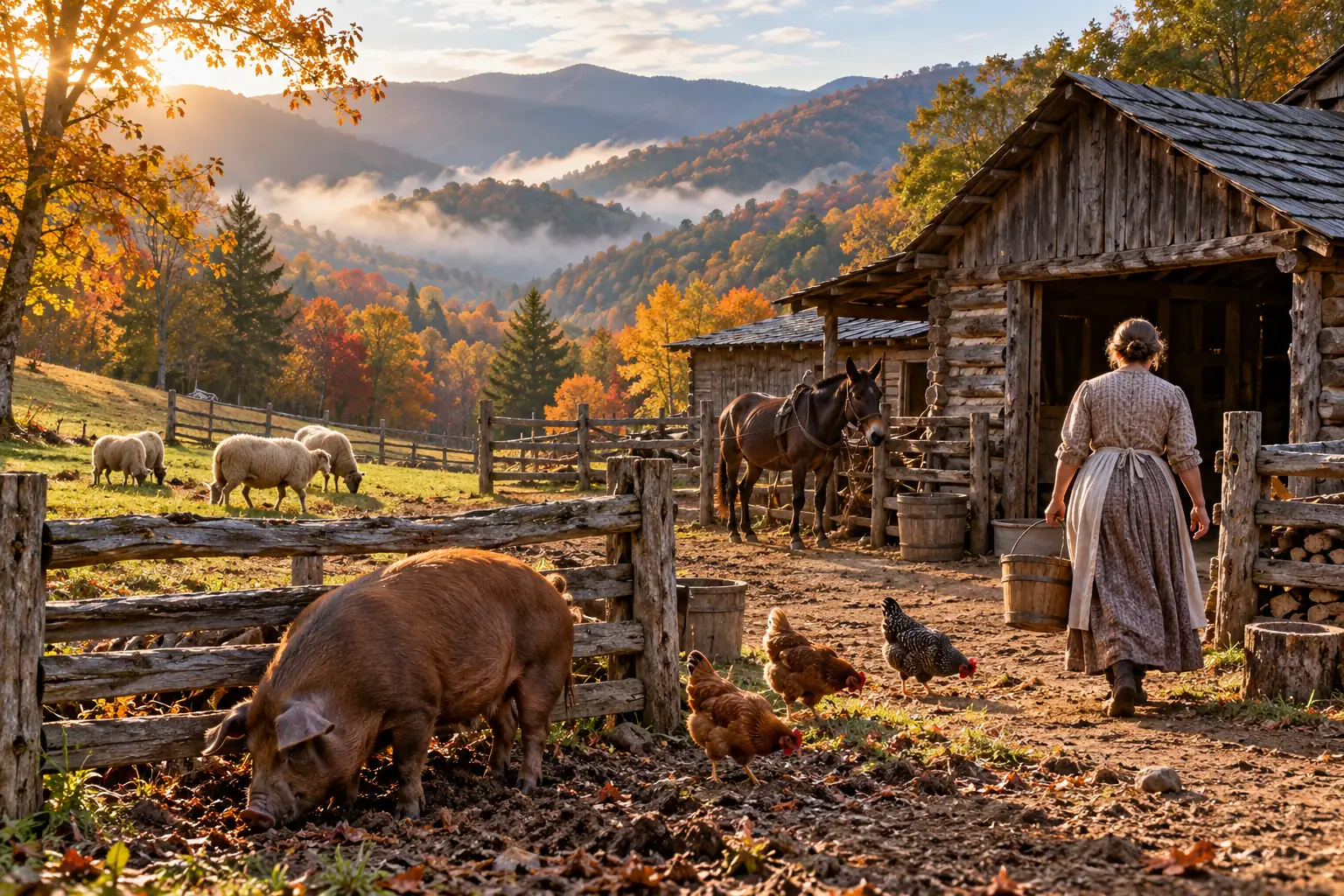
What animals did Appalachian settlers raise? On many farms in the 1800s and early 1900s, families kept hogs, chickens, cattle, and sheep. Horses, mules, or oxen supplied pulling power. Some households also raised goats, ducks, or geese. Those animals gave families meat, eggs, milk, wool, help with heavy work, and sometimes something valuable to trade or sell.
The list is easy. The work behind it was harder. A hog could find food in the woods, but someone still had to mark it and bring it home. Sheep supplied fleece, but the fleece did not turn itself into clothing. What a family kept depended on its land, resources, labor, and where it lived in the mountains.
The Walker Farm Was a Working Household
In Little Greenbrier Cove, Tennessee, the Walker family left a useful picture of a mountain farm. The National Park Service describes a barn, corn crib, pig pen, smokehouse, and springhouse on the property. John and Margaret Walker raised eleven children there, along with chickens, sheep, goats, and hogs. The springhouse beside a creek helped keep milk and butter cool.
After their father’s death in 1921, six unmarried Walker sisters inherited the homestead and continued making a living from it. They raised livestock and maintained the farm long after many other families had left the area. The Park Service records that the sisters’ meals often included pork and corn. Their sheep supplied wool that they processed into cloth.
Each building served part of the household’s work. The corn crib held a crop that could also feed animals. The pig pen kept hogs close when needed. The smokehouse held meat for later meals. The sisters’ farm shows why livestock belonged in the same story as a family’s garden, clothing, and daily chores.
Hogs Roamed the Forest and Came Home for Winter
Hogs were especially important in much of the southern mountains. The National Park Service cites the 1880 agricultural census for the Oconaluftee area of North Carolina: 59 families reported owning more than 830 pigs in 1879. One family had as few as two; another had more than 50. That was one community’s livestock count, not an average for every Appalachian farm.
Why so many hogs? They could find much of their own food. Farmers often let domestic pigs roam the woods, where they rooted for plants, insects, and other food. In fall, acorns, chestnuts, and other nuts helped fatten them. This saved feed that would otherwise have to be grown, stored, or bought.
A pig in the woods might be out of sight for days, but it was not necessarily ownerless. Families used distinctive cuts or holes in the animals’ ears to show ownership. Some farmers even registered these earmarks with the county court. They also carried salt and corn to regular feeding spots so the hogs would return and could be found when needed.
As cold weather approached, farmers selected animals to bring in and feed more heavily, often with corn. When the air was cold enough, families butchered hogs and prepared meat and lard for the months ahead. Relatives and neighbors sometimes worked together on that demanding day. The hog might have spent months feeding in the woods, but its value still depended on work at home.
The arrangement was never effortless. Hogs could wander, root up places where they were unwanted, or attract predators. The Park Service describes sturdy log pens built to hold hogs in and keep bears out. A farmer might spend less grain feeding a free-ranging pig, but still had to manage a living animal across a wide piece of land.
Chickens and Cattle Supplied Food Between Harvests
Chickens fit a different need. A small flock could supply eggs when the hens were laying, as well as meat. Some families also kept ducks or geese. Their feathers and down could be used in bedding. These animals were useful around a household that could not count on a fresh field harvest every month.
Milk cows required steady care. Milking, making butter, providing water, and finding pasture were recurring jobs. A springhouse could keep dairy foods cooler than the air outside. The Walker springhouse is one documented example, though it does not tell us exactly how many dairy animals the sisters kept at any given time.
John and Lucretia Oliver’s early Cades Cove homestead offers another example. The National Park Service records that the Olivers kept cattle along nearby Abrams Creek while they cleared fields for corn and wheat. Animals and crops shared the same ground and water. Corn might become a family meal or feed for livestock. That connection between growing crops on mountain land and raising stock shaped much of the year’s work.
Cattle might supply milk or meat, and some farmers raised more animals than the household would consume. But a cow was a larger investment than a few hens. It needed enough forage, protection, and care through cold weather. Families with different amounts of land and money could make very different choices.
Sheep Put Wool on the Family’s Backs
A flock of sheep could give a mountain household both meat and wool. Wool was especially valuable where buying cloth meant a long trip, scarce cash, or both. Yet shearing a sheep was only the beginning of the process.
The Walker sisters provide a documented example. They washed the wool, carded it to prepare the fibers, spun yarn, and wove fabric. They used natural dyes at times and also worked with flax and cotton: one fabric they made, called linsey-woolsey, combined linen and wool fibers. The animals supplied the raw material; the family supplied the skill and hours of labor.
Sheep could graze on rough pasture that did not suit a cornfield. In Cades Cove, cattle and sheep used grassy mountain balds above the valley. Other families had smaller flocks or none at all. The Walkers also raised goats, but that does not make goats a standard animal on every mountain farm.
Horses, Mules, and Oxen Provided Power
Before tractors and trucks reached rural mountain communities, draft animals did work people could not easily do alone. A horse, mule, or yoke of oxen might pull a plow or wagon, haul supplies, or help move materials for a building. Oxen were cattle trained to pull, not a separate species.
The type of work depended on the ground. The National Park Service notes that gardens in the nineteenth-century Smokies were usually worked with hoes, shovels, and rakes, while animals pulled equipment in larger fields. A steep, rocky plot could leave plenty of work for human hands even when a farm owned a mule.
Animal power could also serve jobs beyond plowing. A historical account of Cades Cove describes a mule-powered mill used to press sorghum cane. Horses and mules helped carry people and goods along mountain routes as well. Owning one meant another mouth to feed, but it could change how much work the family could finish and how far it could take a load.
How Families Fed and Protected Their Animals
Not all livestock stayed behind a fence. In some mountain communities, hogs foraged in the woods, while cattle and sheep grazed in clearings, valleys, and high grassy balds. Farmers still needed accessible water, winter feed, places to shelter animals, and a way to protect planted fields.
The seasonal rhythm mattered. Spring often brought young animals, pasture work, and field planting. Summer meant keeping animals supplied and away from crops. Fall was the time to gather hogs and prepare for winter. Cold months meant relying more on stored feed and buildings near home. The work changed by farm and year, so no one calendar describes the entire region.
Rail fences and gates had a practical purpose: crops could disappear quickly if livestock wandered into them. Predators and bad weather added risk. Even a farm that let hogs feed themselves in the forest could not simply forget the herd until autumn. Large flocks or herds also demanded more land and more people to handle them.
Open grazing had consequences beyond the farm. Hooves and rooting could disturb plants and soil, while fences, pastures, and cleared fields changed the landscape. The ability to turn animals loose also depended on access to land and on the rules governing that land, which were not the same everywhere or forever.
Whose Animals and Whose Work
There was never one kind of Appalachian livestock owner. Cherokee communities had raised crops for generations before European-American settlement. They also adopted cattle, horses, hogs, goats, and sheep. A National Park Service study of Cherokee Georgia describes substantial livestock holdings by the 1830s, before federal removal forced many Cherokee people from their homes and farms. Accounts that begin with white pioneer barns leave out that history.
Nor did every livestock chore belong to an independent farm family. Historian Wilma A. Dunaway documents how enslaved African Americans cared for animals on some larger Appalachian farms and plantations. Perry Madden recalled that, as children, he and his brother guarded an opening in a rail fence while workers passed through. If the boys left the gap unattended, livestock could reach the crop. It is a small remembered task, but it shows the human labor behind a fence line and the unequal conditions under which some of it was done.
Farms also differed in size. Some households kept a cow and a few pigs mainly to feed themselves. In parts of western Virginia, wealthy landowners raised much larger herds and sent cattle to distant markets. Even within one community, the number of animals a family owned could vary enormously, as the Oconaluftee hog count shows.
Livestock Could Also Pay the Bills
An animal could be kept for the table, but a surplus could also be sold or traded. Hogs were well suited to this in an age of rough roads: they could walk to market. Cattle moved in herds, too, and West Virginia developed a significant livestock trade long before railroads became common. The scale of that trade was very different from selling one or two extra animals close to home.
Money or store credit from livestock helped some families obtain goods they could not make or grow. That does not mean every farm turned a profit. Feed, land, time, losses, and distance to a buyer all mattered. For a mountain household, animals were a way to spread its chances across more than one crop or season.
The system changed over time. Railroads opened new markets, forestry and industry altered land use, and the loss of the American chestnut reduced an important forest food for hogs. Later, the creation of Great Smoky Mountains National Park changed what some families could do on their remaining homesteads.
The Walker sisters saw that change firsthand. They received a lifetime lease after the park acquired their property, but grazing livestock within the park was among the traditional activities that were prohibited. The family could remain at home, yet a familiar part of farm life was no longer theirs to carry on in the same way.
What the Old Barnyard Leaves Behind
A barn, a worn path to a spring, or a gap in a rail fence may look ordinary today. On a nineteenth-century farm, those places connected animals to food, clothing, planting, travel, and work. The Walker sisters’ wool and the Oconaluftee farmers’ marked hogs offer two very different clues to the same story: keeping animals took knowledge and steady labor, not merely a bit of pasture.
Do you have a family story about a farm mule, a hog earmark, or wool spun at home? We’d be glad to hear what you know through Redneckosity’s contact form. Family memories can help us find questions and records worth checking.
Strong Backs. Red Necks. Deep Roots.

Explore more stories about mountain work, family, and survival in Appalachian Mountain Life.
Sources and Further Reading
- National Park Service — The Walker Sisters
- National Park Service — Pigs Were Farmers’ Best Friends
- National Park Service — John Oliver Place
- National Park Service — Cultural Landscapes by Bicycle (Cades Cove)
- National Park Service — Farmers Watched Nature to Guide Planting
- National Park Service — History of Cataloochee
- National Park Service — Life in Appalachia (Cumberland Gap)
- National Park Service — Cherokee Removal from Georgia
- Wilma A. Dunaway / Virginia Tech — Slaves in Livestock Production
- West Virginia Encyclopedia — Livestock
- University of Tennessee Digital Collections — History, Culture, and Agriculture
- U.S. Forest Service — Mountaineers and Rangers: Southern Appalachian History