
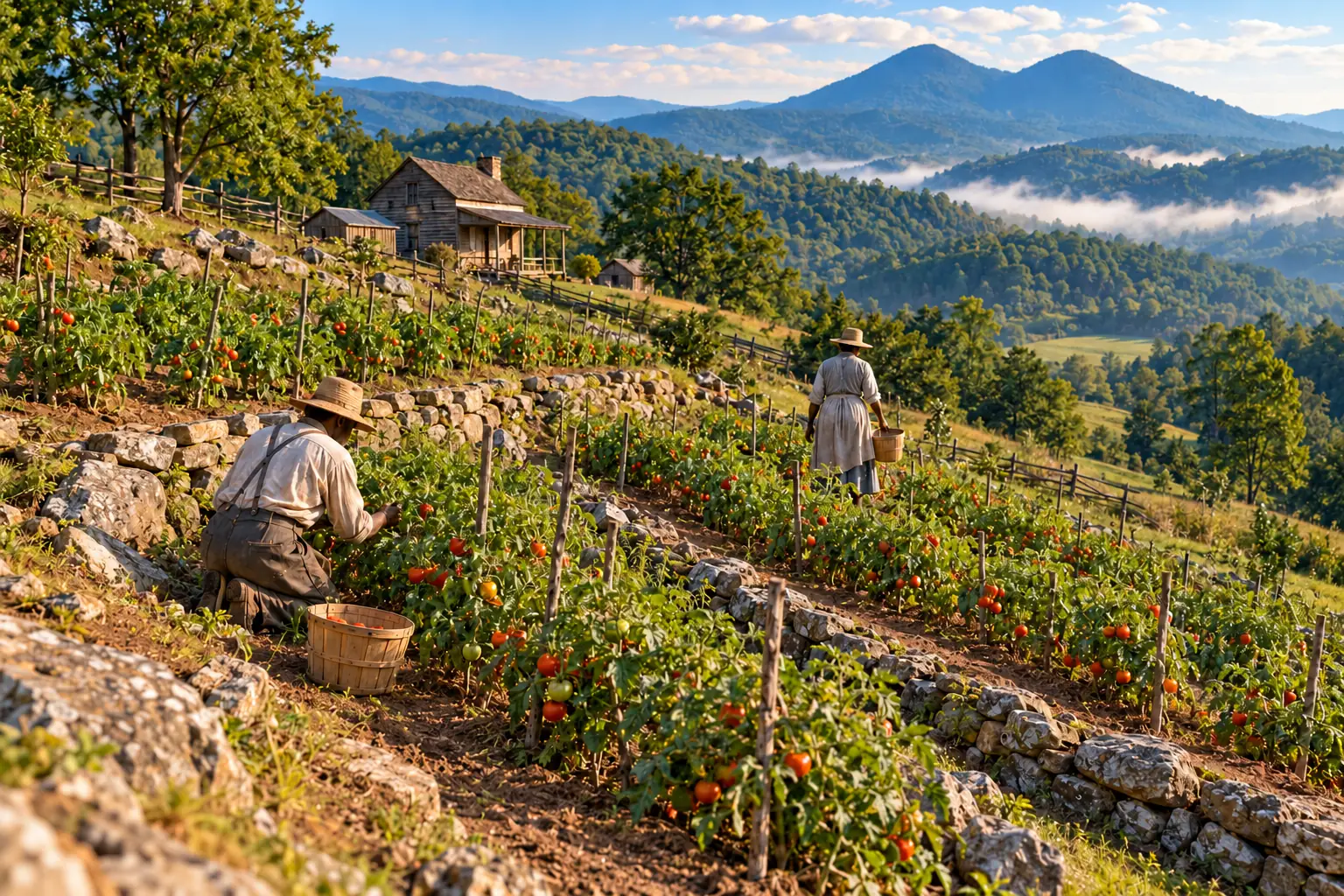
How did mountain farmers grow crops on land that could be steep, rocky, and covered with trees? In the 1800s and early 1900s, Appalachian families cleared workable patches, used fertile valley bottoms when they could, and planted corn, beans, potatoes, and other crops. They worked gardens by hand, plowed larger fields with animals, and sometimes carved terraces into hillsides. The methods depended on the land a family had, the weather, and the people available to do the work.
A Virginia family left an unusually clear example. On a rocky slope near the Peaks of Otter, the Saunders family grew tomatoes on sixteen terraces. The family grew much of its own food, while those tomatoes brought in a little cash for Christmas.
Sixteen Terraces on a Rocky Virginia Farm
In May 1912, George Saunders bought a 22-acre hillside farm from his parents, Edward and Mary, near the Peaks of Otter in Virginia. George and his wife, Bettie, raised nine children there. Much of the ground was rocky and sloping, which made ordinary fieldwork difficult.
The National Park Service records sixteen manmade terraces on the Saunders property. These flatter planting strips let the family raise tomatoes on a hillside. The Saunders sold the crop to a nearby cannery, and the proceeds became what the family called “Christmas money.” Even a small cash crop could make a difference in a household that grew much of its own food.
Katherine Saunders West, the youngest child, recalled life on the farm in a 2005 interview. She remembered preparing food with her mother, feeding animals, and playing with her brothers. Her memories do not tell us who built each terrace or how many tomatoes the family picked. They do show the people behind the work: this field belonged to a home full of daily chores, meals, and children.
The Saunders were an African American farming family. Their story matters because Appalachian farm history has often been told mainly through white settler households. The Park Service has acknowledged that Black families’ homes and histories along the Blue Ridge Parkway were sometimes overlooked or lost. The surviving records help tell a broader story of mountain farming.
Finding Enough Ground for a Field
The easiest place to grow crops was often the level ground along a creek or in a cove. Soil in some valley bottoms was deeper and easier to work than the thin ground on a steep ridge. That helps explain why farms and settlements gathered in places such as Cades Cove, Tennessee, and Cataloochee, North Carolina. But a valley was not automatically fertile, and not every family had access to its best land.
Farming in these mountains began long before European American settlement. Cherokee communities cultivated corn, beans, and squash on fertile river bottoms. Later settlement and the loss of Indigenous land changed who could farm those places. The fields that appear in pioneer stories were part of a much longer history.
A new household also needed to open space for planting. In the early 1820s, settlers in Cades Cove cleared land for fields and built homes and farm buildings. In other mountain areas, families cut trees or girdled them by removing bark around their trunks. They still had to work around stumps and stones. Clearing land took time, and the best planting ground was not always next to the house.
When flat ground ran short, some farmers used slopes. An archaeological study of Nicholson Hollow in Virginia found that residents cleared and terraced hillsides as the community grew. That is a second documented example of terracing, but it does not mean every Appalachian farm looked like the Saunders property. Many relied on small fields, narrow bottoms, and garden patches instead.
Water was another part of the decision. A usable field could still be a hard place to live if the household had no dependable spring, creek, or well. Our earlier story about how settlers found water in the mountains explores that problem in more detail.
What Crops Filled the Table
Corn was one of the most important crops. It could be ground into meal for the family, and field corn also helped feed farm animals. A National Park Service study of nineteenth-century farms around West Virginia’s New River Gorge lists beans and potatoes for household meals, along with oats, wheat, rye, buckwheat, sorghum, and hay. Many farms also kept kitchen gardens and fruit trees.
The mix changed by place and season. In the Smokies, spring gardens could include onions, turnips, mustard greens, potatoes, and cabbage. Some mountain households grew apples, and Cataloochee had residents who raised apples commercially. The Saunders grew tomatoes for sale. There was no single crop list followed by every mountain family.
These choices had practical reasons. Families needed food they could eat during the growing season, crops they could store or process for later, and sometimes a surplus they could trade or sell. Preserving harvests through winter was another challenge. The planting plan had to serve the whole household.
The Work Started Long Before Planting
A mountain farm’s growing season did not begin when the first seed went into the ground. According to the National Park Service, farmers in the nineteenth-century Smokies spent winter and early spring repairing tools, pruning fruit trees, clearing new ground, and hauling manure to enrich garden soil. Some plowed during winter; others waited until spring.
Most kitchen gardens were worked with shovels, hoes, and rakes. In larger fields, an animal could pull a plow or cultivator where the ground allowed it. On a steep or stony patch, handwork remained essential. Seeds did not grow into a harvest simply because a family had managed to plant them.
Weeds kept growing alongside the crops. Cornfields, for example, needed repeated hoeing around the young plants. Farmers in the Smokies spoke of corn being “laid by” once it had grown enough that the main round of cultivation was finished. The phrase marked a stage in fieldwork, not the end of the family’s chores.
Harvest brought another rush of work. At Cataloochee, corn husking and sorghum making were jobs that brought neighbors together. People shared labor, caught up on news, and made work that was too large for one household more manageable. The crops were planted on individual farms, but their harvest could be a community event.
Reading the Season and the Planting Signs
Farmers watched the weather closely because mountain springs could be deceptive. The National Park Service notes that frost could reach some Smoky Mountain valleys as late as May. Cold-tolerant crops might go into the ground earlier, while tender crops had to wait for warmer conditions. Elevation and the shape of a valley could change the risks from one farm to another.
People also watched signs in nature. Some waited for the first whip-poor-will call or for oak leaves to reach the size of a squirrel’s ear before planting corn. Almanacs and moon signs were part of planting traditions, too. The Park Service records beliefs about planting aboveground crops during a waxing moon and root crops during a waning moon.
Those details tell us what some farmers believed and how they marked the passing seasons. They should not be mistaken for proof that the moon or a zodiac sign caused a better crop. The hard questions still involved the soil, frost, moisture, and whether a family could get its work done in time.
When a Hillside Lost Its Good Soil
Rock and steep ground made planting difficult, but exposed soil created another problem. Heavy rain could wash loose earth downhill. Crop after crop could also leave a field less productive if nutrients were not replaced. A history of the Southern Appalachian landscape from the U.S. Forest Service describes erosion as a result of changing land use in the region.
Farm families had ways to respond, though their choices were limited by land, tools, and labor. The Park Service describes Smoky Mountain farmers carrying manure to their gardens. Early U.S. Department of Agriculture publications discussed worn-out soils and recommended restoring fertility with manure, legumes, and changes in how crops were grown. That does not tell us which advice any one Appalachian household followed.
Terraces were one possible answer to the problem of a difficult slope. At Saunders Farm, the documented result was sixteen workable places to grow tomatoes. We should not claim the family invented terracing or that all other hillside farms used it. Their terraces show how one household altered a stubborn piece of land to keep it productive.
Subsistence Did Not Mean Living Apart from Everyone
A subsistence farm grew much of the food its household used. That did not mean a family never bought anything, sold a crop, or needed neighbors. The Saunders family’s tomato sales are one clear example. Cataloochee’s apple growers are another.
Research in three Virginia mountain hollows also challenges the old picture of families cut off from the outside world. Archaeologists found evidence of purchased household goods, and historical records showed that some farmers produced crops beyond what their families needed. Conditions still differed sharply from one hollow to the next. A family’s chances depended on its land, access to roads and markets, and circumstances at home.
These records describe many kinds of mountain farms. Some families worked fertile bottoms, while others cleared narrow patches of steep ground. They used tools, experience, family labor, neighbors, and whatever trade opportunities they could reach. Hard work did not guarantee a good harvest.
What the Saunders Terraces Still Tell Us
In 1942, George and Bettie Saunders sold their farm to the federal government as the Blue Ridge Parkway was being developed, and the family moved to nearby Thaxton. The hillside they had worked was no longer their home. The Park Service’s records, including Katherine’s memories, keep part of that family’s story from disappearing.
The sixteen terraces answer a practical question about farming on slopes. They also leave us with a human one: what could a family accomplish with the ground it had, and what did that work cost in time and effort? For the Saunders, the answer included food for the household, tomatoes for a cannery, and a little Christmas money.
Does your family remember a hillside garden, a difficult corn patch, or a planting sign passed down from older relatives? We’d welcome the details through Redneckosity’s contact form. Family memories can point us toward more records and better questions.
Strong Backs. Red Necks. Deep Roots.

Explore more stories about mountain work, family, and survival in Appalachian Mountain Life.
Sources and Further Reading
- National Park Service — Saunders Family
- National Park Service — African American History on the Parkway
- National Park Service — History of Cades Cove
- National Park Service — History of Cataloochee
- National Park Service — Farmers Watched Nature to Guide Planting
- National Park Service — Tennessee and North Carolina Great Smoky Mountains
- National Park Service — Mountain Settlements
- National Park Service — New River Gorge Historic Context Study
- U.S. Forest Service — The Southern Appalachians: A History of the Landscape
- USDA National Agricultural Library — Historical Soil Productivity Publications