
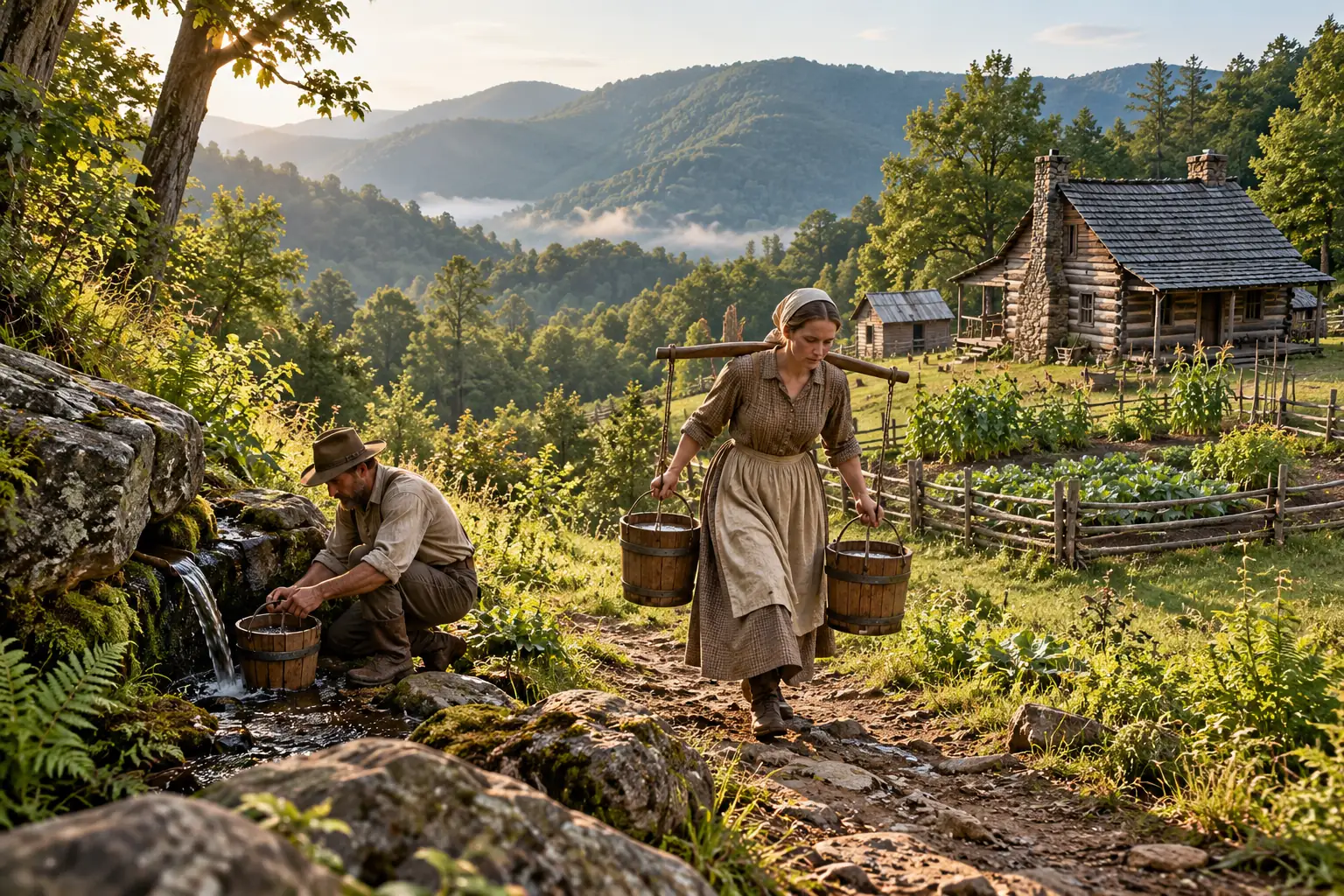
How did settlers find water in the Appalachian Mountains? They looked for creeks, hillside springs, and places where a well could reach groundwater. Finding water was only the beginning. A family also had to consider whether it would last through a dry summer, how far they would have to carry it, and whether the supply could support a working homestead.
Water could decide where a family built its home. It could also decide how much work that family faced every single day. The story of one early Cades Cove household shows why.
The Creek That Wasn’t Enough
In 1818, John and Lucretia Oliver arrived in Cades Cove, Tennessee, with their young daughter, Mary. According to the National Park Service, they chose the drier east end of a valley that was still heavily wooded. They began clearing fields, raising cattle, and establishing a home.
But a nearby creek had a problem: it often dried up during the summer. A well was dug to provide a more dependable water source. The National Park Service does not say exactly how the family chose the well site or how long the digging took, so we should not pretend to know. What the record does show is the problem they were trying to solve.
Imagine putting months of work into a cabin and fields, only to find that the convenient stream could not be counted on when the weather turned dry. For the Olivers, the answer was not simply to keep walking to the creek. Their water supply had to change.
Their experience also reminds us that mountain settlement was not a solo adventure on unoccupied land. Cherokee people were already living in Cades Cove. Lucretia later recalled that Cherokee neighbors helped the Oliver family survive its first winter by providing food. Knowledge, neighbors, and cooperation could matter as much as muscle.
Where Did Settlers Look for Water?
Mountain geography gave people useful clues. A stream might run along the bottom of a hollow. Water might seep from a hillside or flow from a spring. Low ground sometimes offered a better chance of reaching shallow groundwater than the crest of a ridge.
A spring forms where groundwater reaches the surface. The water may emerge as a small trickle or a strong flow. Modern U.S. Geological Survey explanations help us understand what people could observe on the land: the presence of a spring or seep showed that groundwater was nearby, though not how much usable water it would supply.
That distinction mattered. A creek could run strongly after a storm and shrink later. A hillside spring might flow year-round, or it might weaken when rainfall was scarce. Seeing water in the spring was not proof that the same amount would be there in late summer.
Families also had to think about the rest of the site. Water at the bottom of a steep slope was useful, but getting full buckets back to the house could be another job entirely. A place near water still needed enough workable ground for a home, paths, and the household’s daily needs.
Our earlier article on what a holler is in Appalachia explores how the shape of a mountain valley influenced where families could live.
Creeks, Springs, and Old-Fashioned Wells
These three sources solved related but different problems. Creeks made water visible and reachable. Springs brought groundwater naturally to the surface. Wells offered a way to reach water that could not be collected directly from a convenient stream or spring.
An old-fashioned well could be a labor-intensive answer. Before mechanized equipment became common, digging through soil and rock took planning, tools, and physical work. Water still had to be lifted or pumped and carried to where people needed it. The well did not erase the daily work; it moved the source to a more convenient spot.
A well also was not an unlimited guarantee. Water underground responds to rainfall, local geology, and seasonal changes. The U.S. Geological Survey documents that well levels can rise and fall, sometimes significantly during drought. That makes the Oliver family’s decision especially interesting: their well was a response to an unreliable creek, not a promise that every well would always be dependable.
And clear-looking water should not be confused with proven safe drinking water. Historic families relied on the sources they had, but modern science shows that visible springs and shallow groundwater are not automatically free of contamination. This is a story about historical decisions, not instructions for choosing drinking water today.
What Was a Springhouse Used For?
A springhouse was a small building placed over or beside a flowing spring. It protected access to the water and made use of the spring’s naturally cool surroundings. On some homesteads, that cool water also helped keep perishable foods from spoiling as quickly.
Elijah Oliver, a son of John and Lucretia, established his own Cades Cove farm after the Civil War. The National Park Service records that his homestead included a springhouse built over a trickling spring. The family used the water supply and its cooling effect to help preserve eggs, milk, and butter.
The Walker family in nearby Little Greenbrier Cove used a springhouse along a flowing creek, too. Their springhouse helped keep milk and butter cool, and it provided space for stored vegetables. These examples show the same resource serving two needs: access to water and a cooler place for some household supplies.
The springhouse was useful, but it did not turn the whole home into a refrigerator. We will look more closely at food storage in our separate article about how pioneers preserved food. Here, the important point is that a dependable spring could shape the buildings and work around a family’s home.
One Family Brought Spring Water Into the Yard
Not every household had to rely only on a bucket trip to the spring. At the Peter Cable and Dan Lawson homestead in Cades Cove, water was directed from a spring through the yard for domestic use.
That detail survives in a National Park Service cultural landscape report. It describes earthworks that once guided the flow into the yard and out again. The old springhouse is gone, and the water system was later covered, but traces of how the property was arranged still tell a story.
Think about what this meant. Rather than treating the spring as something separate from the home, the household used the slope of the ground to bring water closer to everyday activities. The surviving evidence does not tell us every task that water supported, and it would be wrong to invent one. But it shows that mountain families sometimes altered the land to make a difficult job more manageable.
Who Carried the Water Every Day?
It is easy to admire a springhouse or an old stone-lined well. It is harder to picture the repeated labor behind the water that finally reached the kitchen.
Water was needed for drinking, cooking, washing, cleaning, and animals. Before household plumbing, somebody had to bring much of it where it was needed and carry used water away. That work could fall to different members of a household, depending on age, health, circumstances, and how the family divided its chores.
A small glimpse survives in a 1915 letter from Evelyn K. Wells, who worked at Pine Mountain Settlement School in Kentucky. Writing about children living at the school’s Far House, she described their sweeping, dishwashing, and “packing” water from the spring. She added that they usually sang while working.
These were schoolchildren in 1915, not an example of every pioneer family in the 1800s. But the account makes an easily overlooked point. Water did not simply appear when someone needed to wash a plate or cook a meal. It arrived through someone’s time and effort, sometimes as part of a child’s daily chores.
Now picture what happened when the source was down a hill. A trip that felt easy with an empty bucket could become tiring on the way back. It is one reason the distance between water and home mattered so much.
What Happened When Water Ran Low?
A creek or spring that seemed generous during rainy weather could disappoint a family later. Groundwater levels respond to the balance between rainfall soaking into the earth and water leaving it. Some springs flow continuously; others become weak or disappear during dry periods.
That was not a minor inconvenience. Less nearby water could mean longer carrying trips, extra work for livestock, and difficult choices about where to spend the day’s labor. Families had to adapt to the sources their land actually provided, not the ones they wished they had.
The Oliver well is a documented example of that adjustment. It also reminds us to be cautious about sweeping claims. Some mountain households had ample springs. Others depended on creeks, dug wells, or arrangements that changed over time. There was no single system that worked for everyone.
Did Settlers Use Forked Sticks to Find Water?
You may have heard of “water witching,” also called dowsing. A dowser carries a forked stick or rod and claims that its movement reveals water underground. The practice has a long history and was used in rural communities, but the claims should not be confused with a reliable scientific method.
The U.S. Geological Survey has examined water dowsing and explains that apparent successes do not establish that a stick detects hidden water. Groundwater can be common beneath the surface in many regions, so a well may find water regardless of the dowser’s prediction.
It is a fascinating part of the history of looking for water. But we have no evidence that the Olivers used dowsing to select their well, and it would be misleading to add that detail to their story.
Could You Have Built a Home Around a Water Source?
Imagine standing on a wooded mountainside and trying to decide where your family should live. You find a creek. Does it keep flowing in August? You spot a spring. Can you reach it when the ground is muddy? If you dig a well, will it provide enough water? Even after those questions come the everyday trips with buckets, the washing, the cooking, and caring for animals.
The families in these records did more than “find water.” They observed the land, worked with what it offered, and sometimes changed their plans when the first solution did not hold up.
And if your own family has a story about a mountain spring, a hand-dug well, or the walk to fetch water, we would be interested in hearing it through Redneckosity’s contact form. The details people remember can give us new questions to investigate.
The next time you turn on a faucet, consider what that simple movement replaced for generations of mountain households. A strong back helped carry the bucket. Knowing where to find the water was its own kind of strength.
Strong Backs. Red Necks. Deep Roots.

Explore more stories about mountain work, family, and survival in Appalachian Mountain Life.
Sources and Further Reading
- National Park Service — John Oliver Place
- National Park Service — Elijah Oliver Place
- National Park Service — The Walker Sisters
- National Park Service — Peter Cable and Dan Lawson Homestead
- Pine Mountain Settlement School Collections — Evelyn K. Wells, 1915 Letters Home
- U.S. Geological Survey — How Do Hydrologists Locate Groundwater?
- U.S. Geological Survey — Springs and the Water Cycle
- U.S. Geological Survey — Why Do Water Levels in Wells Rise and Fall?
- U.S. Geological Survey — Water Dowsing