
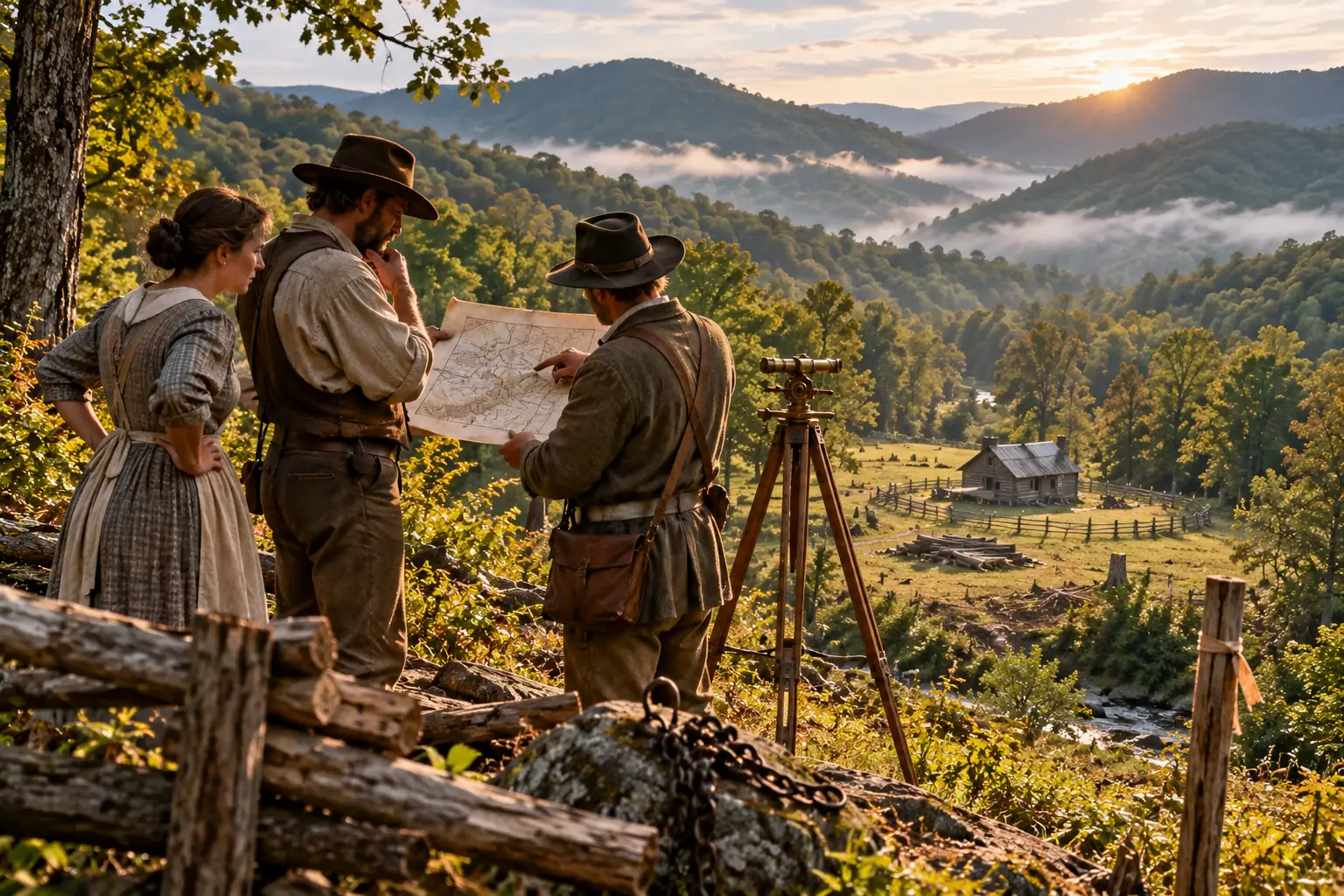
How did Appalachian settlers get land? In the 1700s and 1800s, some people received government land grants, bought property from other owners, inherited family land, or rented farms. Others settled before they had clear legal ownership. The answer depended on where they lived, when they arrived, and what they could afford.
Finding a patch of ground where a family could grow food was only the first challenge. Getting the legal right to keep that ground could be another story entirely.
The Mountains Were Not Empty Land
Long before European-American settlers arrived, Cherokee and other Indigenous communities lived, farmed, hunted, and traveled throughout the Appalachian region. The Cherokee had deep ties to the Great Smoky Mountains, including places later settled by newcomers.
As colonial and state governments claimed more territory, treaties and forced land cessions reduced Indigenous control of those homelands. Families could receive papers saying they owned a tract even though the land had a much longer history. That is an important part of understanding how settlement happened.
How Did Government Land Grants Work?
One route was a land grant. This was an official transfer of land into private ownership, sometimes called a patent. It was not always a free gift. Depending on the law, a person might have to pay for the acreage, cover fees, or qualify because of military service.
For example, North Carolina controlled much of the territory that later became Tennessee. Under one North Carolina system established in 1777, a claimant had to go through several steps:
- Enter a claim for a tract of land and pay the required fees.
- Obtain a warrant so a surveyor could mark and describe the boundaries.
- Receive an official grant or patent after the claim was processed.
- Record the grant so there was a public record of the claim.
That could take months or even years. Overlapping claims sometimes led to court battles. In other places, including Virginia, the names and rules for land papers changed over time. There was no single process that every Appalachian family followed.
Nor was access equal. North Carolina’s 1777 land law, for instance, named free adult men who swore allegiance to the state as eligible purchasers. A family’s legal choices depended partly on the rules and power structures of its time.
Many Families Bought Land From Other Owners
Once the best-known tracts were claimed, a newcomer might buy land instead of seeking a new government grant. People with money could acquire large areas and sell smaller farms to families who wanted to live there. Some owners held land for years without building a home on it.
Land also passed through families. A child might inherit property, or relatives might arrange a purchase nearby. But a family connection did not erase the need to settle ownership questions or keep records. Buying a hillside was one thing; turning it into a working farm was another.
What If a Family Did Not Own the Land?
Not every mountain household had a deed. Some rented land as tenant farmers. Some worked property held by relatives. Others occupied land before the ownership papers were settled, or lived there without legal permission.
The National Park Service describes all these arrangements in its history of Shenandoah mountain communities: grants, purchases, inheritance, renting, and living on land without clear title. That last situation could leave a family in a difficult position. Building a cabin and planting fields did not automatically make the land theirs under the law.
This is one reason the picture of every mountain family owning its own isolated homestead misses so much of the story. Neighbors could live close together yet have very different rights to the land beneath their homes.
The Cades Cove Story: Settlers and Landowners Were Not Always the Same People
In 1818, John and Lucretia Oliver arrived in Cades Cove, Tennessee, with their young daughter, Mary. The National Park Service identifies them as the first permanent European-American settlers there, but the Cherokee had lived in the area for thousands of years and were still present.
According to Lucretia Oliver’s recollection, Cherokee neighbors supplied food that helped the family survive its first winter. The Olivers chose the drier east end of the cove, cleared fields, dug a well, and made a home. Their story shows how much work could begin before a place looked anything like a settled farm.
Meanwhile, William “Fighting Billy” Tipton obtained a Tennessee land grant for 640 acres in Cades Cove during the 1820s. He never made his home in the cove. Instead, he acquired more land and sold parcels to friends and relatives. Some people lived and worked in the valley; others held the papers that let them sell pieces of it.
The contrast tells us something important: moving onto land, improving it, and legally owning it were three different things. And all of this unfolded during a period when Cherokee land was being taken through treaties and government expansion.
Was This the Same as the Homestead Act?
No. The federal Homestead Act was signed in 1862 and applied to qualifying federal public land, largely farther west. It allowed eligible applicants to gain title after meeting rules for living on and improving the land.
North Carolina and Tennessee were not part of that federal public-land system. Their older land histories involved colonial or state grants and private transactions. So the popular image of a pioneer getting 160 free acres under the Homestead Act does not explain how most early families acquired land in the southern Appalachian mountains.
Can You Find Out How Your Own Family Got Land?
Sometimes you can. State land-grant books, county deed records, surveys, and wills can reveal who held title, when the land changed hands, and which creek or ridge marked its boundaries. North Carolina, Tennessee, and Virginia all have historical land records that researchers can use.
There is a catch: a grant names a legal claimant, not necessarily every person who lived or worked on the property. Tenants, relatives, and people without formal title may be harder to trace. The paperwork can help uncover a family story, but it rarely tells the whole story by itself.
Could You Have Made a Claim in the Mountains?
Imagine finding ground that looked promising for a home. You would still need to learn who claimed it, whether you could legally obtain it, how much it would cost, and whether the boundaries were disputed. Then came the hard work of building a life there.
That took more than a strong back. It took money or opportunity, a knowledge of the land, help from other people, and sometimes a great deal of luck. When we look at who settled the Appalachians, we should remember both the determination of the families who built homes and the people whose land was taken in the process.
The next time you see an old mountain cabin, remember: the story began before the first log was cut. Someone first had to figure out whether that patch of ground could become home.
Strong Backs. Red Necks. Deep Roots.

Explore more stories about mountain work, family, and survival in Appalachian Mountain Life.
Sources and Further Reading
- National Park Service — Mapping Our Past (Shenandoah)
- State Library of North Carolina — Land Grants, 1775–1796
- Tennessee Encyclopedia — Land Grants
- National Park Service — John Oliver Place (Cades Cove)
- National Park Service — Tipton Place (Cades Cove)
- National Park Service — Cherokee Relations Before Removal
- National Archives — The Homestead Act of 1862
- National Archives — Guide to Historical Land Records
- Library of Virginia — Virginia Land Patents and Grants