
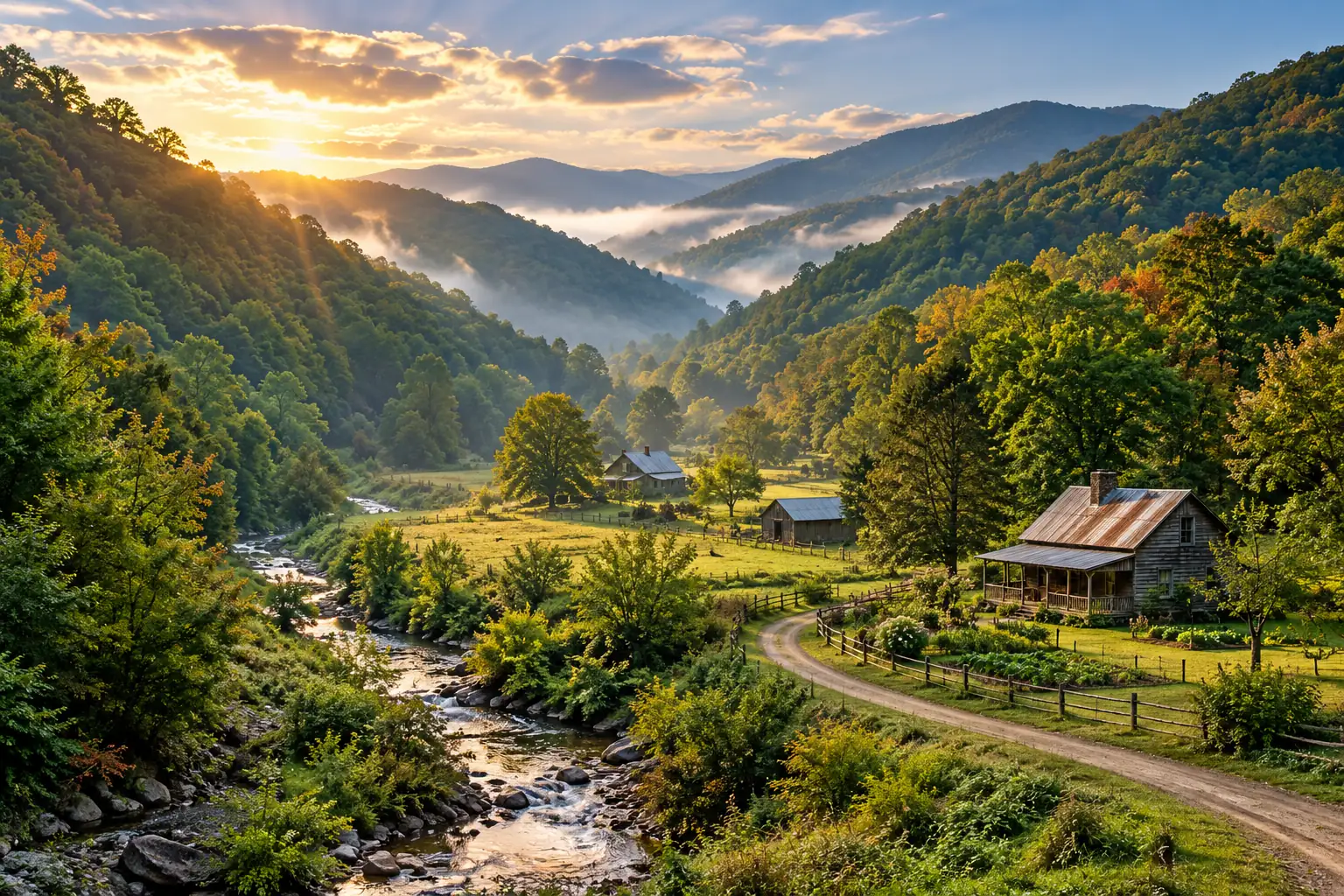
What is a holler in Appalachia? It is a small, sheltered valley between hills or mountain ridges. A holler often has a creek or stream, but it does not need one. For the people who live there, a holler can mean something more personal: a home, a neighborhood, and a place tied to family history.
Picture a narrow patch of land with wooded slopes rising on either side. A road or path may follow the valley floor, passing homes and fields along the way. That is one way a mountain holler can look. But no two hollers, or the communities within them, are exactly alike.
How Did a Hollow Become a Holler?
A holler is not named for someone shouting across the mountains. In Appalachian and other Upper Southern speech, “holler” is a regional pronunciation of “hollow.” The two words can name the same kind of place.
The University of South Carolina’s Dictionary of Southern Appalachian English describes a hollow as a small, sheltered valley that may have a stream running through it. The American Heritage Dictionary also records “holler” as a regional form of “hollow.” What sounds unusual to an outsider is ordinary place-name language to many people who grew up with it.
A holler can have a name of its own, just as a road or town does. It can also be a way to explain where a family lives: up one hollow, across a ridge, or down by a creek. The word tells you about both the land and how people describe their home.
What Does a Mountain Holler Look Like?
Imagine standing where two ridges slope toward each other. The low ground between them forms a hollow. Some are narrow and steep, while others open into wider areas with room for homes, gardens, or a small farm. A branch or creek often follows the bottom.
A holler is not quite the same thing as a broad river valley. You may also hear the word “cove.” A cove generally describes a sheltered valley enclosed by ridges, often with a more level floor and one main drainage outlet. The terms can overlap in local speech. In some Appalachian communities, a place called a cove elsewhere might be called a hollow or holler.
That difference matters when we talk about historic places such as Cades Cove in Tennessee. It is a mountain valley with a well-documented farming history, but that doesn’t mean every holler offered the same amount of level, fertile ground.
Why Did Families Settle in Hollers?
For families trying to build a life in the mountains, the landscape shaped almost every decision. They needed somewhere to put a home, access to water, ground they could use for crops, and ways to reach other people or trade what they produced.
The National Park Service notes that the valleys between ridges in the Cumberland Gap area were often more fertile and easier to farm than the higher ground. Families also made use of nearby forests and raised animals for food and other needs. In a mountain hollow, even a modest stretch of workable bottomland could matter.
But a holler came with trade-offs. Steep slopes left less room for fields. Roads could be difficult to build and maintain. The same ridges that marked a community’s home could make travel and hauling supplies harder. A good site was not simply a pretty view; it had to support daily life.
And these valleys were not empty places waiting for settlers to discover them. Indigenous peoples lived throughout the Appalachian region long before later European-American communities developed. Land access, ownership, and dispossession are part of the history, not details to skip.
Were Mountain Hollers Cut Off From the World?
Some hollers were hard to reach, but “isolated” does not tell the whole story. A place could have farms and woods while still being connected to outside markets, roads, stores, and jobs.
That is more than a modern guess. Archaeologists studying three mountain hollows in what is now Shenandoah National Park found evidence that residents bought manufactured goods and took part in the wider economy. Their finds included household items, shoes, and even pieces of phonograph records.
The National Park Service concluded that the people living in those hollows had different ways of making a living. No hollow farm in the study was entirely self-sufficient. That is a far cry from the old picture of every mountain family living alone and never seeing the outside world.
Three Hollers, Three Different Ways of Life
The Shenandoah research gives us three good examples of why one description never fits every mountain community:
- Weakley Hollow, Virginia: A road helped connect residents to other places. Over time, the hollow had mills, stores, churches, a school, and a post office. This was a working community, not just scattered cabins.
- Nicholson Hollow, Virginia: Fertile land along the Hughes River supported farming. Residents cleared and terraced some slopes, and records show that some farms produced enough surplus to sell.
- Corbin Hollow, Virginia: Rocky ground made farming more difficult. Some families earned money through work and craft sales tied to the nearby Skyland resort. When the Great Depression arrived, that dependence on wages created serious problems.
These communities shared mountain geography, but their daily lives were not the same. Land, road access, family circumstances, and job opportunities all mattered. Some households had more resources than others, and the history also includes unequal rights and opportunities.
What Did a Holler Mean to the People Who Lived There?
A holler was a landform, but it could also be a close-knit place where families recognized the same hills, roads, creeks, and neighbors. People knew which path led to which home and where a name on the map came from.
Family and community connections mattered, especially when work or hardship made cooperation necessary. Yet that did not mean every neighbor got along or every family had the same chances. Real communities are more interesting—and more complicated—than the picture of a perfect mountain neighborhood.
The names of mountain hollows still preserve traces of their history. They can recall a family, a local landmark, a workplace, or a story that mattered to people living there. A small valley can carry a surprising amount of memory.
Could You Have Built a Life in a Holler?
Imagine having to judge a piece of mountain land without modern conveniences. Where would your family get water? Which ground could grow food? How would you move supplies, earn money, and get help when you needed it?
Those are the kinds of choices that shaped life in many Appalachian hollers. The people who lived there were not all the same, and they did not all succeed in the same way. But their stories show how much knowledge, work, adaptation, and community could matter.
The next time someone says they grew up “up the holler,” think of more than a narrow road between two ridges. Think of the families who made that place a home.
Strong Backs. Red Necks. Deep Roots.

Explore more stories about mountain work, family, and survival in Appalachian Mountain Life.
Sources and Further Reading
- University of South Carolina — “hollow,” Dictionary of Southern Appalachian English
- University of South Carolina — “cove,” Dictionary of Southern Appalachian English
- American Heritage Dictionary — “holler”
- National Park Service — Mountain Settlements (Shenandoah)
- National Park Service — Life in Appalachia (Cumberland Gap)
- National Park Service — History of Cades Cove
- PBS — Smoky Mountain Speech