
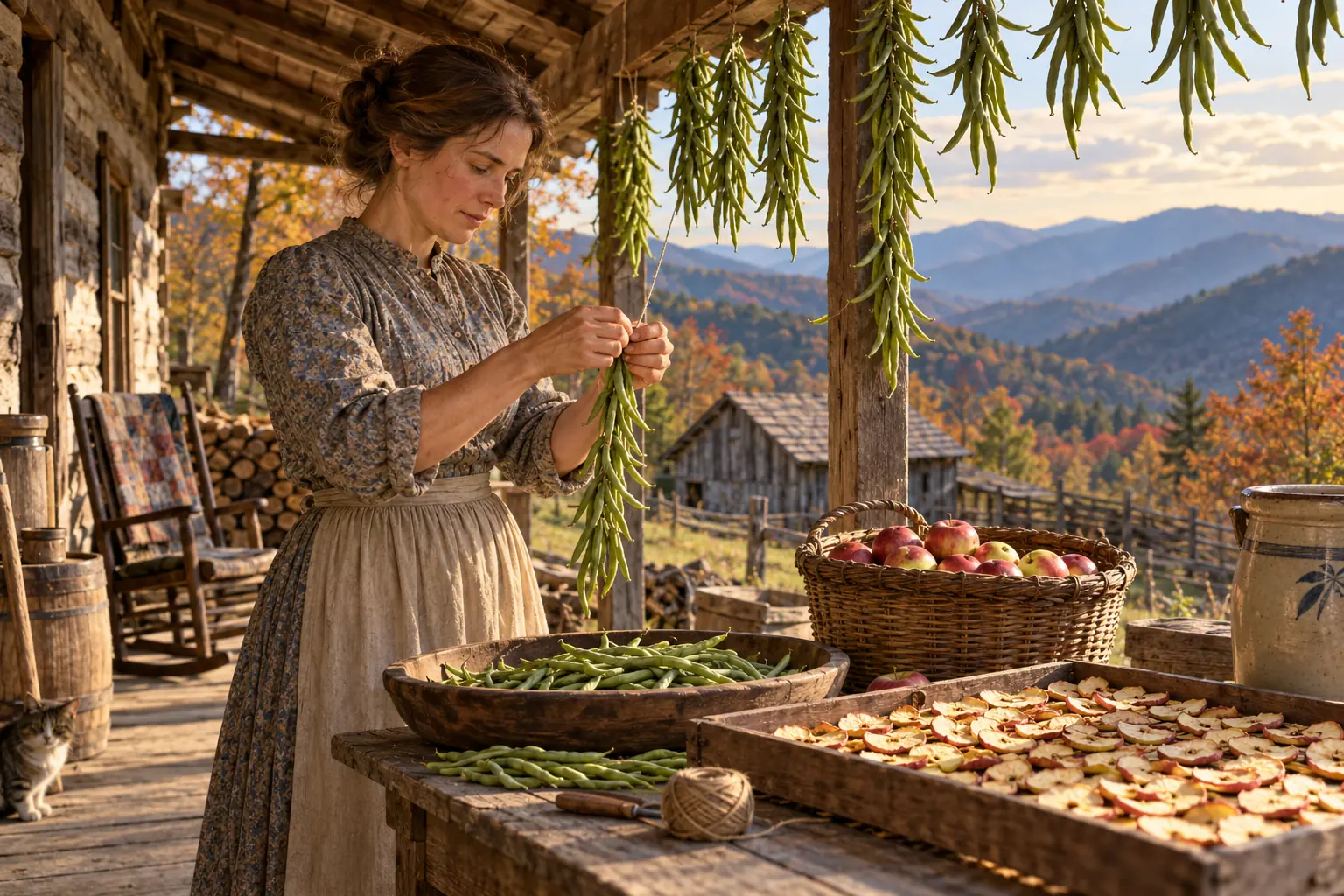
How did pioneers preserve food in the Appalachian Mountains before electric refrigerators? They dried beans and fruit, cured meat with salt, sometimes added smoke, pickled vegetables, and kept certain foods cool in cellars or springhouses. Later, home canning gave families another choice. No single method kept everything fresh. Families used several methods together to make a harvest last beyond the growing season.
The real work was not simply putting food on a shelf. It meant deciding what to save, when to prepare it, and how much a household could spare. Surviving accounts from the Smoky Mountains and the Blue Ridge show how much skill and labor went into what people called ‘putting food by.’ They also show why one mountain family’s pantry could look quite different from another’s.
Why Saving Food Was a Yearlong Concern
A garden could be productive in summer and nearly empty in winter—fruit ripened in its season. Hogs had to be raised before they could supply pork. Without dependable refrigeration, fresh food had a limited life, and a trip to a store did not guarantee that money, supplies, or a passable road would be available.
The National Park Service describes mid-1800s winter meals in the Smokies that could include cornbread, salt pork, dried green beans, pickled vegetables, potatoes, chestnuts, butter, and preserved apples. That list depended on a good crop, productive livestock, and successful preservation. It was not a promise that every family ate well every winter.
Different foods called for different treatment. Drying helped keep fruit and beans. Salt was central to preserving pork. Cool storage worked for some apples and root vegetables, while a springhouse offered temporary cooling for dairy foods. These choices were part of the farm calendar, shaped by weather, buildings, access to supplies, and the number of hands available to help.
Drying Beans and Fruit Made Summer Food Last
Drying was one of the oldest and most useful methods because it did not require expensive equipment. Removing moisture made many foods less likely to spoil quickly. Mountain households dried green beans, apples, peaches, corn, pumpkin, and other produce. Sun and air were useful when the weather cooperated; indoor heat was sometimes used when it did not.
One memorable example was the dried bean known as a ‘leather britches’ bean. Green beans could be strung together and hung to dry until their pods became wrinkled and leathery. The name describes their appearance. In different families and communities, similar dried beans were also called shuck beans. Both names connect a simple food to a way of saving it.
The Archives of Appalachia at East Tennessee State University preserves a recording of Clara Crisp, who was 65 when she spoke with folklorist Joseph Sargent Hall in the late 1950s or early 1960s. Crisp remembered her grandmother hanging beans on a string near the porch or fireplace. Crisp, herself, preferred drying them in the sun. She also recalled that her grandmother dried pumpkin, a practice Crisp did not continue.
That small difference between two generations tells us more than a tidy list of pioneer techniques. The knowledge was handed down, but people adapted it. Crisp’s account does not prove that every Appalachian family dried beans in the same way. It shows how a named woman remembered a family practice and made her own choices within it.
Apples Could Be Eaten, Stored, Dried, or Sold
Apples were especially useful in parts of the southern mountains. Some varieties kept for months under suitable storage conditions. Others were better for cooking, cider, or drying. Families made applesauce and apple butter, and some used cider to produce vinegar. A household with an orchard had more than one way to use the fruit before it spoiled.
The Park Service’s history of mountain orchards offers an eye-opening detail: a bushel of fresh apples weighing about 50 pounds could produce roughly 7 pounds of dried apples. Drying therefore did more than supply winter meals. It made some of the harvest easier to carry to market. A lighter load mattered where families had to move goods over difficult roads.
The same Park Service account describes apples dried in the sun or near a fire or stove. Some families also used sulfur fumes, a practice known as bleaching or sulfuring. The fruit they saved might be used months later for dishes such as fried pies and stack cakes. A familiar dessert could begin with work done long before anyone lit the cooking fire.
Apple butter illustrates another change over time. Before home canning became common, some families stored it in crocks in a cool place. Later, jars offered a different way to put up fruit. The old methods did not disappear everywhere at once, just as a good keeping apple did not need to be handled in the same way as one grown for cider.
Salt Was the Heart of Preserving Pork
For many farm families in the Smokies, pork was a major source of meat. The National Park Service’s account of hog raising explains that families often planned butchering for colder weather. The lower temperatures helped protect the meat while it was being prepared for preservation. That made autumn work directly connected to the winter table.
A smokehouse was important, but its name can mislead modern readers. In the historic Smokies, salt did much of the work of curing pork; smoke was sometimes added for flavor and extra protection. Pieces of meat might spend a long period in a meat house while they cured. Families used different combinations of salting, storing, and smoking, rather than one universal procedure.
The process also required organization. The animal had to be raised or bought, the right weather awaited, meat divided among immediate meals and later use, and supplies gathered. Salt itself mattered so much that the Walker sisters of Little Greenbrier named it among the things their land did not provide. Being resourceful did not mean a household produced every necessity alone.
A smokehouse was therefore more than a picturesque building beside a log cabin. It represented a family investment in food, materials, time, and work. It also carried risk: a mistake in preservation could mean spoiled meat or illness.
What Were Root Cellars and Springhouses Used For?
A root cellar and a springhouse solved different storage problems. A root cellar used the earth’s relatively steady, cooler temperatures to help keep certain crops, including some vegetables and fruit. A springhouse used the cooling effect of flowing spring or creek water. It could hold milk, butter, and other foods that needed a cooler place for a shorter time.
The buildings were real parts of Appalachian farms, not just objects in old photographs. At the Brinegar farm along today’s Blue Ridge Parkway in North Carolina, the National Park Service identifies both a granary/root cellar and a springhouse. Martin and Caroline Brinegar also managed gardens, an orchard, livestock, and other work on their farm. The site shows how growing food and keeping it were connected through the layout of a working homestead.
The Walker family’s property in Little Greenbrier Cove, Tennessee, offers another clear example. The Park Service records a springhouse by a flowing creek that helped cool milk and butter and hold pickled root vegetables. The family also had an apple barn, corncrib, and smokehouse. Each space served a purpose. It would be misleading to imagine one cold room that safely kept every kind of food for a whole winter.
Cool storage didn’t stop spoilage altogether. A household still needed to watch what it had put away and use foods before they went bad. The limits of a springhouse are one reason preservation depended on several methods, not simply on having fresh water nearby.
Pickling and Fermenting Kept More Than Cucumbers
Families also preserved vegetables by making them sour. Some foods were put up with vinegar; others changed through fermentation. Both involved acids, but they were not exactly the same process. Historic accounts mention pickled vegetables and fermented beans along with other stored foods. What a family called a pickle could depend on the food and local custom.
Apples link this method to the orchard. The Park Service explains that cider could turn into hard cider and eventually vinegar. Vinegar had uses beyond the cup or cooking pot, including food preservation. Meanwhile, the Archives of Appalachia documents the place of pickling and fermenting among many methods used in mountain households.
When Did Families Start Using Canning Jars?
Canning belongs in this story, but it helps to keep the dates straight. People were drying, salting, pickling, and storing food long before a Mason jar appeared. The U.S. Department of Agriculture’s National Agricultural Library dates John L. Mason’s glass jar patent to 1858. The Ball company began making home-canning jars in 1884. New containers expanded what families could preserve, but a patent did not place affordable jars in every mountain kitchen overnight.
Home canning became increasingly visible in the late 1800s and early 1900s, and it grew considerably across the nation during the world wars. The National Agricultural Library’s history also shows that knowledge of safe processing changed. By 1917, the USDA had identified pressure canning as necessary for low-acid foods. A sealed jar was not automatically a safe jar.
Family memories show how large the work could become in later generations. In the Archives of Appalachia exhibit, Danny Ray Cable of Carter County, Tennessee, remembered his mother putting up what he described as hundreds of containers of food. That is his recollection, not a measured total for all mountain households. Still, it makes the scale of family food storage easier to grasp.
Canning added work and tools rather than erasing every older method. Dried beans, salt meat, cellar storage, and jars could share a household’s routine. The Library of Congress’s Blue Ridge Parkway Folklife Project documented canning and drying among the traditions people still practiced in the Virginia–North Carolina border area in 1978. Old and new methods lived alongside one another.
Who Did All the Work of Putting Food By?
A full pantry could make household labor nearly invisible. Someone had to grow or gather the food, haul it home, prepare it, dry or cure it, watch it, store it, and use it wisely. Children helped with harvests in some families. Adults divided work according to their skills, circumstances, and the demands of the farm. In many households, women carried much of the day-to-day preservation work, but no single division of labor describes every community.
The Walker sisters are a documented example of sustained home and farm work. After inheriting their family’s Little Greenbrier property, the unmarried sisters kept gardens and livestock, maintained buildings, and supplied much of their own food. Their smokehouse and springhouse explain how that labor turned a farm’s produce into meals across seasons. Their full family history deserves its own telling; here the buildings and food are the evidence.
Access mattered, too. A family with land, an orchard, livestock, storage buildings, and help had different options from one with little ground or cash. Some bought or traded for staples they could not raise. Some had to rely more heavily on wages, neighbors, or stores. Calling everyone in Appalachia ‘self-sufficient’ hides those differences. Saving food was a skill, but it was also shaped by opportunity and circumstance.
What Might a Mountain Family Eat in Winter?
A meal made from preserved food might include cornbread, a pot of dried beans, potatoes, salt pork, and something pickled. Dried or stored apples could add another flavor later in the season. The Park Service’s list of mid-1800s Smoky Mountain winter foods also includes butter, chestnuts, honey, and sorghum molasses. Much depended on what a particular household had put away.
Not all of that food had been preserved in the same sense. Corn kept dry in a crib, a cured piece of pork, apples in storage, and pickled vegetables each followed a different path to the table. Some families could add fresh or purchased foods when the weather and their means allowed it. Others faced lean months when a harvest failed, or supplies ran short.
That is why food preservation belongs in the larger history of Appalachian mountain life. A bean hung to dry could become a winter meal. A smoked ham might represent months of feeding an animal and days of family labor. A jar or cellar was not just a container. It held part of the household’s plan for getting through the seasons.
Keeping food on hand was only one part of how mountain families survived winter.
The Old Methods Left More Than Recipes
Clara Crisp’s memory of her grandmother’s hanging beans is valuable because it gives us two people, two ways of doing the same job, and a clear line of family knowledge. The surviving farm buildings at Little Greenbrier and the Brinegar place add another kind of record. Government and university archives preserve still more voices and photographs. Together, they show that food preservation was an evolving set of skills learned, shared, adapted, and sometimes replaced.
Historical practices are not a substitute for current preservation guidance. The National Center for Home Food Preservation warns that old recipes and methods, especially for canning, may be unsafe. Anyone preserving food today should use current, tested instructions rather than copy a description from a pioneer kitchen.
If your family used the names ‘leather britches’ or ‘shuck beans,’ kept an apple house, or remembers the work of filling jars, we’d enjoy hearing the story through Redneckosity’s contact form. A family name, community, or approximate decade can help place a memory in context. Those details give us a starting point to investigate, not a reason to treat every recollection as an established fact.
Strong Backs. Red Necks. Deep Roots.

Explore more stories about mountain work, family, and survival in Appalachian Mountain Life.
Sources and Further Reading
- National Park Service — Gettin’ By in Winter
- National Park Service — Mountain Orchards
- National Park Service — Pigs Were Farmers’ Best Friends
- National Park Service — The Walker Sisters
- National Park Service — Brinegar Cabin
- East Tennessee State University Archives of Appalachia — Methods of Preservation: Drying
- USDA National Agricultural Library — How Did We Can?
- USDA National Agricultural Library — Canning Timeline
- University of Kentucky — Heirloom Beans in Southern Appalachia
- Library of Congress — Blue Ridge Parkway Folklife Project
- National Center for Home Food Preservation — General Canning FAQs