How did pioneers survive winter in the Appalachian Mountains? They kept a fire going when they could, worked to make log homes less drafty, used wool clothing and quilts for warmth, and kept up the farm chores that could not wait for spring. Food saved during the growing season helped, but survival also depended on firewood, a sound roof, healthy animals, and sometimes the help of other people. There was no single winter routine that fit every mountain household.
A cabin in a sheltered cove and one higher on a mountain could face different weather. So could families with different amounts of land, money, help, and time to prepare. The records that survive from the Great Smoky Mountains offer a close view of how some nineteenth- and early-twentieth-century families managed the cold. Their stories make clear that winter was not just something to endure indoors. It was a season of work and hard choices.
Winter Was Different From One Home to the Next
In the mid-1800s, a typical log home in the Smokies was about 18 by 20 feet, according to the National Park Service. It might have a sleeping loft. More than one generation could share that space, sometimes in a large family. On cold, wet days, everybody’s work, rest, and noise had to fit into a few rooms—or just one.
One woman left a vivid account of that confinement. Dorie Woodruff Cope grew up in the Smokies after her birth in 1899. In a life story recorded by her daughter, Florence Cope Bush, she remembered snow that kept adding to the snow already on the ground. Wind came down the chimney, sent the fire outward, and scattered ashes while her mother had beans and meat cooking. The Park Service preserves an excerpt from that account in its history of winter life.
That is a memory of an early-twentieth-century childhood, not an eyewitness report from an 1850 cabin. It is still useful. It puts a person beside the fire and reminds us that a hearth could bring heat, food, smoke, and trouble into the same small room. A cabin could be a refuge from the weather without feeling comfortable.
The word ‘pioneers’ also has limits. Cherokee people lived in these mountains long before white settler farms were built, and Appalachian communities were never one uniform group. The examples here mainly concern the settler farm households documented in the southern Smokies. They cannot stand in for every family or every part of Appalachia.
How Did People Keep Warm in Log Cabins?
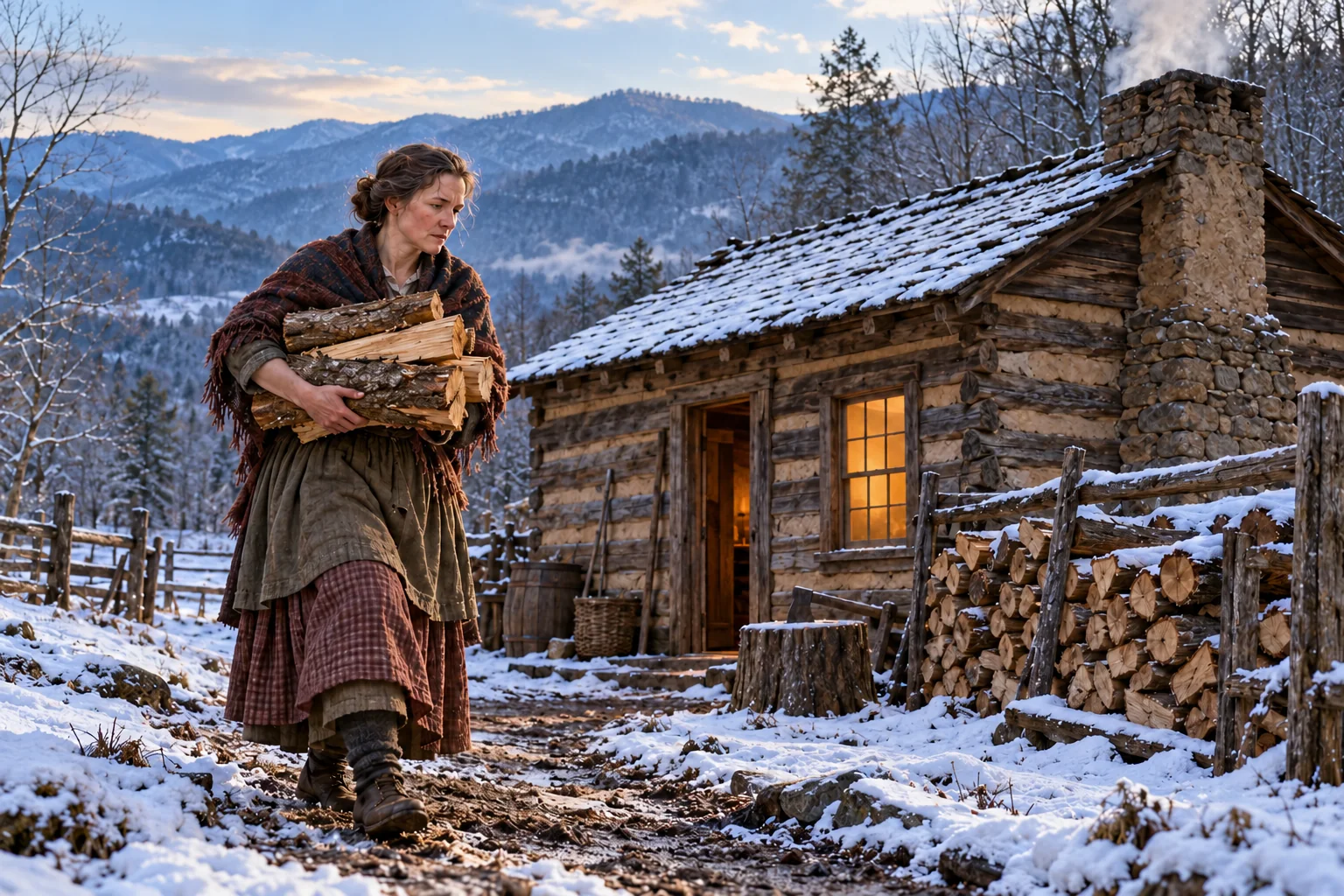
The answer began with a working fireplace or, in some later homes, another form of wood-burning heat. The same fire that helped warm a room might also cook a meal. But a flame could not be left to tend itself. Someone had to gather or cut fuel, move it near the house, and feed the fire when needed. A family’s access to nearby woods made a difference.
A surviving cabin shows the materials involved. The John Ownby Cabin, built in the Sugarlands area in the 1860s, has hand-hewn white pine and tulip-poplar walls, a roof of split-oak shingles, and a chimney made from stone and clay mortar. Those are not decorative details. The roof kept weather above the family, the walls stood between people and the wind, and the chimney carried the fire’s smoke away. The National Park Service documents those features at the site.
The fire still had limits. Heat near a hearth did not mean every corner of a cabin felt warm. Smoke, blowing ash, and drafts were possible, as Dorie’s memory shows. The family also had to protect bedding, clothing, and the building itself from sparks. Warmth came with work and watchfulness; a fireplace was not the same as turning up a thermostat.
Firewood linked a winter evening to labor done outside. If someone could not safely reach a woodpile, or the household ran short of dry fuel, the difficulty moved straight indoors. The Walker sisters’ later history gives a measure of how important forest access was: after the creation of Great Smoky Mountains National Park, cutting wood on park land became restricted, along with other long-used practices. That later change should not be projected backward onto every pioneer family, but it shows why access to fuel mattered.
The Two Cabins That Tell Matilda Shields’s Story
At the Whitehead Place in Cades Cove, two connected log buildings tell a story about winter shelter without anyone having to guess what the family felt on a particular night. The first was put up in a hurry in 1881. Matilda Shields had come to visit relatives with her young son when her husband abandoned them. Her brothers built a rough, one-room cabin for her out of necessity, according to the National Park Service.
Matilda later married Henry Whitehead, a widower with three young daughters, in 1887. Between 1895 and 1898, Henry built the larger house that stands in front of the earlier cabin. It was made from logs cut square at a sawmill. Unlike the rough hand-hewn logs of the first building, these were more even and fit together closely.
In the first cabin, irregular spaces between logs needed mud or clay chinking. The later sawn-log house needed very little of that filling and was better insulated, the Park Service explains. The contrast is plain: two homes on the same property, built within a couple of decades, offered different protection from drafts.
The record does not tell us how Matilda felt on a winter night. It does show a family emergency, relatives who supplied shelter, a remarriage, and a stronger house built later. Winter survival depended partly on whether someone had a building that could hold heat—and the people and resources to improve it.
Clothing and Quilts Were Part of the Heating Plan
Clothing mattered because the whole house could not be counted on to stay equally warm. Families used what they could make, buy, repair, or hand down. Wool had an important place where households kept sheep, though not every farm had its own flock or loom. Layering and repairing clothes made practical sense when new fabric cost money or required a long trip to obtain.
The Walker family in Little Greenbrier Cove gives one documented example. The Park Service records that the Walker daughters washed, carded, and spun wool from the family’s sheep. They wove yarn into cloth, including linsey-woolsey, a blend used for their clothing. Growing flax and cotton supplied other fibers. This work called for tools, time, and skilled hands; it was not simply a matter of pulling a warm coat from a closet.
Quilts helped make beds warmer and put worn cloth to use again. The Park Service describes mountain quilts made with tops from scraps, old clothing, or sacks, and middle layers filled with pieces of used fabric, old quilts, feed sacks, or sheep’s wool. It also preserves a photograph of Caroline Walker Shelton standing with her children in front of a quilt she made.
The story continued well beyond the period usually called pioneer life. In interviews for the Library of Congress’s 1978 Blue Ridge Parkway Folklife Project, Maggie Shockley remembered learning to quilt from her mother, who gave her paper patterns and small cloth scraps to practice with. Other interviewees described quilting during the quieter winter months; some worked alone, while others recalled shared work around a frame.
Those 1978 interviews are evidence of later memories and living traditions, not proof that every family followed the same custom a century earlier. They help us see how winter sewing could meet more than one need: a warmer bed, useful work for the hands, and a skill passed between generations. A quilt might be beautiful, but it earned its place in a cold room first by being useful.
What Did Pioneers Do in Winter Besides Stay Warm?
The farm did not close when the fields stopped growing. Livestock still needed care. A horse, cow, sheep, or hog could not wait until April for food or attention, and a family still needed water for daily life. Feeding animals, checking them, hauling supplies, and tending fires competed for the same hours of daylight.
The Park Service offers an especially useful correction to the idea of an idle winter. Nineteenth-century Smoky Mountain farmers pruned fruit trees, repaired equipment, cleared land for later crops, and hauled manure from barns to gardens or fields. Some plowed in winter so freezing and thawing could help break up the soil. Others waited for spring. The work and timing varied with the land and the farmer.
Those jobs made winter part of the next harvest. Fixing a tool before planting season, pruning an orchard, or preparing ground was not dramatic, but it could shape what the family had to work with when the weather turned. The day’s tasks might change from season to season, while the need to keep the household supplied did not.
Food storage belongs in that larger picture. Families drew on what they had dried, salted, pickled, or stored earlier, and they could run short when crops or livestock did poorly. Our separate article on how pioneers preserved food explains those methods in depth. Here the important winter fact is simpler: the household had to make what was on hand last while continuing the work that would provide the next season’s food.
Why Was Winter Sometimes School Season?
It sounds backward today, but in some Smoky Mountain communities winter was a practical time for school. Children were needed for farm work during the busiest growing months. When that demand eased, a short school term could fit into the family calendar.
The National Park Service says early school terms in the Smokies often lasted only two to four months. In some communities, families paid a teacher about a dollar per child per month, sometimes in produce instead of cash. The teacher might board with a local family. Education depended on people organizing and paying for it, and on children having enough time away from other duties.
Little Greenbrier School offers a named place, not just a general rule. John Walker and his son James Thomas helped build the log schoolhouse in 1881. Classes there met in winter for two or three months because children had farm jobs during the warm seasons. The Park Service lists spelling, arithmetic, reading, and writing among the lessons.
That does not mean every child attended regularly, that a snowy walk was always safe, or that winter school solved every gap in education. The short term matters here because it shows how families fitted learning around survival. The larger story of mountain schools and the children who attended them deserves its own telling.
What Happened When Weather Kept Everyone Inside?
Cold rain, snow, and muddy roads could shrink a family’s world to the cabin and its nearby buildings. Dorie Woodruff Cope’s memory of repeated snow captures the waiting as well as the wind. The Park Service’s winter history notes that a large family could be confined in very little space for much of the day.
Indoor hours were not necessarily empty ones. Clothing needed mending. Bedding and household goods could be sewn or repaired. Meals still had to be prepared and dishes cleaned. Young children needed care, and a family that lived with grandparents had more people sharing the space, its work, and its supplies. What looks like a quiet winter day in an old photograph might have involved constant tasks outside the camera’s frame.
These household tasks were part of the wider work Appalachian women did to support their families.
The later quilting interviews give us one way to picture work done at home, but they also warn against a romantic picture of a cabin full of people happily stitching together every evening. Some interviewees said it was hard to gather neighbors for a quilting group. One woman’s winter could include welcome company; another’s might be spent largely within her own household.
Roads, Neighbors, and the Risks of an Isolated Season
Mountain roads and paths mattered all year. During winter, rain, snow, ice, and short daylight could make an already difficult trip less predictable. A family might delay a visit, market trip, or errand rather than risk it. But not every cove was cut off, and road conditions changed by place and year. It would be misleading to write as if the entire mountain region vanished behind snow for months.
The risks were ordinary and serious: a drafty building, a weak roof, a shortage of usable firewood, an injured worker, a sick family member, or food supplies that did not last. We cannot attach a single risk level to every household. A family with close neighbors and a sturdy house had different options from one farther away with fewer resources. Even the choice to stay home could have a cost if something essential was needed elsewhere.
Neighbors and relatives could be part of the answer. Matilda Shields’s brothers building her first cabin is a documented act of family help, though it happened as a housing emergency rather than a specific winter rescue. The account matters because it shows that survival was not always the achievement of an isolated household doing everything alone. Families used their own labor and also lived within networks of kin, trade, and community.
Why the Word “Self-Sufficient” Needs Care
It is easy to admire families who raised food, made cloth, cut wood, and repaired their own homes. Those skills were real. But people still needed goods they could not produce, and access to land, forest, neighbors, and cash was uneven. The Walker sisters themselves said their place provided nearly everything they needed except sugar, soda, coffee, and salt. Their remark says as much about the few things they had to obtain elsewhere as it does about what they made at home.
Circumstances changed across the nineteenth and early twentieth centuries, too. The Whitehead family could build with more closely fitted, saw-cut logs decades after Matilda’s first emergency cabin. The Walker sisters later faced new park restrictions on customary forest uses. A person described as a ‘pioneer’ in one decade might have had tools, choices, or limits that someone earlier did not.
And these settler stories are not the whole of Appalachian winter history. Cherokee communities had deep histories here before settlers arrived. Black families also farmed the mountains, including the Saunders family near Peaks of Otter, Virginia, whose history is documented by the National Park Service. Their lives and opportunities cannot be read from a handful of preserved Smokies cabins. It would be a mistake to let those buildings speak for everybody’s experience.
The Work Behind a Warm Room
There was no trick that made winter hardship disappear. Warmth depended on a roof and walls that held up, fuel that had to be carried, clothing and bedding made or cared for, and people who kept working when the weather narrowed their choices. School might open while fields rested. Repairs made in January could matter in May. A family’s winter was tied to what it had done before the first frost and what it hoped to do when spring returned.
The two houses at the Whitehead Place make a fitting last image: a quick shelter built by Matilda’s brothers in a hard moment, and a more closely fitted house built years later. Neither building tells us exactly how warm its occupants felt. Together, they show the steady work of making a home better able to protect a family.
Did someone in your family tell a story about carrying wood, sharing a cabin, winter school, or sleeping under heavy quilts? We’d welcome the memory through Redneckosity’s contact form. A community name and rough decade help place it in history. Family stories are valuable leads, and we can explore them carefully alongside surviving records.
Strong Backs. Red Necks. Deep Roots.

Explore more stories about mountain work, family, and survival in Appalachian Mountain Life.
Sources and Further Reading
- National Park Service — Gettin’ By in Winter
- National Park Service — Whitehead Place
- National Park Service — John Ownby Cabin
- National Park Service — The Walker Sisters
- National Park Service — Planting
- National Park Service — People of the Smokies
- National Park Service — African American History on the Parkway
- Library of Congress — Quilts and Quilting: Piecing Together Family History
- University of Tennessee Press — Dorie: Woman of the Mountains