What did Appalachian women do to keep their households and communities going? They grew food, cooked, made and repaired clothing, cared for relatives, managed farm tasks, and earned money. Some also served as midwives, craft workers, teachers, and community leaders. Much of this labor brought no paycheck, but families depended on it every day.
There was no single Appalachian woman’s life. A Black farm mother in Virginia, an unmarried landowner in the Smokies, and a Cherokee woman defending her community’s land faced different choices. The strongest answer comes from looking at named people and the records they left, rather than assigning the same chores to every woman in the mountains.
The examples here center on the 1800s and early 1900s, with some stories continuing into the mid-1900s. Earlier Cherokee history helps explain why women’s roles in these mountains cannot all be traced to settler households.
Household Work Was Part of Making a Living
A family’s food supply depended on more than a harvest. Someone had to turn crops and animal products into meals, keep food for later, and make limited supplies stretch. Women often carried much of that responsibility while also helping plant and harvest. The National Park Service’s account of Appalachian textile history places food preservation, fieldwork, spinning, and weaving within the same household economy.
That makes the familiar label “housework” easy to underestimate. Preparing food and making cloth supplied things a family would otherwise need money to buy. Work done inside a home could be just as necessary to its survival as work done in a field.
Responsibilities also overlapped. Planting season, illness, widowhood, or a shortage of help could change who did a task. A tidy division between men outdoors and women indoors does not explain the families documented here.
Our article on how pioneers preserved food follows the storage methods in more detail. Here, the important point is the labor behind them: keeping a household fed required planning and repeated work, not simply putting away a few jars at harvest time.
Bettie Saunders and the Work Behind a Family Farm
Near Virginia’s Peaks of Otter, Bettie and George Saunders raised nine children on a hillside farm. They were an African American family whose history is preserved by the Blue Ridge Parkway. George bought the property from his parents in 1912.
Their daughter Katherine Saunders West offered a close view of home life in a 2005 interview used in an ethnographic assessment. She remembered preparing food and cooking with Bettie. She also recalled feeding animals and milking cows. Her memories place mother and daughter working together within a farm that supplied much of the family’s food.
The family also grew tomatoes for a nearby cannery. Sixteen terraces made that crop possible on difficult slopes, and its proceeds provided Christmas money. The record describes a family enterprise; it does not identify Bettie as the person who built the terraces or handled every crop.
Katherine’s account shows how practical knowledge passed from mother to daughter through shared work.
Making Clothing Required Several Different Skills
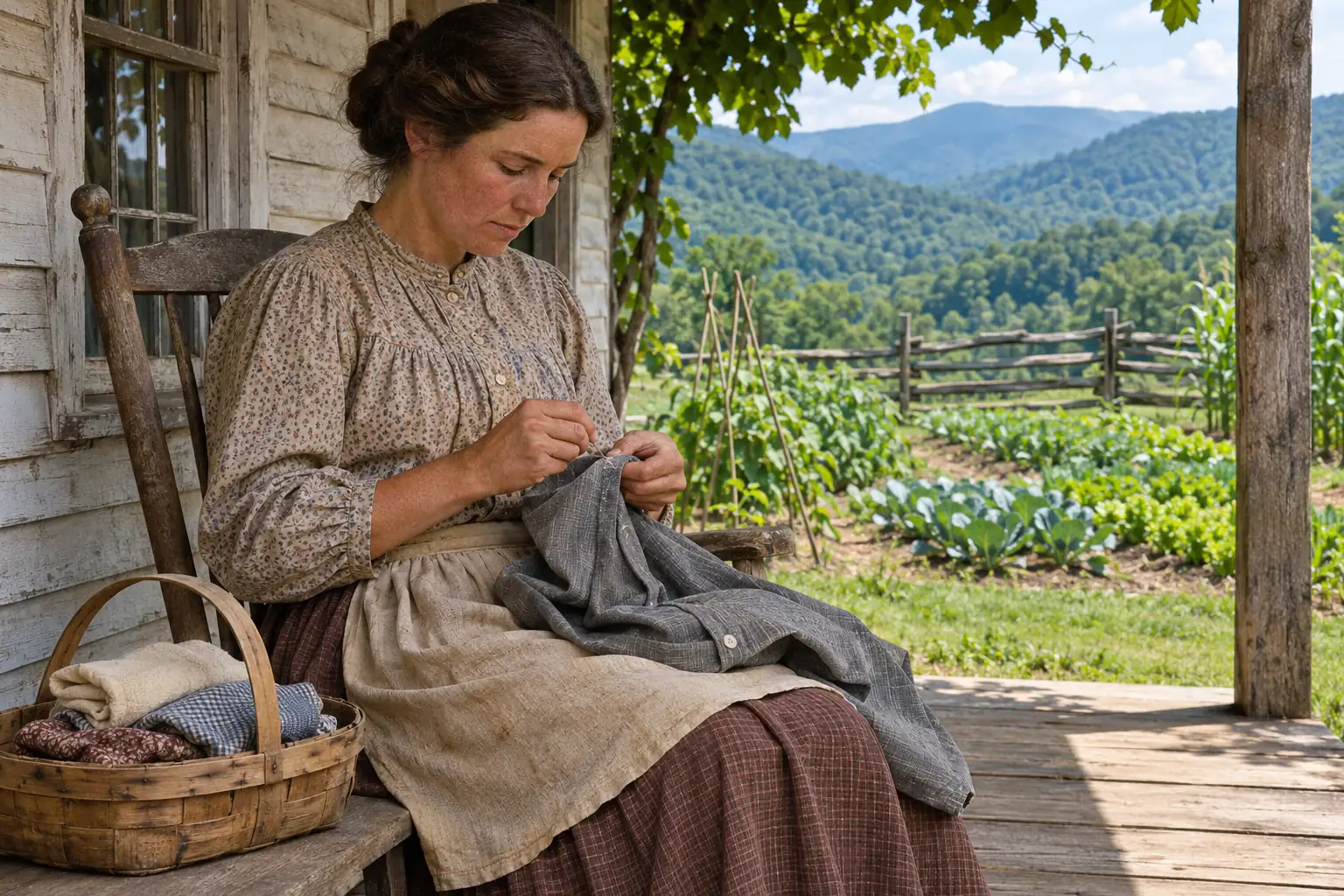
Clothing production could begin long before sewing. In Little Greenbrier Cove, the Walker sisters washed and carded their sheep’s wool, spun it into yarn, and wove cloth. Their farm also supplied flax and cotton. Making something wearable meant knowing how to handle fibers, operate tools, and turn fabric into clothing.
The sisters also raised livestock and kept their homestead running. Their example challenges a rigid idea of women’s work: unmarried women could carry both farm and household responsibilities. It is one documented family, however, not a pattern we should impose on every Appalachian home.
Their skills later brought cash as well. Visitors bought handmade goods, fried apple pies, and Louisa Walker’s handwritten poems. Work that served the household could also become something to sell as circumstances changed.
Homemade cloth was not the only option throughout this period. The Park Service explains that cheaper manufactured fabric helped quilting become more common. Women’s work changed as goods became affordable and available. A spinning wheel in a preserved cabin should not lead us to imagine that every mountain woman made every garment from raw fiber.
Lydia Kear Whaley Built a Livelihood After Loss
Lydia Kear Whaley’s life shows how many skills one woman might draw on. In 1864, her three-year-old son died. Less than a month later, her husband, a Union soldier, also died during the Civil War. She did not remarry and raised two daughters.
The National Park Service identifies her as a farmer, midwife, tailor, and basket maker. She traveled to care for sick neighbors and helped wash and prepare bodies for burial. People knew her as a “grannywoman,” a local term associated with women who provided healing and birth care.
These were serious responsibilities. A neighbor might need her during childbirth, illness, or a death in the family. Describing that role records a historical practice; it does not establish that every remedy she used was effective.
Her story also includes support that a simple tale of self-reliance might miss. Berea College’s Loyal Jones Appalachian Center records that she received a military widow’s pension beginning in 1867. It was part of how she supported herself, alongside her work and nearby family ties.
The Objects That Make Her Work Visible
Berea’s collection holds more than thirty artifacts connected with Whaley. They include her baskets, shoemaking tools, a bottle that held herbal remedies, and a sifter. These objects give substance to the range of work associated with her name.
The center’s research also draws on census records. In 1900, she was listed as a farmer; in 1910, as having her own income. Neither short description captures everything she did.
In 1914, Whaley began teaching basket weaving at Gatlinburg’s Phi Beta Phi school. By then she was in her seventies. A skill she had used herself became knowledge she could pass to others. Her later life was connected to younger generations through teaching as well as through her own daughters’ families.
Earning Money Often Grew Out of Work at Home
Paid and unpaid labor were not neatly separated. Taking in washing, preparing meals for boarders, selling farm products, or making goods for customers could bring money into a household. Yet those activities could disappear behind a census entry that recorded no occupation.
Historian Janet W. Greene examined this problem through interviews with women from southern West Virginia coal communities, checked against other historical records. Her study covers 1900–1950, a particular setting and period rather than all Appalachian women.
The women described taking in laundry and boarders, selling butter and eggs, and doing domestic work for other households. Some worked in stores or boardinghouses. Those earnings mattered when a husband’s wages were low or stopped.
Greene also records Annie Allen’s memory of accompanying her mother to work making beds in a company boardinghouse during the 1930s. Allen was the daughter of a Black miner. Her account adds another kind of workplace to the picture of women’s mountain labor.
These accounts show why formal job titles alone miss work that helped pay for daily life.
Cherokee Women Had Distinct Roles in Land and Family
Cherokee women’s history begins long before European settlement in Appalachia. It belongs to a distinct society with its own systems of kinship, land use, and authority.
The Smithsonian’s National Museum of the American Indian explains that Cherokee society traditionally followed a matrilineal clan system: children belonged to their mother’s clan. A husband joined his wife’s household. Women grew crops including corn, beans, squash, and tobacco, and gathered edible plants. Cherokee Nation’s account also describes women’s economic and political contributions within town life.
Historian Theda Perdue explains that crops and cultivated fields were tied to women and their maternal family groups within a system of commonly held land. Farming was central to women’s standing.
Defending the Land That Fed Their Families
Perdue’s research preserves a striking example of women speaking for family continuity. In 1817, thirteen Cherokee women signed a message to the National Council opposing further land sales and removal west. They connected their claim to the land with raising children and growing provisions. Women protested again in 1818.
Their concern was practical as well as political. Losing land meant losing the place where families produced food and expected future generations to live.
Land loss, United States policies, missionary influence, and changes within Cherokee society altered these roles. Forced removal later tore many families from their homes.
Family Continuity Meant More Than Keeping Old Customs
The surviving evidence shows several ways women connected generations. Katherine Saunders remembered working with her mother. Whaley taught a craft she had practiced for years. Cherokee women addressed leaders as mothers concerned about their children’s future on the land.
Continuity could mean passing on a skill, but it could also mean finding a new source of income or defending the resources a family needed. Adapting was part of keeping people going.
That work deserves respect without turning hardship into a virtue everyone willingly chose. A woman might value her abilities and still be tired, short of money, or limited by her circumstances. These records show what people did; they do not let us assign the same feelings to them all.
Seeing the Women Behind the Work
Bettie Saunders appears in a daughter’s memory of preparing food. Lydia Kear Whaley appears in baskets, tools, and census entries that each capture only part of her livelihood. Cherokee women appear in a protest that tied land to the survival of coming generations.
Together, these records make women visible as producers, earners, caregivers, and people with a stake in community decisions. Their work helped determine whether a household could eat, remain on its land, and give the next generation something to build on.
Does your family keep a basket, garment, photograph, or story connected with a woman’s work in Appalachia? You can share what you know through Redneckosity’s contact form. A name, community, approximate date, and any surviving records would help us explore the story carefully. Family memories are useful leads to investigate alongside other evidence.
Strong Backs. Red Necks. Deep Roots.

Explore more stories about mountain work, family, and survival in Appalachian Mountain Life.
Sources and Further Reading
- National Park Service — Saunders Family
- National Park Service — The Walker Sisters
- National Park Service — Fabric of Appalachia Part 1
- National Park Service — Women of the Smokies
- Berea College Loyal Jones Appalachian Center — Lydia Kear Whaley and Related Artifacts
- Janet W. Greene — Strategies for Survival: Women’s Work in the Southern West Virginia Coal Camps, West Virginia History, 1990
- Smithsonian National Museum of the American Indian — Early History and Cherokee Removal
- Cherokee Nation — Pre Contact Cherokee Lifestyle
- Theda Perdue — Cherokee Women and the Trail of Tears, Journal of Women’s History, 1989