What chores did pioneer children do to keep a household running? They carried water and firewood, fed livestock, helped prepare meals, worked in gardens and fields, and learned sewing and other household skills. Their work helped supply food, warmth, and clothing. The jobs they received depended on their age, the season, and what their household needed.
In Appalachia, that answer needs a place and a date. The examples here come from the 1800s and early 1900s, including mountain communities whose work continued long after their first settlers arrived. Looking at named children helps show both the jobs and the different circumstances behind them.
A Household Needed Work Before Breakfast
Herbert Hensley remembered his father or one of the boys building a fire while his mother prepared breakfast. When the meal was ready, the family sat down together. The National Park Service preserves his account in its history of the Lige Hensley House at Cumberland Gap.
That small memory shows how household jobs depended on one another. Cooking required heat, and someone had to get the fire going. A boy’s contribution could become part of the meal even if he did not cook it.
Hensley Settlement began in 1903. Its history reminds us that routines associated with “pioneer life” also belonged to twentieth-century families. A log house or a wood fire alone cannot tell us when a childhood took place.
For the wider demands of cold weather, our article on how pioneers survived winter follows the work of keeping a household supplied and warm. Here, the important detail is who shared that work: children were among the people helping make an ordinary morning possible.
Farm Chores Changed With the Season
A U.S. Children’s Bureau report published in 1918 gives unusually specific examples. Its mountain survey covered selected communities in one North Carolina county, not the entire region. The families in that sample were white, another limit on whose experiences it records.
In one family, boys aged eleven and fourteen helped plow and plant corn, beans, and potatoes. Summer brought hoeing. Autumn meant gathering crops, digging potatoes, and helping make syrup.
Their sisters, aged eight and nine, sometimes hoed too. They picked beans and fruit and helped their mother dry apples and beans. Both boys and girls contributed to the farm, although their assignments differed.
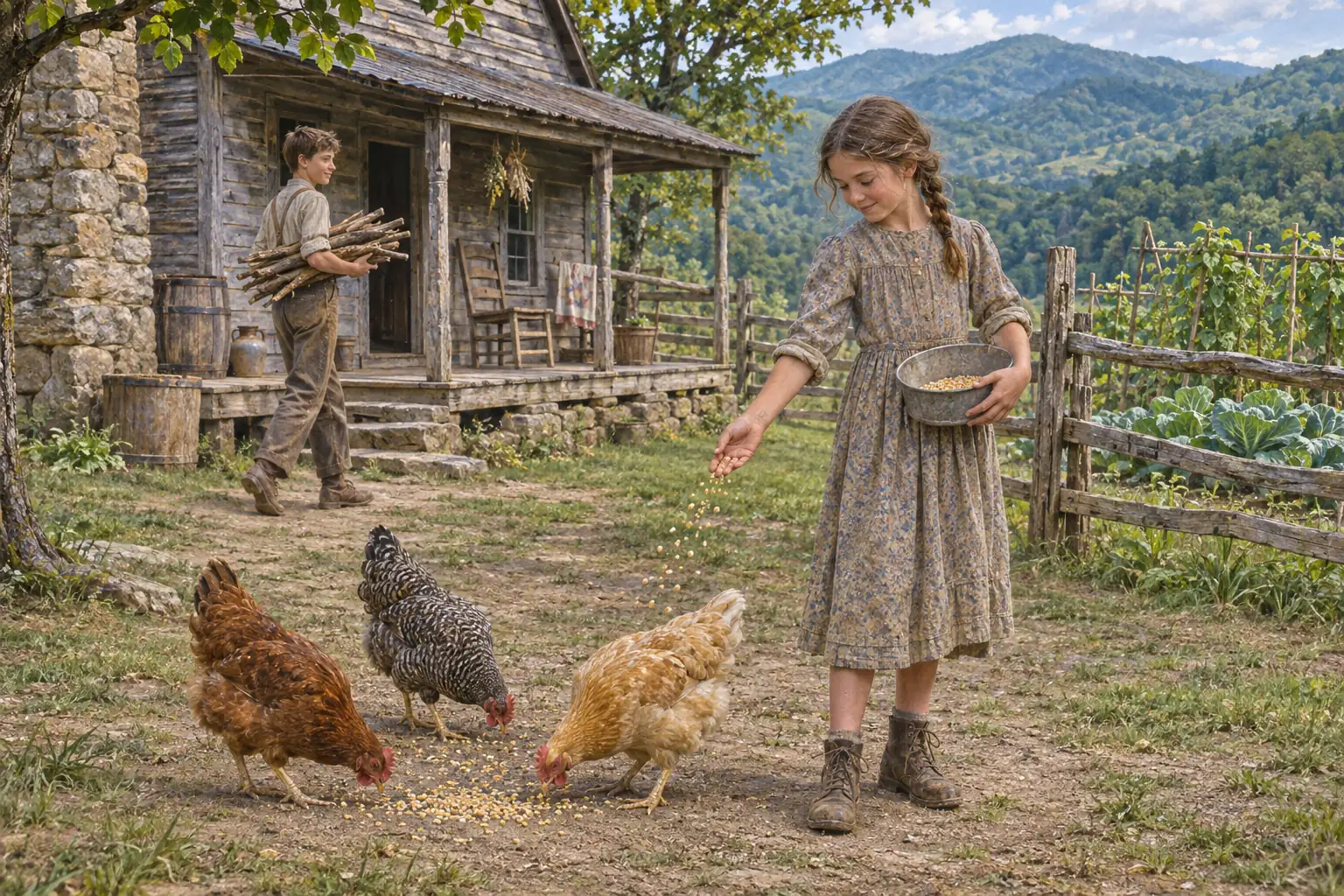
The report also records children bringing wood and water, feeding animals, running errands, cooking, sewing, milking, and churning. Fieldwork added seasonal demands to recurring household jobs.
These ages describe particular families, not a universal timetable of safe tasks. Investigators noted fatigue and soreness from some work.
Katherine Saunders and the Pig That Followed Her
On a farm near Virginia’s Peaks of Otter, Katherine Saunders West remembered preparing food and cooking with her mother, Bettie. She also fed animals and milked cows. Her family was African American; her parents, George and Bettie Saunders, raised nine children there.
In an interview used for a 2005 ethnographic assessment, Katherine recalled a pet pig that followed her because she fed it. The animal came to the kitchen door and would enter if the door stood open. A feeding chore had become part of a relationship she still remembered many years later.
Her account also includes running up and down the hillside and playing games such as checkers and dominoes with her brothers. Work was part of this childhood, but her memories make room for play too.
Her memories preserve the feeding and milking alongside games and a persistent pig. They give us a particular child’s view of farm life, with details a list of chores would leave out.
Learning to Sew With the Smallest Scraps
Maggie Cochran Shockley, born in 1913 in Hillsville, Virginia, remembered learning quilt work with her mother, Sybella. Her account survives in the Library of Congress’s Blue Ridge quilting collection.
Sybella cut paper into diamond shapes and gave her daughters narrow strips of fabric to sew onto them. Maggie recalled that the girls received the smallest scraps. Their mother assembled the pieces into eight-pointed stars.
This was a way for a beginner’s work to become part of something useful. A child did not have to plan and finish an entire quilt to contribute. The mother prepared the pieces, and the daughters practiced a smaller part of the process.
Maggie also remembered the girls gathering around the quilting frame and learning to make small stitches. Skill developed through shared work and repetition.
The paper shapes and narrow strips help explain how a demanding craft could be taught in stages. They also show that scraps had a use long before a quilt was finished.
When an Errand Was Too Much for a Child
Booker T. Washington’s childhood in Franklin County, Virginia, shows why similar-looking tasks could mean very different things. He was enslaved. His labor was under an enslaver’s control.
In the first chapter of his autobiography, Up from Slavery, Washington recalled cleaning yards, carrying water to workers, and taking corn to a mill about three miles away. The mill journey frightened him.
He rode with a heavy sack of corn across a horse’s back. If the load shifted and fell, he could not lift it back himself. He sometimes waited for hours until someone passed and helped. He also feared punishment when delays made him return late.
“Going to the mill” sounds like a short entry on a chore list. His account reveals the weight of the sack, the child’s limited strength, and the consequences he feared. Calling every historical task character-building would erase what happened to children like him.
This is part of the region’s labor history, but it must be understood as a child’s experience of slavery.
Children Had Opinions About Their Work
A record of what a child did does not always tell us how that child felt. When a personal account does preserve those feelings, they deserve attention.
In a study published through Western Carolina University, Mary Martinez discusses Florence Cope Bush’s book about her mother, Dorie Cope. Dorie remembered children taking part in farming, harvest, preserving, and canning. She also remembered strongly disliking pig slaughter and trying to escape it.
That response matters. Familiarity with farm life did not mean a child welcomed every part of it. A household could depend on a task while a child found it upsetting.
The distinction also helps us read family stories more carefully. “We all helped” may be true without explaining who worked longest, who needed help, or which jobs someone dreaded. Those details tell us more than a general claim that children worked hard in the old days.
Looking Beyond the Chore List
Children’s work helped mountain households function, and some tasks passed useful knowledge from one generation to the next. The same records also show why responsibility and burden must be considered together. The task’s size, the help available, and the child’s freedom to refuse all mattered.
Does your family remember a childhood chore in Appalachia, perhaps a first sewing job or an animal someone cared for? You can share the story through Redneckosity’s contact form. Include the person’s name, community, approximate year, and any photograph or written account that survives. Those details help turn a familiar family saying into a history we can investigate.
Strong Backs. Red Necks. Deep Roots.

Explore more stories about mountain work, family, and survival in Appalachian Mountain Life.
Sources and Further Reading
- National Park Service — Lige Hensley House, including Herbert Hensley’s recollections
- National Park Service — Hensley Settlement
- Frances Sage Bradley and Margaretta A. Williamson — Rural Children in Selected Counties of North Carolina, U.S. Children’s Bureau, 1918, especially pages 85–87
- National Park Service — Saunders Family, including Katherine Saunders West’s recollections
- Library of Congress — Maggie Shockley, Blue Ridge Quilters
- Booker T. Washington — Up from Slavery, Chapter I, A Slave Among Slaves
- Mary Martinez — Growing Up Poor in Appalachia and the Rural South: Defining Attitudes Toward Work, Western Carolina University, 2020