
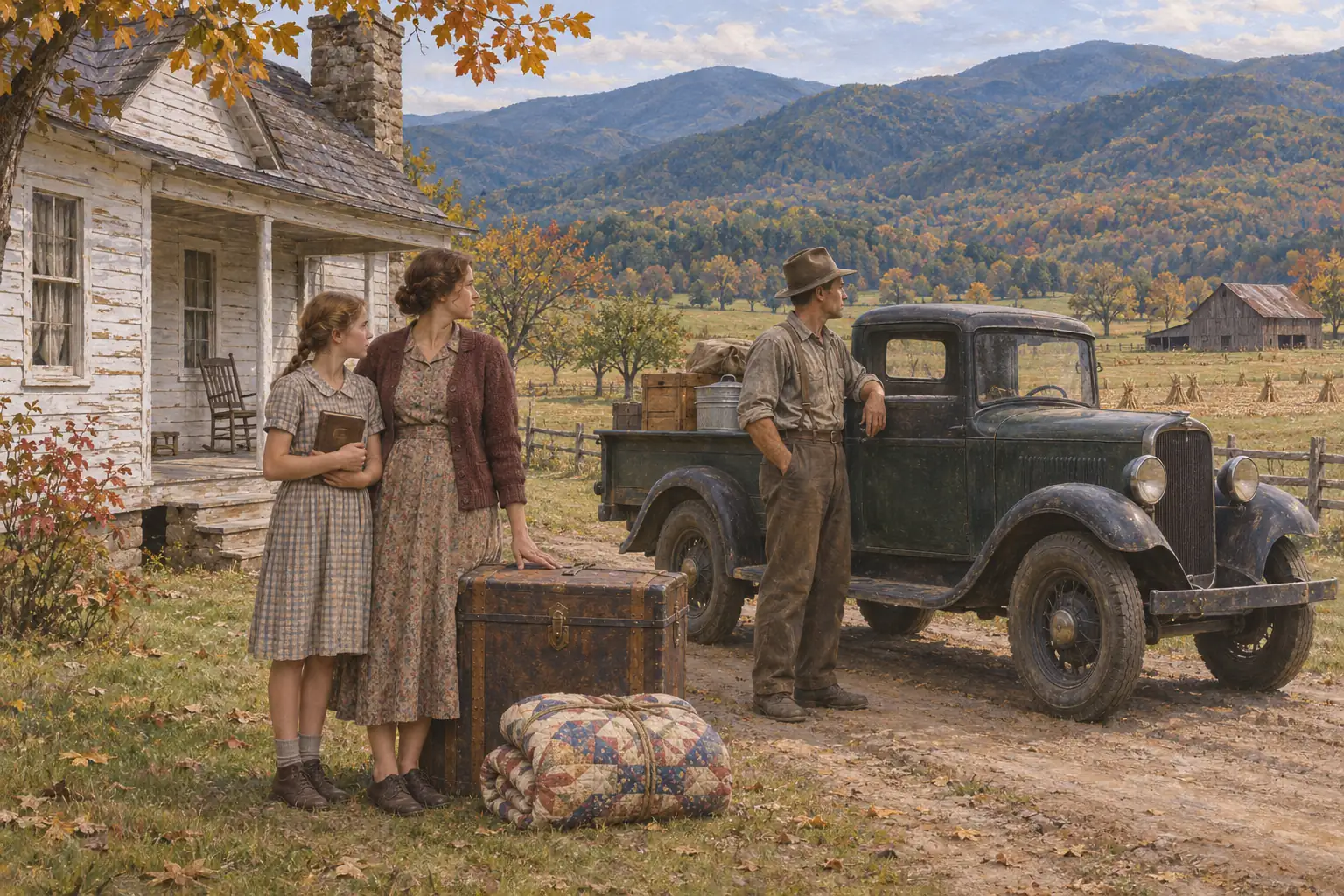
Why did people leave Cades Cove? The main reason was the creation of Great Smoky Mountains National Park. Tennessee acquired farms through purchases and condemnation, and the valley gradually changed from a residential farming community into parkland. Some families welcomed a sale, others resisted, and some stayed under lifetime leases or other agreements. There was no single day when everyone packed up and left.
The park preserved a remarkable landscape, but its creation also broke apart a community. Understanding that history means looking beyond the surviving cabins to the homes, livelihoods, and family ties that residents were trying to protect. It also means allowing people to have different feelings about leaving the same place.
Cades Cove Before the Park
Cades Cove’s human history began long before its European-American farmsteads. Cherokee people used and occupied the valley, and their loss of land belongs in its history. The growth of white settlement followed an earlier transfer of control: the 1819 treaty forced Cherokee land cessions in the Smokies. The park-era purchases came more than a century later and affected a different community under different circumstances.
By the early twentieth century, the cove was an established farming valley with roads, churches, mills, stores, and family homes. Historian Durwood Dunn describes farmers taking part in agricultural improvements before the park campaign. People traded, traveled, and sought work beyond the mountains.
Some were already leaving during the 1920s as farm prices fell and jobs elsewhere drew them away. The national park did not cause every move in Cades Cove’s history. It did, however, bring a much larger change: remaining privately owned farms would become part of a public landscape managed for a different purpose.
Why Was Cades Cove Included in a National Park?
The campaign to protect the Smokies grew from several interests. Conservationists feared the loss of the region’s forests. Business leaders and automobile clubs also saw possibilities in scenery, roads, and tourism. The changes brought by logging helped make protection seem urgent.
Creating the park required acquiring land already owned by farmers, timber companies, and others. Tennessee and North Carolina raised money and assembled properties for transfer to the federal government. Private donors contributed, including a $5 million matching gift from the Laura Spelman Rockefeller Memorial in 1928.
Three dates help separate the stages:
- 1926: Congress authorized the creation of Great Smoky Mountains National Park, subject to acquiring land.
- 1934: The national park was established.
- 1940: President Franklin D. Roosevelt formally dedicated the park.
These were milestones in a long process, not three different dates for a mass departure. Land purchases, disputes, leases, and moves stretched across years. Cades Cove became part of Great Smoky Mountains National Park; it was not established as a separate national park of its own.
A Land Purchase Could Still Mean a Forced Move
The National Park Service acknowledges that some cove residents willingly sold and moved away. A payment could offer a chance to obtain another farm or pursue a different living. Other owners wanted to keep the land they already had.
For those who refused, Tennessee could use condemnation to acquire property for the park. In this context, condemnation meant a legal taking for public use, with compensation determined through the process. It did not mean that a house had been declared unsafe.
Payment and consent are different questions. An owner could receive money and still oppose the loss of a home. Nor did a price assigned to land replace a nearby relative, a familiar field, or a family’s place in a church community.
That distinction keeps two misleading accounts out of the story. The cove did not empty solely because everyone chose to sell. The records also do not support saying that every owner simply lost property without compensation. The terms and the residents’ responses varied.
John W. Oliver Welcomed Visitors and Fought for His Home
John W. Oliver’s experience shows why support for tourism could turn into resistance to the park. He was a descendant of the early Oliver settlers, not the same John Oliver associated with the cabin built in the 1820s.
A National Park Service cultural-resources report records that Oliver rented cabins to visitors and built a tourist lodge in 1928. He was preparing to earn from people coming to see the mountains. The report also records Senator Lawrence Tyson’s assurances that cove residents would not lose their homes. A park nearby could sound like an opportunity under those conditions.
The acquisition of the cove changed that expectation. Oliver challenged the state’s power to take his property. The published 1932 Tennessee Supreme Court opinion in Oliver v. State describes an earlier trial-court ruling in the Olivers’ favor, followed by a reversal upholding the state’s condemnation authority. The family continued to challenge that authority, but the court dismissed the petition.
The Park Service’s inventory of the Elijah Oliver homestead traces the property through the family to John W. Oliver and records the eventual loss of family ownership during the condemnation proceedings. His legal fight could not keep the farm outside the park.
Oliver’s opposition was not simply a rejection of roads, visitors, or change. He had invested in tourism. What he resisted was a future in which welcoming visitors meant surrendering control of his own homeplace.
Lifetime Leases Allowed Some People to Stay
Some residents accepted less money for their land in exchange for permission to remain for life. Others stayed through shorter agreements. These arrangements delayed departure, sometimes for many years, but ownership had changed.
The National Park Service describes restrictions on activities such as hunting, trapping, and cutting timber. For a household used to drawing food, fuel, and income from the surrounding land, those rules could change daily life even while the family remained in its house.
A lifetime lease also could not preserve the surrounding neighborhood. It might protect one person’s residence while nearby households moved away. The meaning of staying changed as familiar doors closed and the valley became a place visited by strangers.
These agreements should not all be treated as identical. A life lease, a shorter residential lease, and an agricultural permit served different purposes. The later presence of a farming family does not prove that every former owner received the same right to remain.
The Community Dispersed a Household at a Time
The loss of a community was more than a count of occupied houses. Neighbors had shared work, worship, news, and help in emergencies. As families left, those relationships could continue, but they could no longer operate in the same way across the same nearby farms.
The closing dates of two services make that change concrete. According to the Park Service, Cades Cove’s last school closed in 1944, and its post office closed in 1947. Both dates fall well after the park’s establishment in 1934.
Families did not have to travel far to experience a major break. Leaving for another valley could still mean giving up familiar fields, nearby kin, and ordinary visits that once required little planning. Those who remained also had to adapt to a place with fewer permanent neighbors.
The buildings could survive this change more easily than the relationships that gave them a daily purpose. A preserved church tells us something about community life; it cannot, by itself, show who once sat together or stopped to talk on the way home.
The Caughrons Lived Through the Long Transition
Kermit and Lois Caughron show how far life in the cove extended beyond the 1930s. A Tennessee legislative memorial to Lois records their marriage in 1942 and their early farming life with Kermit’s parents. In 1946, the young family moved into the Dan Lawson cabin. They later raised their children in a frame house nearby.
Their presence is documented in an especially direct way. On December 16, 1975, researcher Mary Lindsay interviewed Kermit at his Cades Cove home, with Lois and their son Rex present. He described the old grazing practices that connected farms on the valley floor with the surrounding mountains. Here was a resident explaining a working landscape decades after the park had opened.
Staying did not mean that husband and wife felt alike. In his reporting on the family, John Gullion reproduces Lois’s words from a 2007 Daily Times interview: “I never wanted to go back to Cades Cove.” Kermit preferred farming there; she knew the work involved in a home without electricity. Her view deserves a place beside his attachment to the mountains.
Gullion’s interview with Rex also describes renewable leases and the family’s responsibility for maintaining pastures and hayfields. The Caughrons were living and working under agreements with the park, rather than continuing as independent owners of the old family land.
Park records identify Kermit as the last agricultural permit holder grazing cattle in the cove before his death in 1999. That long survival should not be mistaken for an intact community lasting unchanged until then. The Caughrons had lived through the gradual disappearance of the neighborhood around them.
The Surviving Cabins Show a Selected Part of the Past
Why does Cades Cove look like an earlier settlement if families were still living there in the twentieth century? The answer includes choices made after the land became park property.
The Park Service preserved selected older buildings and removed many later features. Its inventory of the John and Lucretia Oliver homestead documents the removal of another nearby log house, outbuildings, and a fenced vegetable garden. The approach to the property changed for visitor access. Even a familiar historic scene can contain decisions made long after the original residents arrived.
Kristen Olson’s Cornell research examines this process: officials shaped an appealing pioneer landscape while removing evidence of the cove’s more recent life. The setting visitors see therefore tells two histories. It preserves parts of mountain settlement and also reflects the park’s choices about what deserved to remain visible.
The Caughron house and associated outbuildings were removed after Kermit’s death. Their disappearance makes the point especially clearly. A family’s life could be within living memory and still fall outside the older scene the park chose to present.
Leaving Did Not End the Connection to Home
The cove’s history did not end when its farm community dispersed. Family records, photographs, recollections, and graves preserved ties to the place. The Park Service’s cultural-resources report notes continuing use of churches for occasional events and continued burials in some cemeteries.
These connections matter because a park boundary could change ownership without erasing belonging. A descendant may see a family homeplace where another visitor sees a scenic stop. Both are looking at the same valley, but they bring different knowledge to it.
The forests and historic buildings are a lasting public benefit. The loss of homes and the breakup of the community are also part of how that benefit came about. Remembering the residents’ choices, resistance, work, and attachments gives the preserved landscape a fuller history.
Does your family have a Cades Cove letter, lease, photograph, or story about leaving or returning? We’d welcome it through Redneckosity’s contact form. A family name, approximate date, and location can help connect a personal memory with the surviving record.
Strong Backs. Red Necks. Deep Roots.

Explore more stories about mountain work, family, and survival in Appalachian Mountain Life.
Sources and Further Reading
- National Park Service — History of Cades Cove
- Tennessee Encyclopedia — Cades Cove, by Durwood Dunn
- National Park Service — Creating a National Park
- National Park Service — Smoky Mountain Timeline
- National Park Service — People of the Great Smoky Mountains
- National Park Service — Cades Cove Cultural Resources Summary Report (2004 PDF)
- Tennessee Supreme Court — Oliver v. State (1932 opinion excerpt, via vLex)
- National Park Service — Elijah Oliver Homestead: Cultural Landscape Inventory
- Tennessee General Assembly — Memorial Resolution for Margie Lois Shuler Caughron (PDF)
- National Park Service — Kermit Caughron Interview, December 16, 1975 (archived transcript)
- John Gullion — Cades Cove History: The Last Family to Have Lived in Cades Cove (family interviews)
- National Park Service — Peter Cable and Dan Lawson Homestead: Cultural Landscape Inventory (archived PDF)
- National Park Service — John and Lucretia Oliver Homestead: Cultural Landscape Inventory
- Cornell University — A Window of Opportunity: Cades Cove and the National Park Service, by Kristen Olson (abstract and thesis record)