
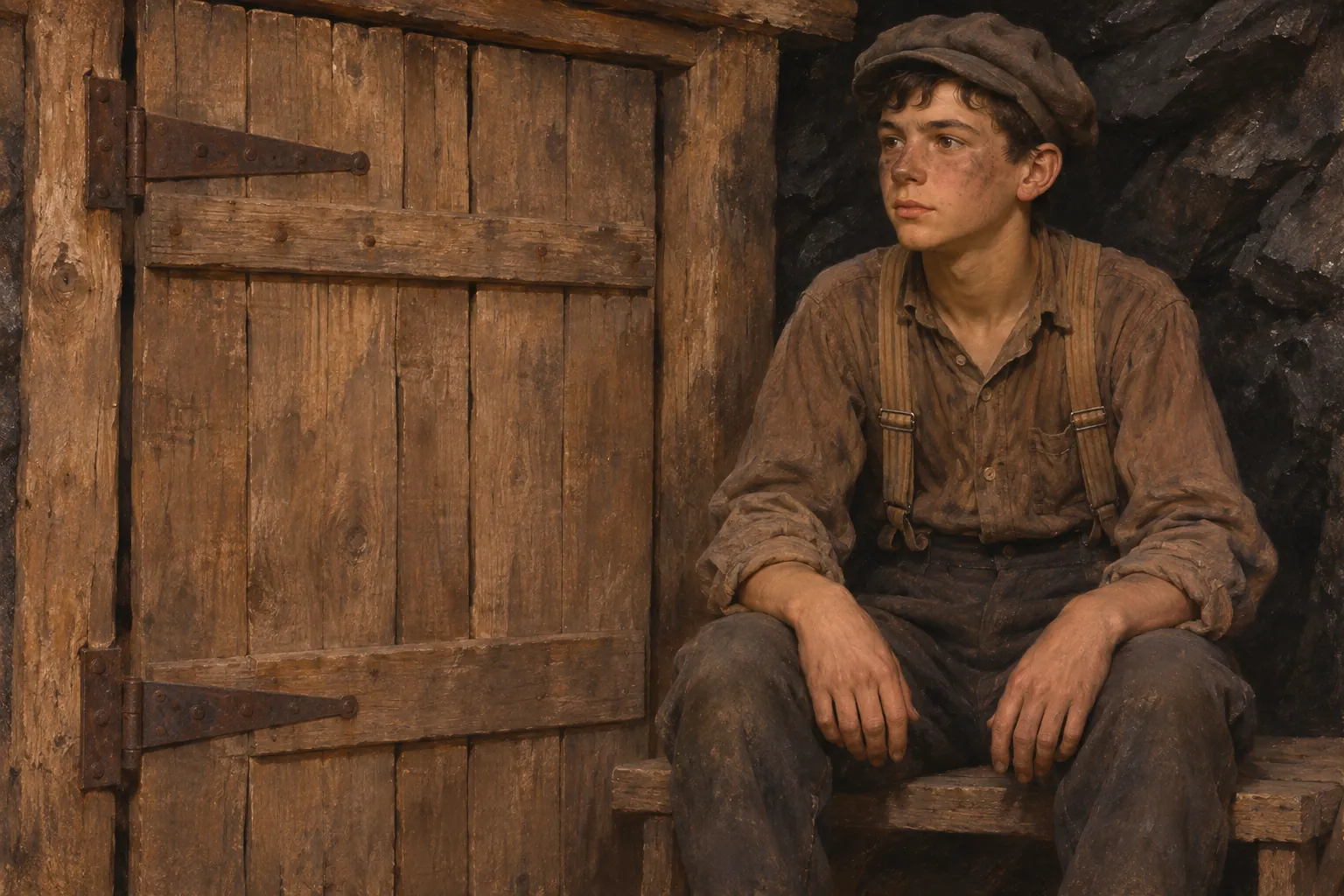
In September 1908, Lewis Hine photographed a West Virginia trapper boy named Vance. His caption listed an age of fifteen and a ten-hour day spent tending a mine door. Children in coal mines also loaded coal, helped move cars, and sorted rock from coal at the surface.
These jobs supported an industry that depended on work above and below ground. A child’s earnings could matter to a household, while long hours and early employment narrowed the time available for school. The examples here center on Appalachian mining communities in the early 1900s, with Pennsylvania’s anthracite breaker boys identified separately from workers in the southern bituminous coalfields.
Trapper Boys Kept Mine Doors Moving
A trapper tended a door in the mine’s ventilation system. He opened it when coal cars needed to pass and closed it afterward. The job helped keep both traffic and the mine’s air system working.
Much of the shift could pass in darkness with little to do until another car approached. A Bureau of Labor Statistics history describes that long, lonely wait as a defining part of the work.
Hine’s caption recorded Vance’s pay as seventy-five cents for a ten-hour day. It also noted that he had already done the job for several years.
Children Helped Load and Haul Coal
Some children worked beside experienced miners. The Bureau of Labor Statistics describes a helper system in which a miner hired assistance, sometimes from his own family. These helpers could be paid from the miner’s earnings instead of appearing as employees on the company’s payroll.
Robert “Bob” Forren remembered beginning that way in West Virginia. In his 1980 interview, preserved by the National Park Service, he said his father took him into the mines at age twelve in 1919. He helped load coal on Saturdays and during school vacations.
Forren later tended doors and drove a mule. His recollection puts a young worker beside the coal mine mules that pulled cars through the workings. In 1924, he said, his leg was caught between a mine post and a coal car and broken.
Learning the job from a relative offered a way into the trade. It also brought children into the same confined spaces, moving equipment, and daily risks faced by adults.
Why Families Relied on Children’s Earnings
Household need and employers’ demand for cheap labor reinforced one another. The National Archives’ history of child labor explains that low wages pushed families to seek income from their children. Employers could hire young workers for less than adults.
In a mining household, helping a parent load more coal could contribute to family earnings even without a separate company paycheck. The helper system makes it important to ask who paid a child, not just whether his name appears in a mine’s records.
Other pressures mattered too. In historian Perry Blatz’s account of Pennsylvania’s anthracite workers, Andrew Toth recalled joining friends at the breaker at age nine. His parents had not pushed him to work, but the other boys had already left school.
Schooling Could End in Stages
Forren’s story shows how school and mine work could overlap before steady employment began. He recalled a six-month school term, with mine work filling some of the time outside it. After finishing school in March 1922, he began regular mine work in April.
He remembered earning a dollar for a ten-hour day as a trapper.
For other children, leaving school happened earlier. A Bureau of Labor Statistics history of reform explains why compulsory school attendance and child-labor laws needed to work together. A restriction on hiring could do little if it was ignored, and a place in school mattered only if a child could keep attending.
When a family story says someone “started in the mines,” it is worth asking what that meant. Occasional work with a father, a first paid helper’s job, and the start of full-time employment might have happened in different years.
Breaker Boys Worked Above Ground
In northeastern Pennsylvania’s anthracite region, breakers were surface buildings where coal was cleaned and sorted for sale. Their young slate pickers became known as breaker boys.
Blatz describes boys seated beside or across chutes, reaching into the passing coal to remove slate and other waste. Sharp pieces cut their fingers, and moving machinery added danger. In many breakers, managers prohibited gloves because they believed bare hands picked small pieces more effectively.
A photograph of these workers shows a different setting from a southern Appalachian mine interior. Sorting anthracite above ground and tending an underground door were separate jobs, each part of getting coal to market.
Photographs and Testimony Made the Work Visible
Hine worked for the National Child Labor Committee, which gathered evidence and used photographs and statistics to build support for reform. According to the National Archives, he interviewed children and recorded details for his captions, sometimes working around managers who did not want their workplaces photographed.
A photograph and its caption answer different questions. The image can show clothing, equipment, and surroundings. A claimed age, daily wage, or number of years worked usually comes from a note or interview. Keeping those sources together makes the evidence more useful.
Blatz also describes false age statements used to secure jobs in Pennsylvania. An employment paper did not always establish a child’s true age.
Later oral histories add another view: workers could explain tasks, family decisions, and injuries that a single photograph never captured. Their memories are valuable testimony, while dates and sequences still deserve comparison with other records.
Reform Took More Than One Law
Federal action came in steps, with serious setbacks. The Keating-Owen Act of 1916 sought to restrict interstate trade in goods produced under certain child-labor conditions. Its mining provision covered products from mines employing children younger than sixteen.
The Supreme Court struck the law down in 1918. A later attempt to discourage child labor through a federal tax was also overturned. The Fair Labor Standards Act of 1938 finally established federal protections that survived a Supreme Court challenge in 1941.
Those dates do not mean child labor vanished everywhere at once. The Bureau of Labor Statistics’ reform history describes a decline already underway before 1938, shaped by schooling, changing household circumstances, and changes in the demand for labor. Laws and their enforcement were part of that larger change.
For the children pictured years earlier, reform was not an abstract question. It concerned when they could begin work, what employers could ask of them, and whether school remained a real option.
The Boy in the Photograph Had a Life Beyond It
Vance’s story did not end beside the mine door. Researcher Joe Manning traced him as Vance Palmer and interviewed his children. Palmer later worked as a glass cutter.
His daughter, Eloise Jurick, remembered a father who made sure his children reached school. In her 2007 interview with Manning, she said he drove them there before going to work. She had never seen Hine’s childhood photograph until Manning sent it to her.
The photograph preserves a child at work. His daughter’s memory lets us see the adult he became. Both belong to the history.
If your family kept a photograph of a young mine worker, preserve any writing on its back and record what relatives remember. A name, a place, or a job title may help connect a familiar face with a much larger story.
Strong Backs. Red Necks. Deep Roots.

Explore more stories about mountain work, family, and survival in Coal Mining Lives & Labor.
Sources and Further Reading
- Joe Manning, The Lewis Hine Project: Vance Palmer, Harrison County, West Virginia; Hine’s caption and interviews with Palmer’s children
- National Park Service: Robert “Bob” Forren oral-history interview, September 24–25, 1980, Part 1
- Michael Schuman, Bureau of Labor Statistics: History of Child Labor in the United States, Part 1
- Perry Blatz, Pennsylvania Heritage: Breaker Boys of the Anthracite Coal Region in the Early 1900s
- National Archives: Photographs of Lewis Hine—Documentation of Child Labor
- National Archives: Keating-Owen Child Labor Act (1916), original document and historical background
- Michael Schuman, Bureau of Labor Statistics: History of Child Labor in the United States, Part 2—The Reform Movement