
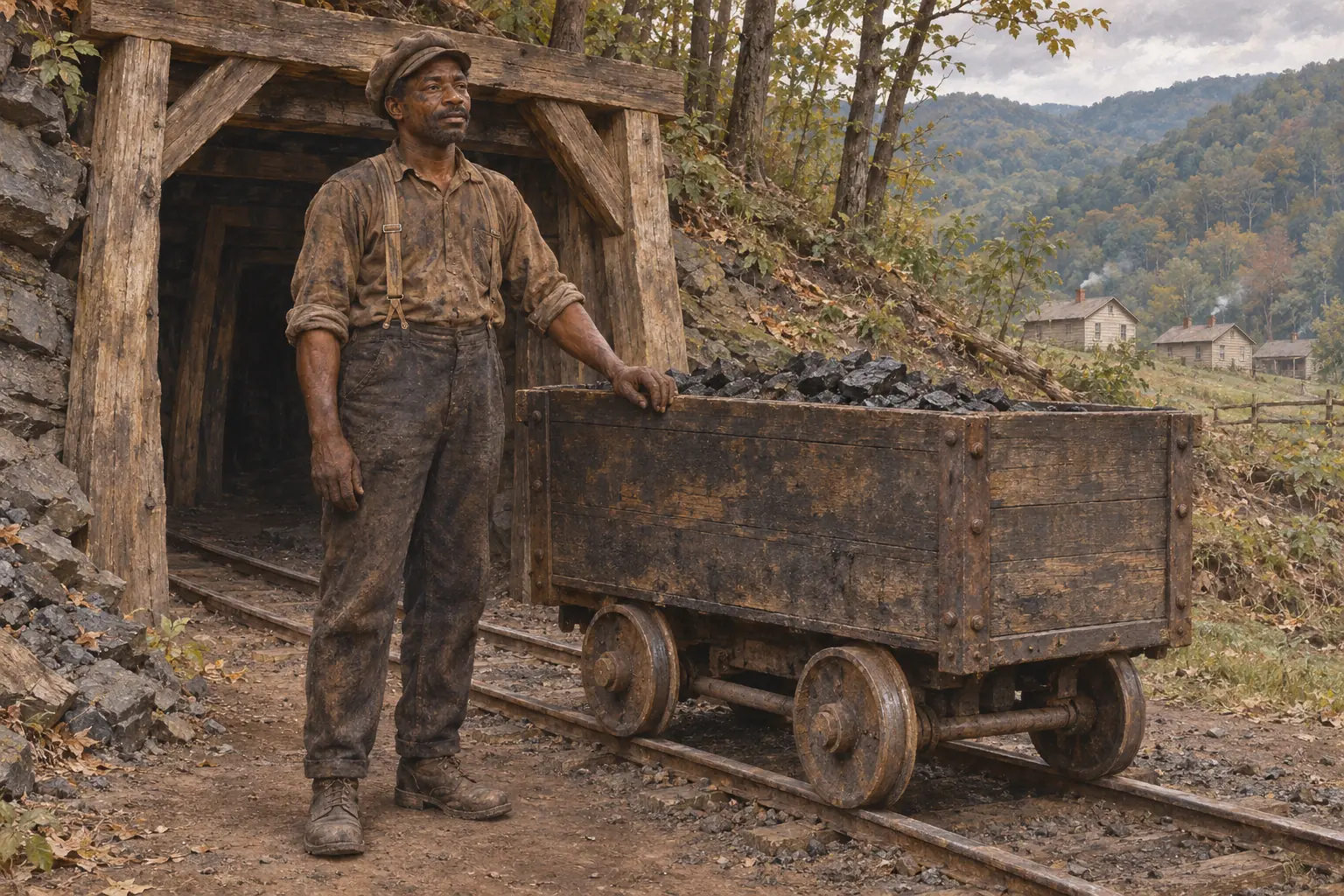
African American coal miners helped build Appalachia’s coal industry while seeking wages, independence, and better lives for their families. The opportunities came with limits. At Nuttallburg, West Virginia, Black and white residents worked in the same mining community but lived on opposite sides of Short Creek, with separate schools and churches.
That divided town helps explain a larger history. A mining job could offer a way forward without bringing equal treatment. This account centers on southern West Virginia from the late 1800s through the mid-1900s, where work, migration, and community building left a lasting record. Other Appalachian coalfields had their own histories; one town cannot stand for them all.
Why Black Workers Came to the Coalfields
Railroads helped open routes into the southern West Virginia coalfields. Historian Joe William Trotter Jr. describes Black railroad workers staying to mine coal after construction moved on. Other migrants traveled directly to mining jobs.
Early arrivals often came from nearby Virginia, Kentucky, and Tennessee. During World War I, more came from Alabama, Georgia, and Mississippi. Coal companies recruited workers, but families and friends also helped newcomers find their way. Migration was more than a company’s hiring campaign.
From the turn of the century through the early 1930s, Trotter estimates that Black workers made up roughly one-fifth to one-quarter of southern West Virginia’s coal-mining workforce.
For a family deciding whether to move, the question was practical: where could they earn a living, find a home, and build a future? Those decisions helped turn industrial settlements into places where generations grew up.
What African American Coal Miners Did
The National Park Service’s history associated with Helen, West Virginia, describes Black workers loading coal, handling mules, working as brakemen, and tending coke ovens. These jobs connected the coal face to the railroad cars carrying the finished product away.
Hand loading offered a measure of control. A miner paid by the ton could work with less constant supervision than in some other jobs. That independence mattered to men leaving the close white oversight of the Jim Crow South.
Independence did not make the work easy. The loader’s day could include cutting, drilling, bringing down coal, and filling cars. Necessary work such as setting roof supports and extending track could bring no separate pay. The National Coal Heritage Area Commission emphasizes that mining demanded skill and judgment, even when historical job classifications described workers as unskilled.
Drivers handling coal mine mules and the brakemen working beside them moved loaded cars toward the main haulage route. The coal then had to be weighed and credited to the right miner. Work at the face depended on the people who kept that traffic moving.
Opportunity Did Not Erase Segregation
At Nuttallburg, Black households lived east of Short Creek and white households west of it. The National Park Service describes separate schools, churches, and clubhouses. The creek marked a social boundary as well as a physical one.
The town’s employment record also resists a single description. In 1900, most African American men there worked in the mine, but others worked for the railroad or in construction. The record includes a Black company-store clerk and a coke-yard boss.
Those positions show a range of work. They do not establish that everyone had the same chance to advance. A few named occupations cannot tell us which doors remained closed to other workers.
To understand a coal town, it helps to look at both its jobs and its layout. Working near one another did not necessarily mean sharing a neighborhood, a classroom, or equal access to opportunity.
Schools Gave Families Another Reason to Stay
Coalfield growth brought a rising need for Black teachers and schools. The National Park Service’s history of Stratton High School describes families seeking education for their children alongside better-paying mine work.
Small community schools often stopped at eighth grade. Students continuing to high school might need to travel by train to a larger town with a school for Black pupils. Access to a classroom therefore depended on more than a child’s wish to learn.
Stratton High School in Beckley began in 1918 with two rooms and nearly eighty students. A brick building added in 1938 included a gymnasium and auditorium. That growth gave a mining region’s families more than additional classroom seats: it provided space for school life beyond lessons.
School records belong beside mine records when tracing these communities. They can preserve names, friendships, ambitions, and achievements that never appeared in a company’s production figures.
Carter G. Woodson Read the News to Fellow Miners
One young miner carried his coalfield experience into the study of history itself. In the early 1890s, Carter G. Woodson worked at Nuttallburg. According to the National Park Service, Oliver Jones ran a gathering place for Black miners in his home and asked Woodson to read newspapers aloud.
The arrangement gave the young reader refreshments and brought the day’s news into a room of working men. Jones also had reading material about Black history, including accounts of Civil War veterans. Woodson later described the place as “all but a reading room.”
Woodson left Nuttallburg in 1895 to attend high school in Huntington. He later returned to the coalfield region as a teacher at Winona. In 1926, he launched Negro History Week, the observance that eventually developed into Black History Month.
His story gives the mine community an intellectual life as well as a working one. Those conversations about news, politics, and the past belong to coalfield history alongside the work underground.
Mechanization Took Away Jobs Unevenly
Machines changed the prospects of coalfield families. Trotter describes loading machines displacing miners during the 1940s and 1950s. Black workers had already suffered a disproportionate share of unemployment during the Great Depression.
A 1995 report by the West Virginia Advisory Committee to the U.S. Commission on Civil Rights explains one reason the later losses fell unevenly. Black miners were concentrated in hand-loading jobs. Earlier seniority rules counted years within a job category, so a long-serving loader could lose his position while someone with fewer years kept a different job.
The committee also described barriers to technical training. Experience underground did not automatically bring access to instruction on new equipment. The problem involved both the disappearance of familiar jobs and unequal routes into the jobs that remained.
These changes reached beyond the mine gate. When employment drew families into a town, the loss of that employment could pull them away again.
Miners Also Worked to Open New Paths
Black miners did not simply wait for those barriers to fall. The advisory committee’s report notes that Ulysses G. Carter obtained state approval in 1937 to offer a technical mining course for Black miners.
West Virginia University’s archive preserves material Carter gathered about Black miners and access to courses in safety, foremanship, and engineering. The collection includes correspondence, pamphlets, and other records of that work.
It is a useful reminder of what can survive outside a payroll ledger. A course announcement or letter about training may reveal someone trying to secure a better position, protect fellow workers, or pass knowledge along.
African American coal miners left more than coal cars and abandoned workplaces behind. They helped build schools, gathered to exchange ideas, and pressed for chances to advance. If your family has a miner’s photograph, school keepsake, or letter, preserve the names and places attached to it. Those details help restore people to a history too often told only through production totals.
Strong Backs. Red Necks. Deep Roots.

Explore more stories about mountain work, family, and survival in Coal Mining Lives & Labor.
Sources and Further Reading
- Joe William Trotter Jr., West Virginia Encyclopedia: African American Coal Miners, migration, employment, and displacement
- National Park Service: African American Coal Miners—Helen, West Virginia, work and haulage in the southern coalfields
- National Coal Heritage Area Commission: Coal Miners, recruitment and the skills of hand-loading work
- National Park Service: African American Life in a Coal Camp—Nuttallburg, town geography and community institutions
- National Park Service: Early African American Education—Stratton High School, Beckley, West Virginia
- National Park Service: Carter G. Woodson—Winona, West Virginia, including Oliver Jones’s reading room
- West Virginia Advisory Committee to the U.S. Commission on Civil Rights: Rising Racial Tensions in Logan County, West Virginia (1995), historical job segregation and training, printed pages 7–9 (PDF)
- West Virginia University, West Virginia and Regional History Center: Ulysses Grant Carter collection, A&M 2463, archival finding aid