
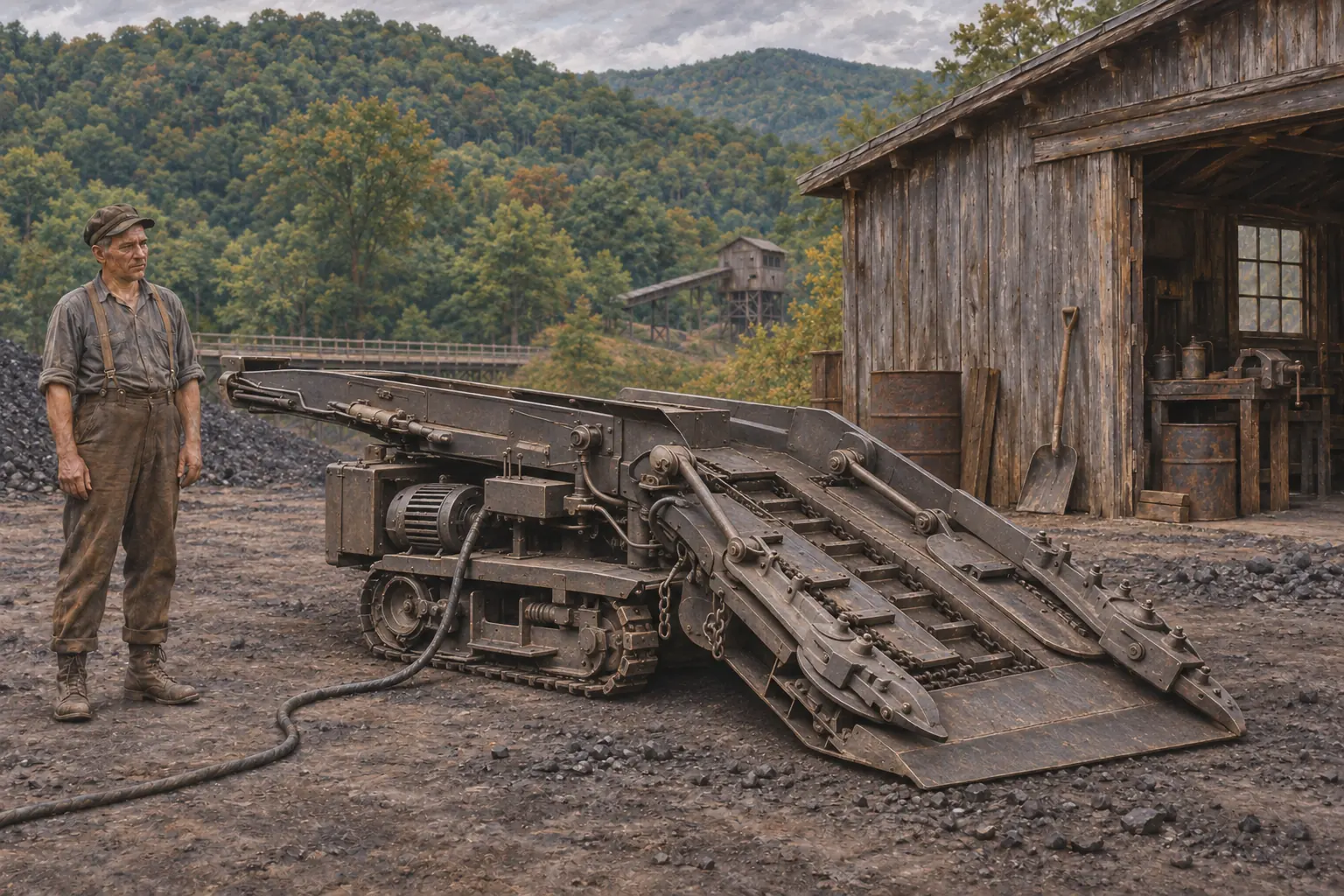
Coal mining mechanization replaced more and more hand labor with powered equipment. Machines helped crews cut, load, and move coal faster, reducing the workers needed for many jobs. The change unfolded over decades, and its benefits did not reach every mining family equally.
Clifford Davis’s working life crossed those decades. He arrived at Kaymoor, West Virginia, in 1933, expecting a short stay. His wife wanted to remain, and he stayed with the company for 28 years, working his way into management.
Machines Changed Different Parts of the Job
Underground mining involved several separate tasks. Coal had to be loosened from the seam, loaded, and hauled away. Early machinery might handle one task while leaving the next to men with shovels. The equipment did not transform a whole mine overnight.
These changes overlapped rather than following one timetable everywhere:
- Powered cutters took over much of the exhausting work of undercutting coal, but miners could still have to loosen and load it separately.
- Electric locomotives replaced animals on haulage routes, without necessarily changing how coal reached the cars.
- Mechanical loaders gathered loose coal and transferred it to other equipment, taking over much of the shoveling.
- Continuous miners combined cutting and loading in one machine, reducing the interruptions between those operations.
- Longwall equipment, which became more popular in West Virginia during the 1970s, worked across a broad coal face with an advancing conveyor system.
The names of coal mining jobs in the 1900s make more sense when those separate tasks are kept in view. A mine could need machine operators and hand loaders at the same time.
The Loading Machine Reached the Shoveler’s Job
A cutting machine could make coal easier to bring down without putting it into a car. A loading machine reached the part of the work that had demanded shovel after shovel of heavy coal.
Joseph Francis Joy knew that work firsthand. He had loaded coal himself before developing the mechanical loader that carried his name. His design received a patent in 1919, and Joy loaders became widely used in the following decades.
The machine’s gathering arms swept loose coal onto a short conveyor, which carried it onward. It handled coal already broken from the seam. That is the important difference between a loader and a continuous miner, which could cut coal and load it.
Operating a Joy loader became a desirable position on a crew. For the worker who got that job, machinery could bring an opportunity. For men whose loading work disappeared, the same machine could mean a much harder change.
Two Mines Could Be Years Apart
Davis’s 1980 oral history describes a career shaped by changing assignments and uncertain employment. He became a section boss soon after reaching Kaymoor and later its superintendent. He also remembered the company cutting the entire night shift during a late-1930s downturn. His account reminds us that machinery was not the only force shaping a miner’s working life.
Another miner, Chan Forren, recalled cutting machines at Elverton while coal was still loaded by hand. In his 1980 interview, he placed the arrival of Joy loaders at Layland around 1952 or 1953. His recollection shows how long older work could continue beside powered equipment.
Kaymoor’s history supplies another example. According to the National Park Service, the mine added a duckbill conveyor system in the late 1940s but did not install it at every working face. Some shoveling remained necessary even where the conveyor was used. Kaymoor never adopted continuous miners.
A regional invention date therefore tells only part of the story. It does not tell us when a particular worker first used the equipment—or whether his mine ever bought it.
New Skills, Different Pay, Less Independence
Mechanization changed how work was organized. Earlier miners had considerable control over tasks at their own working places. As machinery spread, more work depended on coordinated crews of operators under a foreman’s direction. The pace and order of the jobs became tied to the equipment and the crew.
Skills shifted toward keeping machinery and coal moving. A 1961 Bureau of Labor Statistics study found a growing share of underground work in maintenance, transportation, and supervision rather than direct manual production. Electricians and mechanics mattered to a mine that depended on powered equipment.
The change could also alter how a miner was paid. At Kaymoor, men loading individual cars had used pit checks to identify their coal. With the conveyor system, it was no longer possible to separate each man’s contribution that way. The Park Service describes day pay replacing tonnage pay for that work.
That was a change in the relationship between effort and wages, as well as a change in tools. An individual carload was giving way to shared production.
Why More Coal Did Not Always Mean More Jobs
More output per worker meant a company could meet an order with fewer workers than before. It did not mean that national coal production rose every year, or that every displaced hand loader could become a machine operator.
The Bureau of Labor Statistics reported that, in 1959, mines using continuous miners exclusively produced 24 percent more coal per worker-day than highly mechanized mines using mobile loaders and shuttle cars. That was a comparison between mining systems, not a promise that every mine would gain the same amount.
Historian Mark Myers examined production and employment records from two McDowell County coal companies. His study found that continuous mining allowed companies to produce more coal with fewer employees. In a county so dependent on mining, losing those positions left workers with limited local alternatives.
Many miners sought work in industrial cities such as Cleveland and Columbus. For a family, mechanization could therefore reach far beyond the mine entrance. It could mean looking for a new occupation and moving away from relatives and a familiar community.
Why the Union Supported Mechanization
The United Mine Workers did not simply oppose every machine. By the late 1940s, union president John L. Lewis supported mechanization as a way to strengthen the industry and raise wages for the workers who remained.
The 1950 National Bituminous Coal Wage Agreement became known as the Mechanization Agreement. The union accepted wider use of machinery in exchange for workers sharing in the gains. Larger operators were better placed to invest in equipment and use it across substantial coal reserves.
The tradeoff was painful. More productive mines could support higher wages and better conditions, while less competitive mines closed and jobs disappeared. A union strategy intended to improve the remaining jobs could still leave an individual member unemployed.
Did Machines Make Mining Safer?
Machines reduced some physical burdens and hazards, but they did not remove the need for mine safety. Federal researchers credited improvements to several developments together, including equipment, ventilation, roof support, safety laws, and training.
Faster extraction also created problems. NIOSH’s historical account explains that continuous mining increased methane levels near the working face. Older stop-and-start methods had allowed pauses during which gas could disperse. With more continuous miners underground, gas ignitions increased and better face ventilation became especially important.
Getting coal out faster and protecting the people doing it were separate challenges. New equipment could reduce one danger while making another more urgent.
The Work Behind the Machines
Mechanization changed what a mining job could offer and how many jobs a mine could support. It created openings for some workers while closing them for others. Those outcomes could occur in the same coalfield, even within the same family.
A shovel beside a loading machine represents more than old equipment meeting new. It represents experience that once earned a living, skills that had to change, and the people trying to decide what came next.
Strong Backs. Red Necks. Deep Roots.

Explore more stories about mountain work, family, and survival in Coal Mining Lives & Labor.
Sources and Further Reading
- National Coal Heritage Area Commission: From Shovels to Machines
- Paul H. Rakes, e-WV: Coal Mine Mechanization
- e-WV: Joy Loading Machine
- National Park Service: Clifford Davis and Chan Forren oral histories (1980)
- National Park Service: Coal Mining Methods at Kaymoor
- U.S. Bureau of Labor Statistics: Bulletin 1305 (1961), pages 16, 54, 56
- Mark Myers, East Tennessee State University: McDowell County mechanization and migration study (2001), abstract
- John David, e-WV: Mechanization Agreement
- NIOSH: Methane control and the introduction of continuous mining