Coal scrip was private currency issued by coal companies, usually as paper coupons or metal tokens. Miners could receive it as an advance against their wages and spend it at the company store. It helped families buy necessities before payday, but it could also limit their choices and deepen their dependence on an employer.
The familiar story of miners receiving nothing but company money leaves out important differences. To understand the system, follow three things: what a worker earned, what the company deducted, and where the remaining money could be spent.
Cash Paydays and Scrip Advances
The Stearns Company, which operated in the Kentucky-Tennessee coalfields, paid miners in cash every two weeks. According to the National Park Service, a worker who ran short before payday could request an advance at the company store’s pay window. The advance came in scrip and was deducted from the next paycheck.
That distinction matters. Scrip could provide access to wages before the cash payday. A miner could therefore use company money during the pay period and still receive cash at its end.
Here is a simplified example. These are invented round numbers to show the arithmetic, not a historical wage record or an estimate of typical earnings.
| Pay-period entry | Amount |
|---|---|
| Wages earned | $40 |
| Less scrip already drawn | $12 |
| Less rent and tool charges | $8 |
| Cash remaining on payday | $20 |
The $12 advance has already provided purchasing power. Deducting it settles that advance; it does not mean charging for the same groceries twice. But it leaves less cash available on payday. If deductions used up all the earnings, there could be nothing left to collect.
That was a real possibility. Historian Lou Athey’s account for the West Virginia Encyclopedia describes pay envelopes marked with a curved line to show that no wages remained due. Miners called this a “bobtail check” or a “snake.”
What Coal Scrip Looked Like
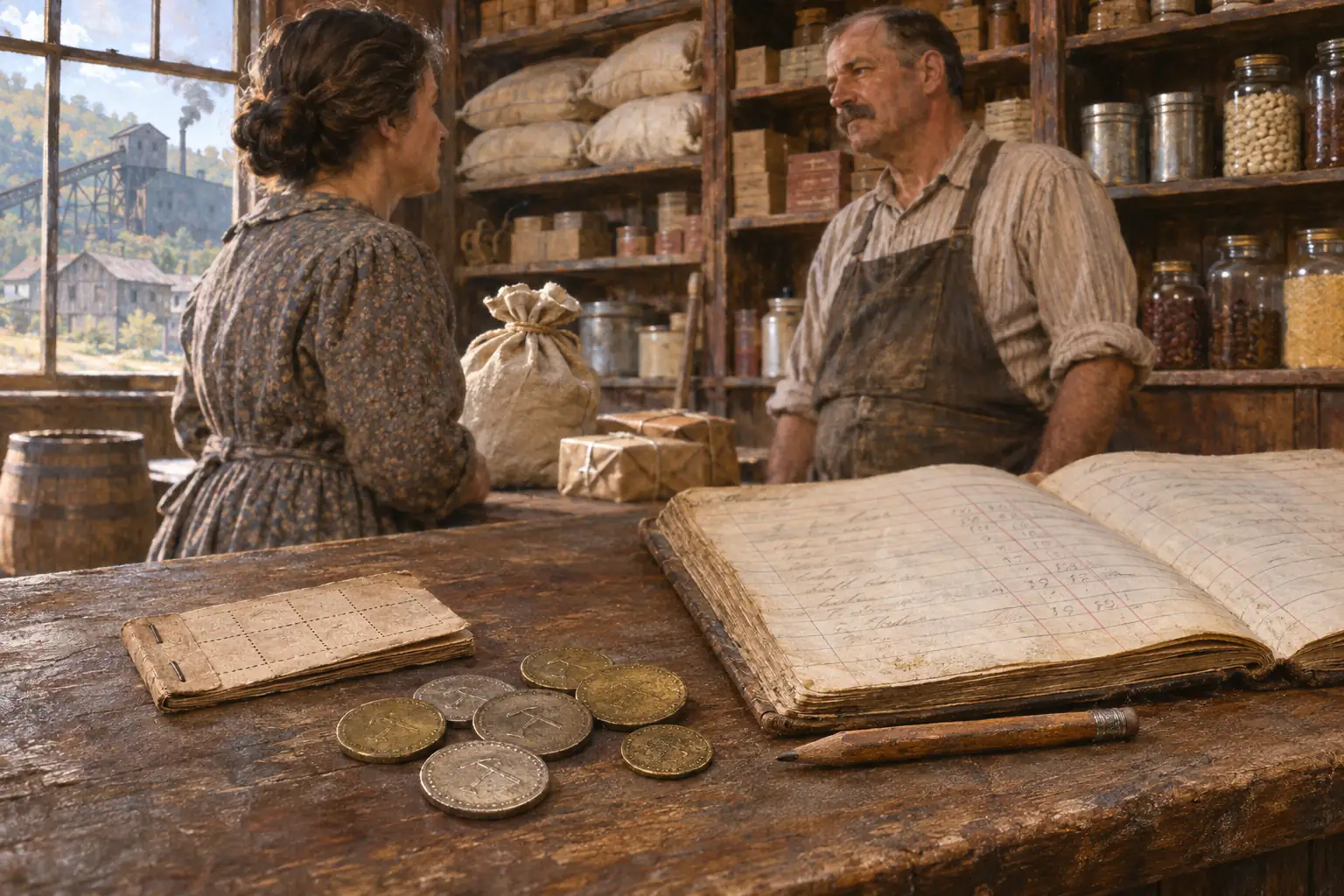
Coal mining scrip took different forms. Some pieces looked like coins. Others were coupons in small books, designed to be used a little at a time.
A surviving booklet at the Smithsonian makes the paper system easier to picture. Black Diamond Collieries issued it in Coal Creek, Tennessee, during the 1920s. It contained five- and ten-cent coupons worth $2 altogether, redeemable for goods at the company’s stores.
The Southern Coupon Company made the booklet. Its design required the recipient to break it open and sign a page acknowledging receipt. This was a controlled issue of spending credit, with a record that someone had received it.
Metal scrip could also come in several values. The Smithsonian holds tokens issued by the Liberty Trading Company of Madera, Pennsylvania, ranging from five cents to ten dollars. A token’s company name and denomination helped identify what it represented. Its value still depended on the rules for accepting it.
Why Companies Favored the System
Scrip offered clear advantages to the employer. Athey explains that it reduced the amount of cash flowing out of the business and lowered the risk of payroll theft. The company could also collect advances directly through wage deductions.
The store had its own business purpose. Coal company stores sold provisions and supported company policy; they were not simply a free service for workers. An employer could earn money from store sales while keeping much of a household’s spending within its own businesses.
This arrangement was part of the wider structure of coal mining company towns, where employment, housing, and everyday services were closely connected. For a family, convenient access to credit came with an important question: how much freedom did that credit leave?
Could Miners Spend It Somewhere Else?
Sometimes, but the answer depended on the issuer, the period, and the merchant. A rule printed on a token did not always describe everything people did with it.
The West Virginia Encyclopedia records traders buying scrip below its face value and independent stores accepting it at a discount. A miner might obtain cash or buy goods elsewhere, but lose part of the scrip’s value in the exchange.
For example, exchanging one dollar of scrip for 75 cents in cash would cost the worker 25 cents of purchasing power. That arithmetic illustrates a discount; it was not a universal rate.
Stearns provides another useful detail. The Park Service reports that private merchants accepted its scrip because they trusted the company behind it. Company store scrip could circulate beyond the original store, even though it was far less flexible than ordinary money.
When Store Credit Became Pressure
Having access to cash on payday did not guarantee a household’s independence. Credit could become a way to influence a worker’s decisions.
Historian Lou Martin recounts an episode from miner Fred Mooney’s memoir. Mooney described remaining in debt despite being one of his mine’s leading producers. He and his wife, Lillian, planned for him to look elsewhere for work when the mine was idle.
According to that account, the store bookkeeper learned of the plan and refused Lillian further scrip. She protested and expressed support for a union. Fred was fired, and the family was given three days to leave town.
This is a remembered personal experience, presented through Martin’s account of the memoir. It shows why the question was larger than the price of flour. When the employer could cut off credit and housing, a family’s effort to find better work could become a crisis.
Were Company Stores Always More Expensive?
The evidence does not support one answer for every store. Isolation, competing merchants, available jobs, and the period all mattered.
Economist Price Fishback’s study of the early 1900s found that company-store prices were generally similar to those at nearby independent stores. Competition from other stores and employers limited what companies could charge. His findings also challenge the claim that miners generally received their entire pay in scrip or always owed the store money.
Other evidence describes costly goods and serious restrictions. The Smithsonian’s scrip records identify markups in isolated towns with weak labor unions. The Mooney story shows that a family could experience company credit as a source of pressure.
These accounts concern different evidence and circumstances. A broad price comparison cannot tell us what happened to every household. A single family’s experience cannot establish the prices and rules at every mine. Both help us ask better questions about a particular place.
Even Nearby Towns Could Use Different Rules
Trammel, Virginia, provides a striking comparison. The Historic American Buildings Survey’s account records that the town’s operators did not use the scrip system, while the nearby Clinchfield mines at Dante and Clinchco did.
The same study preserves Glenn Boyd’s recollection that a miner at Dante could insist on receiving cash. Boyd nevertheless remembered the system as having catches that worked against miners. His later recollection belongs alongside the written records, with its local setting kept clear.
So, how were coal miners paid? There was no single arrangement across the coalfields. Identifying the employer and the year is the first step toward a useful answer. A photograph of company houses alone cannot tell us whether the people living there used scrip.
Why the Tokens Outlasted the System
As shopping and transportation changed, company stores faced more competition. Athey describes automobiles, mail-order goods, and other sources of credit weakening the system. It did not end everywhere at once: Stearns continued using scrip until 1964.
A surviving token or coupon book can still connect a family to a particular company and town. Pair it with a pay statement, store account, or dated recollection, and the picture becomes more useful. The token shows a form of payment; the other records may explain what it meant in someone’s life.
Scrip could bridge the days before payday. It could also make a family more dependent on the business that paid its wages. Understanding both uses gives the people who handled it a fuller history.
Does your family have coal scrip, an old pay envelope, or a company-store account? Share the company name, town, and any known dates through Redneckosity’s contact form. Family stories can provide leads for checking the surviving records.
Strong Backs. Red Necks. Deep Roots.

Explore more stories about mountain work, family, and survival in Coal Mining Lives & Labor.
Sources and Further Reading
- National Park Service — Scrip: A Coal Miner’s Credit Card
- Smithsonian National Museum of American History — Coal Scrip Booklet, Black Diamond Collieries
- Smithsonian National Museum of American History — Mining Tokens, Liberty Trading Company
- Lou Athey, West Virginia Encyclopedia — Scrip
- Lou Athey, West Virginia Encyclopedia — Company Stores
- Lou Martin — Coal Company Scrip Paid to Miners Often Left Them Deep in Debt, including Fred and Lillian Mooney’s story
- Price V. Fishback — Did Coal Miners “Owe Their Souls to the Company Store”? Theory and Evidence from the Early 1900s (study abstract)
- Historic American Buildings Survey — Trammel Middle Camp, including the local scrip comparison and Glenn Boyd’s recollections, page 16 (PDF)