
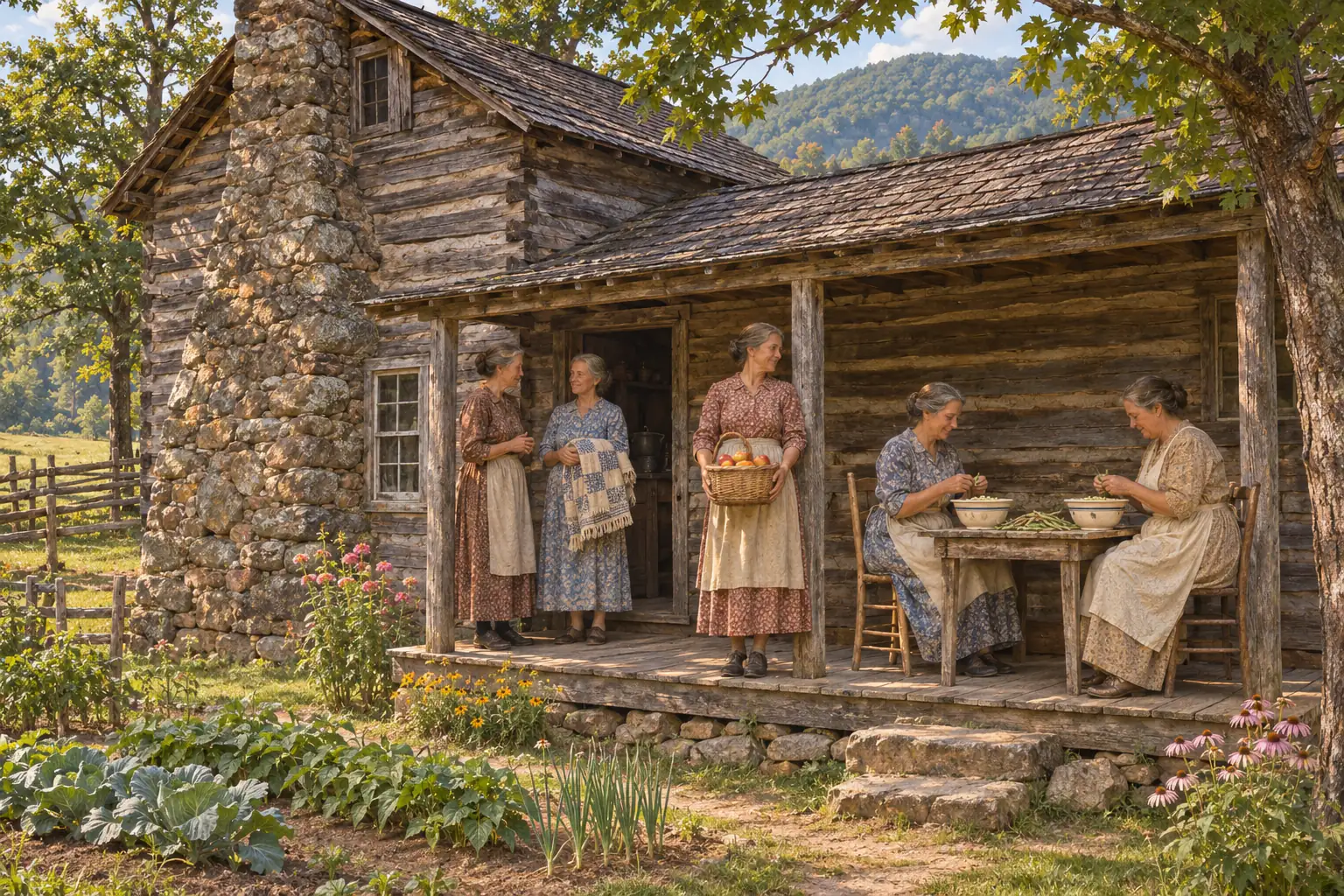
Who were the Walker sisters? They were six unmarried sisters who kept their family farm in Little Greenbrier Cove, Tennessee, and became known for remaining at home after the creation of Great Smoky Mountains National Park. Five were still living when they secured the right to stay.
Their story reaches beyond an old cabin. It follows women who grew food, made clothing, sold goods, cared for one another, and negotiated for the place that held their family history. Keeping that home required steady work, help from others, and decisions about how much of their lives to share with visitors.
Six Sisters, Then Five, Then Fewer
John N. Walker and Margaret Jane King Walker raised eleven children: seven daughters and four sons. Their sons left home, and one daughter, Sarah Caroline, married. The six unmarried daughters who remained were:
- Margaret Jane
- Mary Elizabeth, known as Polly
- Martha Ann
- Nancy Melinda
- Louisa Susan
- Hettie Rebecca
Their father died in 1921. Nancy died in 1931, leaving the five sisters whose home became known as Five Sisters Cove. The number matters: accounts describing six, five, four, or two sisters may be referring to different years.
The Walker Sisters Homestead Was More Than a Cabin
The homeplace came through their mother’s family. John Walker expanded the property and equipped it with buildings, furniture, and tools.
The National Register nomination describes a farm of about 122 acres, with fields and several working buildings. The house had three rooms arranged in an L shape, including a kitchen wing and a porch. Hewn logs rested on a stone foundation. Large fieldstone chimneys served the kitchen and the main living room, which also held beds.
Other structures had specific jobs. The corncrib stored part of the harvest. Water flowed through a stone trough in the springhouse. A mill and blacksmith shop had also been part of the farm. This was a place equipped to produce and store what a household needed.
The preserved house, springhouse, and corncrib show only part of that larger working landscape. To understand the sisters’ lives, picture the fields and supporting buildings along with the cabin. Home included the resources that made staying possible.
Work Connected the Farm to the Family
Journalist John Maloney visited the sisters before his April 1946 Saturday Evening Post article appeared. His account describes stocked food supplies, sheep, homemade garments, and spinning that continued through winter. The work involved many linked skills: raising an animal, preparing its wool, making yarn, and turning that yarn into something useful.
One detail reaches far beyond the cove. Maloney watched Margaret spinning yarn for stockings and for socks intended for nephews still overseas after World War II. Hettie explained their concern about keeping relatives’ feet warm in Europe. Work done beside a mountain fireplace could reach family members across an ocean.
That is a more revealing picture than the article’s title, “Time Stood Still in the Smokies,” suggests. The sisters used older methods while responding to events in their own time. Their family connections did not stop at the mountain ridge.
The Park Service’s historical study also records Hettie’s work in a Knoxville hosiery mill and Martha’s domestic work for nearby families.
Self-Reliance Included Help From Neighbors
Robin Goddard knew the sisters as a child. In an interview published by Smokies Life, she recalled accompanying their friend Elsie Burrell to the farm. Burrell helped with planting and harvesting, and Goddard’s father made drying racks for the household.
Goddard remembered spending weeks there and sleeping in a trundle bed. Her account describes people working together in the garden: Margaret made planting holes, Goddard dropped in seeds, and others followed with fertilizer and soil. It is a memory of cooperation, with different people contributing to the same task.
She also remembered the sisters’ brothers butchering hogs for them. The household’s achievements were substantial, but they were supported by relationships. Self-reliance here meant having skills and resources while still accepting help.
These are Goddard’s later recollections, not a daily record covering every year. Their value lies in the close view they offer of the women as hosts, neighbors, and relatives. They help explain how a demanding farm continued to function as its residents grew older.
Caroline’s Family Helped Preserve Their World
Sarah Caroline’s husband, James Baldwin “Jim” Shelton, provides another connection beyond the household. He had worked for John Walker and became a photographer of mountain life.
An archival record in Southern Appalachian Digital Collections describes Shelton carrying a camera, glass plates, and tripod through the Smokies. He developed his negatives in a small darkroom built over a stream. His photographs preserve people and places that might otherwise be known only through written descriptions.
The sisters’ brother-in-law was helping create that visual record. Their family story includes people who used newer tools to document older ways of living. It also reminds us that the women had relatives whose homes and work followed different paths.
Why Did the Walker Sisters Stay?
Louisa’s poem “My Mountain Home” expresses love for the house that sheltered her and anger at its threatened loss.
Staying required negotiation. The Park Service’s historical study records a late-1940 agreement for $4,750 under threat of condemnation. Title passed to the United States on January 22, 1941. The five surviving sisters reserved a life estate: the right to remain and use the property during their lives.
That distinction matters. They did sell the land; they also secured continued residence. Their experience belongs alongside the wider story of why families left Cades Cove, although the Walker home was in Little Greenbrier Cove, a different community.
Park ownership brought restrictions on hunting and other uses of land. Yet Maloney’s later account still describes cows, sheep, and firewood at the homeplace. Their reserved rights and the continuing farm both matter when explaining how life changed inside the park.
Historian Rachel Lanier Roberts places the sisters alongside women who promoted the park in her research on women and park creation. Her study emphasizes that people valued the mountains differently, including for tourism and economic opportunity. The sisters’ own attachment to a working home helps explain why protecting a landscape and protecting a household could produce different priorities.
Visitors Brought Income and More Work
The national magazine story brought wider attention to the homestead. Smokies Life’s account describes the many visitors who followed and the sisters’ response: they sold things people wanted to take home, including apples, small handmade goods, and Louisa’s poems.
That was a practical adaptation. A visitor might see an unusual way of life; the sisters saw a possible customer. Their knowledge and handiwork could bring spending money without requiring them to abandon the homeplace.
The exchange also changed what home demanded of them. Making something for a buyer took time. So did greeting strangers and answering their questions. Hospitality became another responsibility alongside the farm’s existing work.
Their surviving handmade clothing and baskets, pictured in the Smokies Life account, help keep those skills visible. Such objects deserve attention as products of time, judgment, and practiced hands. They were useful possessions and, in some cases, goods for sale before they became historical artifacts.
When Margaret and Louisa Needed Rest
By 1953, only Margaret and Louisa remained at the house. In a letter preserved in the Park Service study, they asked the superintendent to remove a roadside sign advertising their home. At 82 and 70, they could no longer handle their work and so many visitors. They wanted a rest, while leaving open the possibility of welcoming people again.
Their request deserves the same respect as their earlier determination to stay. They wanted some control over daily life at home.
Margaret died in 1962. Louisa, the last sister living at the homestead, died in 1964. Caroline, who had married and lived elsewhere, survived until 1966.
Remembering the Women Behind the Landmark
The Walker sisters’ story is often told through what they kept: their cabin, older skills, and a home on family land. Their decisions deserve equal attention. They negotiated with officials, sold to visitors, maintained family connections, and eventually asked for fewer interruptions.
Those choices give the familiar cabin a fuller meaning. It was a place where people worked out how to live together as circumstances changed. The strongest tribute is to remember the women as people with abilities, preferences, and limits, rather than expecting them to stand for an entire region.
Does your family have a Walker sisters photograph, a handwritten poem, or a memory of visiting their home? You can share details through Redneckosity’s contact form. Names, dates, and the history of an object can help us investigate a family account alongside other records.
Strong Backs. Red Necks. Deep Roots.

Explore more stories about mountain work, family, and survival in Appalachian Mountain Life.
Sources and Further Reading
- National Park Service — The Walker Sisters
- National Park Service — Walker Sisters’ Place, National Register Nomination
- Robert R. Madden, National Park Service — Walker Sisters Home Historical Study (1969), Including the Sisters’ Letter
- John Maloney — Time Stood Still in the Smokies, The Saturday Evening Post (1946)
- Sue Wasserman, Smokies Life — Robin Goddard’s Recollections of the Walker Sisters
- Southern Appalachian Digital Collections — Jim Shelton’s Photography Studio, Archival Record
- Frances Figart, Smokies Life — Reflecting Upon the Walker Sisters During Women’s History Month
- Rachel Lanier Roberts, Appalachian State University — Great Women of the Great Smoky Mountains National Park, Thesis Abstract and Record (2012)