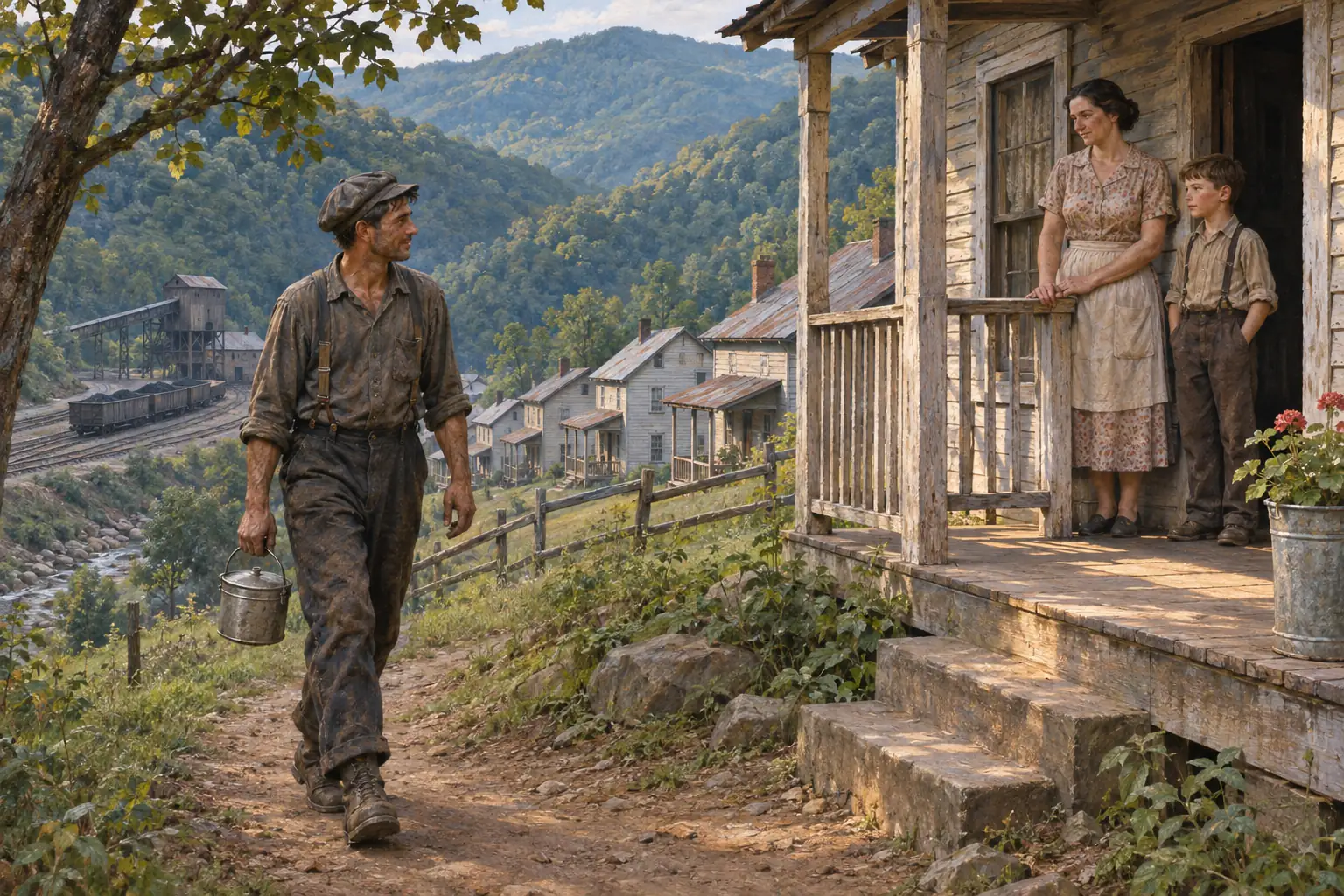
Appalachian coal mining helped power factories, railroads, and homes while changing life in the mountain coalfields. Mines brought wage work, new neighbors, and company towns. They also brought dangerous jobs and employers whose influence could reach from the coal seam to a family’s front door.
To understand that history, follow the people as well as the coal. Their choices about work, housing, children, and staying or leaving explain how an industry became a way of life. This introduction focuses on the central Appalachian coalfields, especially West Virginia, eastern Kentucky, and Southwest Virginia, from the late 1800s through the mid-1900s.
A Temporary Job Became a Family’s Home
Clifford Davis did not arrive at Kaymoor, West Virginia, planning to spend decades there. In a 1980 oral history interview preserved by the National Park Service, he recalled moving between mining jobs as operations closed and the Depression made work scarce. A small farm in Kentucky helped his family get through the hard years.
Then word passed through a friend: Kaymoor was hiring. Davis joined a group of men who went looking for work there in 1933.
He expected a short stay. His wife wanted to remain. In Davis’s account, her preference helped turn a temporary move into a lasting one. He took on different jobs and eventually moved into mine management.
His recollection shows how farming, wage work, friendship, and family decisions could overlap. Moving into a coal town did not mean leaving every older skill or connection behind. It meant finding a way to make a household work under new conditions.
The Railroad Made the Coal Worth Shipping
Coal beneath a mountain was only part of the opportunity. Operators also needed a practical way to get large amounts of it to buyers.
At Nuttallburg in West Virginia’s New River Gorge, John Nuttall began acquiring land and preparing for mining before the Chesapeake & Ohio Railway reached the gorge in 1873. The railroad connected the operation to distant industrial markets. Mines, transport, and settlement grew together.
Southwest Virginia followed a similar pattern. The Library of Virginia traces the coalfields’ expansion through investment, land and mineral-rights purchases, and new rail lines. Norfolk and Western shipped its first Pocahontas coal in 1883. Other lines helped carry coal from the region to buyers beyond the mountains.
Railroads also carried things into coal mining towns. At Nuttallburg, the Park Service describes trains bringing mail, newspapers, and supplies. A rail connection could shape daily life as much as the mine entrance did.
Underground Work Required More Than Strength
The familiar picture of a miner with a pick captures only part of the job. Coal had to be loosened, loaded, hauled out, checked, sorted, and shipped. Work depended on the coal seam, available equipment, and the period.
The Park Service’s study of Kaymoor describes early miners cutting and loading by hand in cramped conditions. Mechanical cutters later reduced some of that labor, but shoveling continued alongside newer machinery. A mine could use modern equipment for one task while relying on handwork for another.
Pay could depend on the coal credited to a worker. At Kaymoor, loaded cars carried identifying tags. Workers could lose the pay for a car rejected for containing too much unwanted rock. Getting coal into a car and getting paid for it were connected, but they were not the same thing.
Roof falls, fires, explosions, and moving equipment added risks. A strong back mattered. So did experience, judgment, and the conditions an employer provided.
The Company Could Be the Employer and the Landlord
Coal companies often built housing and services near their mines. That made it possible to recruit workers where a large town did not already exist. It also gave one business unusual power over a family’s daily needs.
A miner might depend on the company for employment, rent a company house, and buy supplies at its store. In labor disputes, losing a job could also mean losing a home. That connection helps explain why disagreements at work reached so far beyond the mine.
Company-store stories need local detail, though. The claim that every miner received all his wages in company money does not hold up. The Park Service records that the Stearns Company paid miners in cash every two weeks. Workers who needed an advance could receive scrip, which was deducted from their next pay.
Credit could get a family through to payday while increasing its dependence on the employer. The rules and practical choices varied among companies and communities.
Who Built the Coalfield Communities?
The coalfields drew people from different places and backgrounds. Local mountain residents worked alongside Black migrants from other parts of the South and immigrants from Europe. Some arrived with mining experience. Others came looking for a better chance to support a family.
Living near the same mine did not erase unequal treatment. At Nuttallburg, Short Creek divided Black and white neighborhoods. Schools and churches were separate. The Park Service’s account makes clear that a shared workplace could exist alongside a divided town.
Residents also built social lives within those conditions. Churches, clubs, music, visiting, and baseball gave people ways to gather. Black coal-camp teams and their supporters were part of that community history.
These details matter because Appalachia was never one uniform group of people. A coal town’s history changes depending on whose experiences we include.
Family Work Continued After the Shift
A mine payroll did not record all the work that kept its workforce going. Meals had to be prepared, clothes washed, water carried, children cared for, and limited money stretched.
PBS’s account of women in the southern West Virginia coal camps describes that demanding household labor. A home stood close to the workplace, and worries about injury, unemployment, or eviction followed families through the door.
Gardens and other earnings could help. The Library of Virginia notes that some mining families grew and preserved food, while women sold butter and eggs. Its discussion of Depression-era interviews also points to seasonal work and parents’ hopes for better schooling for their children.
Those hopes belong in coal mining history alongside production figures. A household might depend on a mine today while wanting different choices for the next generation.
Why Labor Struggles Reached Beyond Wages
Better pay mattered, but miners also sought safer conditions and the ability to organize. When an employer controlled housing as well as work, a union campaign could put a family’s shelter at risk.
In southern West Virginia, resistance to union organizing helped produce the conflicts known as the Mine Wars. The Paint Creek and Cabin Creek strikes of 1912–1913, the violence at Matewan in 1920, and the Battle of Blair Mountain in 1921 belong to that history.
These were distinct events with their own people and causes, rather than one continuous battle. Together, they show how disputes over work became struggles over power in the coalfields.
Families participated too. PBS describes women maintaining households in union tent colonies after evictions and taking active roles in the strikes. The consequences reached people who never worked a shift underground.
More Machinery Changed Jobs and Towns
Mining technology changed gradually and unevenly. The Park Service’s account of Blue Heron in Kentucky offers a useful example: the operation had electricity from the beginning, yet miners still loaded coal by hand.
Mechanical loaders later changed both the work and the pay system there. As hand loading gave way, workers were paid by the shift rather than by their individual tonnage. New equipment could remove punishing tasks while changing how many workers an operation needed.
Across the coalfields, job losses, exhausted reserves, changing markets, and company decisions affected towns differently. Nuttallburg stopped producing coal in 1958. Some other communities survived after company ownership ended; people continued living in houses that had once belonged to an employer.
There was no single ending shared by every town. A closed mine might leave abandoned foundations, a smaller community, or families carrying their memories to another place.
Remembering a Place Where People Lived
Old mine buildings can make coalfield history look entirely industrial. Former residents often remembered something more personal.
Elizabeth Alexander Lambert, who lived at Nuttallburg from 1924 to 1945, recalled watching moonlight on the New River from a clubhouse porch. The Park Service preserves her memory alongside its account of the town’s mines and segregated neighborhoods.
Affection for a place can exist alongside hardship. Remembering both gives coalfield families room to be people with attachments, disagreements, skills, and plans. Their homes were tied to an industry, but the lives built there cannot be measured only in tons of coal.
Does your family have a coal-camp photograph, a miner’s lunch bucket, or a story about moving for work? Share what you know through Redneckosity’s contact form. Names, places, and dates help us connect family memories with the historical record.
Strong Backs. Red Necks. Deep Roots.

Explore more stories about mountain work, family, and survival in Coal Mining Lives & Labor.
Sources and Further Reading
- National Park Service — Oral History Project: Mining, including Clifford Davis’s 1980 interview
- National Park Service — Nuttallburg
- Vince Brooks, Library of Virginia — Virginia’s Coal Towns
- National Park Service — Coal Mining Methods at Kaymoor
- National Park Service — Scrip: A Coal Miner’s Credit Card
- National Park Service — African American Life in a Coal Camp: Nuttallburg
- PBS American Experience — Women in the Mine Towns
- Rachel Donaldson, National Park Service — Introduction to the West Virginia Mine Wars
- National Park Service — Mine 18, Blue Heron
- National Park Service — Exploring Nuttallburg, including Elizabeth Alexander Lambert’s recollection