
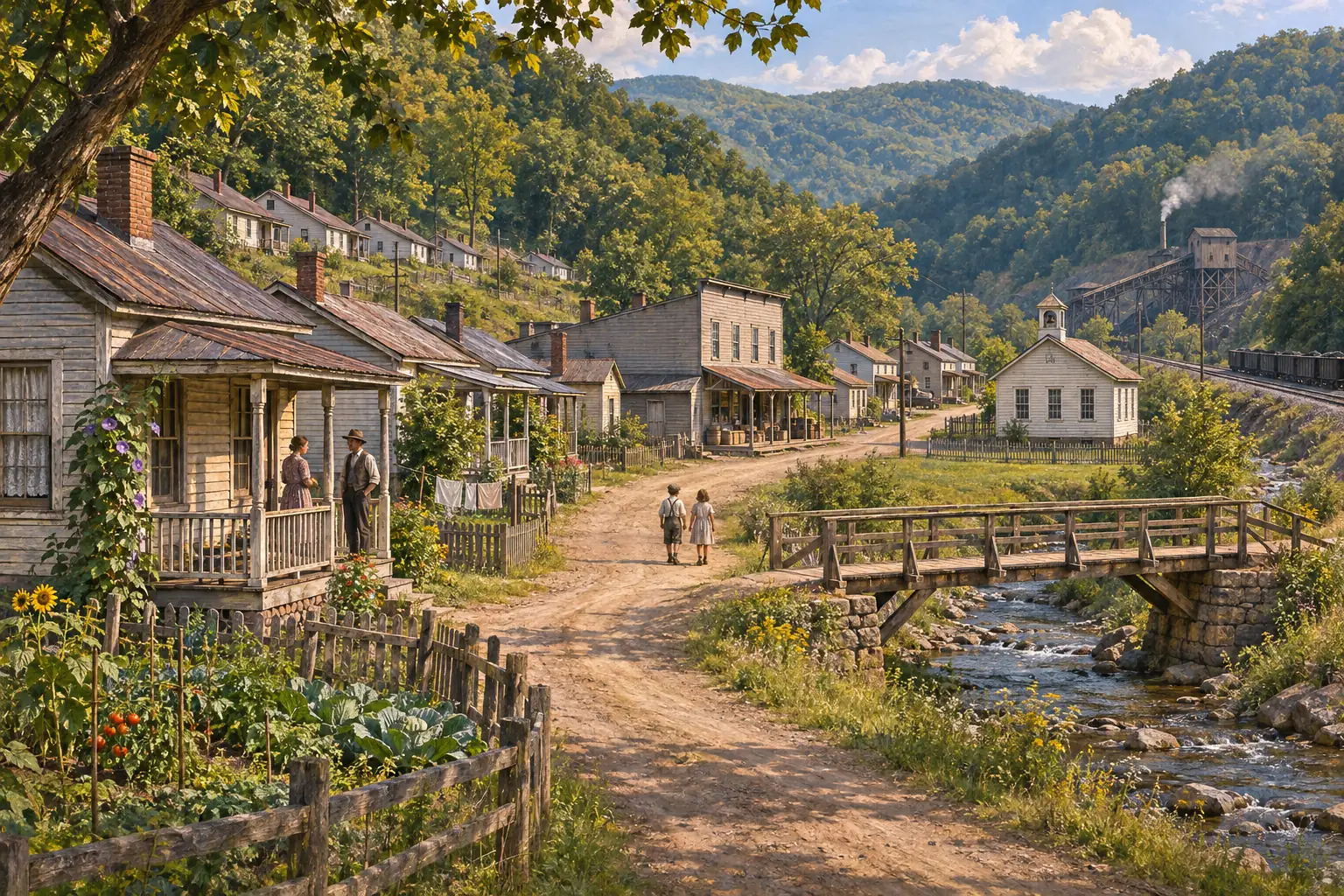
Coal mining company towns gave workers a place to live near the mine, while putting much of daily life under the employer’s control. Companies built homes, stores, schools, and other services to attract a workforce and keep it nearby. Families then made communities within those arrangements, with friendships and loyalties that reached beyond the payroll.
In the central Appalachian coalfields, these settlements were often called coal camps. The name could describe an established town with houses and public buildings. To understand life there, it helps to look at particular places: a steep West Virginia hillside, a Virginia creek valley, and even one woman’s trip to buy milk.
The Town Was Part of the Hiring Offer
A mine opening in a remote area needed more than equipment. It needed people who could get to work, find shelter, and feed their families. Building a town helped an operator meet those needs.
The Library of Virginia describes a change in Southwest Virginia’s coal camps over time. Early boardinghouses served many unmarried men. Duplexes and single-family homes became more common as companies recruited married workers and sought a more settled workforce.
A house, a nearby school, and access to supplies could make a job more appealing. Virginia’s Department of Historic Resources identifies attracting and keeping coal workers as a purpose behind Derby’s carefully planned buildings.
Those practical benefits help explain why families moved into company towns. The larger history of Appalachian coal mining shows how such moves connected household decisions with the growth of an industry.
A Milk Errand at Kaymoor
Bessie Cottrell’s recollection gives us a small, useful window into that world. According to the National Park Service’s history of Kaymoor, she lived at Kaymoor Bottom and bought milk and butter from Mrs. Donnelly at Kaymoor Top. The company store did not carry dairy products in the 1920s.
Getting there meant riding the haulage, a rail system that carried people up and down the steep slope. Kaymoor occupied three levels, with homes above and below the mine. Passenger trips operated around the mine’s transportation needs.
That ordinary errand reveals two parts of company-town life. The employer’s equipment shaped how a resident moved through town. A neighbor supplied something the company store did not. Daily life depended on both.
Mountains Drew the Street Plan
Coal mining towns often followed the land available between a creek, a railroad, and a steep hillside. Their layout affected the walk to school, the route to a neighbor’s house, and access to the world outside.
At Nuttallburg, West Virginia, houses climbed the gorge slope above the New River. The Park Service describes homes built on piers, fitted into the hillside. The town had road access, but most residents lacked automobiles. Trains brought newspapers, mail, and supplies.
Stonega, Virginia, developed along Callahan’s Creek. Its historic district record describes a settlement stretching beside the road and railroad toward the head of the valley. Named sections included Midway, with single-family homes, and Red Row, a historically African American neighborhood of double houses.
These were different ways of fitting a town into a mountain valley. A map can show the distances between buildings; knowing who lived in each neighborhood explains much more.
A Company House Could Mean Different Things
The phrase “company house” does not describe one standard home. Building materials, room arrangements, water systems, and upkeep differed by company, place, and period.
Derby offers a useful example. Built in 1923, it included two-story duplexes made from hollow clay tile. Its National Register nomination records piped water and toilets on rear porches. Some larger homes went to supervisors and other favored residents. Better construction did not remove differences in status.
That example matters because a photograph of one rough camp cannot stand for every coal town. Nor can a well-planned settlement prove that conditions were good everywhere. The Library of Virginia notes that inadequate water and sewer systems remained a problem in many camps.
Ownership created another distinction. A family could make a rented house comfortable without gaining control over whether it could remain there. During labor conflicts in southern West Virginia, eviction from company housing became a threat to the whole household.
Schools and Churches Followed the Town’s Divisions
A school or church within walking distance could help a family put down roots. Coal companies supported these institutions in different ways. In Southwest Virginia, companies paid teachers and made land available for church buildings.
Access was divided by race. At Nuttallburg, Short Creek separated Black and white neighborhoods. Each side had its own school, church, and clubhouses. The same employer and a shared town name did not mean children attended the same classroom or neighbors worshiped together.
Nuttallburg’s schools provided elementary education. Continuing to high school meant traveling beyond town by road or rail. For Black students, that meant reaching a school open to African Americans.
Churches also served as places for social gatherings and community activity. Their importance came from the people using them, as well as the buildings themselves. To understand a family’s experience, we need to know which school and church it could attend, not simply whether the town had one.
The Store Was a Meeting Place and a Seat of Power
A company store supplied goods, but its role could reach well beyond shopping. At Derby, the store building also housed the doctor’s office and company offices upstairs. The town’s public buildings stood together near a widened stretch of road that formed a gathering place.
The historic nomination records men spending time outside the store, whittling and exchanging stories. A building associated with the employer also became a place where residents passed time with one another.
Store credit and company scrip are part of this history, but they do not explain the entire town. The location of the store, the services inside it, and the other places residents could shop all shaped its influence.
Residents Made Their Own Social Life
Coal-camp memories often include music, games, and visiting. Those activities deserve attention alongside accounts of hard work and company power.
The Library of Virginia records a band formed by miners at Roda and an African American quartet sponsored by the company at Stonega. Companies also encouraged sports, and rivalries between camps could become intense.
The Park Service describes porch music, visits with friends, and Sunday baseball in African American coal-camp communities. A team gave players and supporters a reason to gather and a community to cheer for.
At Kaymoor, residents remembered Fourth of July celebrations and advance orders at the company store for ice cream, soda, and watermelon. Such memories help explain people’s affection for places where their choices were often limited.
What the Company Owned and What Neighbors Built
The hardest part of company-town life was how closely a family’s needs could depend on one employer. A dispute at work might threaten its home as well as its income.
PBS’s account of southern West Virginia’s Mine Wars describes striking families evicted from company houses and living in union tent colonies. Residents could challenge company authority, but doing so could carry a cost far beyond a missed paycheck.
Company town history needs room for both that power and the lives people made within it. A school building mattered because children learned there. A porch mattered because neighbors gathered there. A familiar route through town mattered because someone at the other end had something to sell, news to share, or time to visit.
Bessie Cottrell’s milk errand brings that history down to human scale. The company supplied the transport. Mrs. Donnelly supplied the milk and butter. Understanding the town means seeing both.
Does your family have a photograph of a coal-camp school, store, church, or ball team? Share the town’s name, an approximate date, and what you know through Redneckosity’s contact form. Those details give us a useful starting point for checking the story.
Strong Backs. Red Necks. Deep Roots.

Explore more stories about mountain work, family, and survival in Coal Mining Lives & Labor.
Sources and Further Reading
- Vince Brooks, Library of Virginia — Virginia’s Coal Towns
- National Park Service — Kaymoor: Living in Kaymoor, including Bessie Cottrell’s recollections
- National Park Service — Exploring Nuttallburg
- Virginia Department of Historic Resources — Stonega Historic District
- Virginia Department of Historic Resources — Derby Historic District
- Gibson Worsham — Derby Historic District, National Register nomination, including housing descriptions and community history (PDF)
- National Park Service — African American Life in a Coal Camp: Nuttallburg
- PBS American Experience — Women in the Mine Towns