
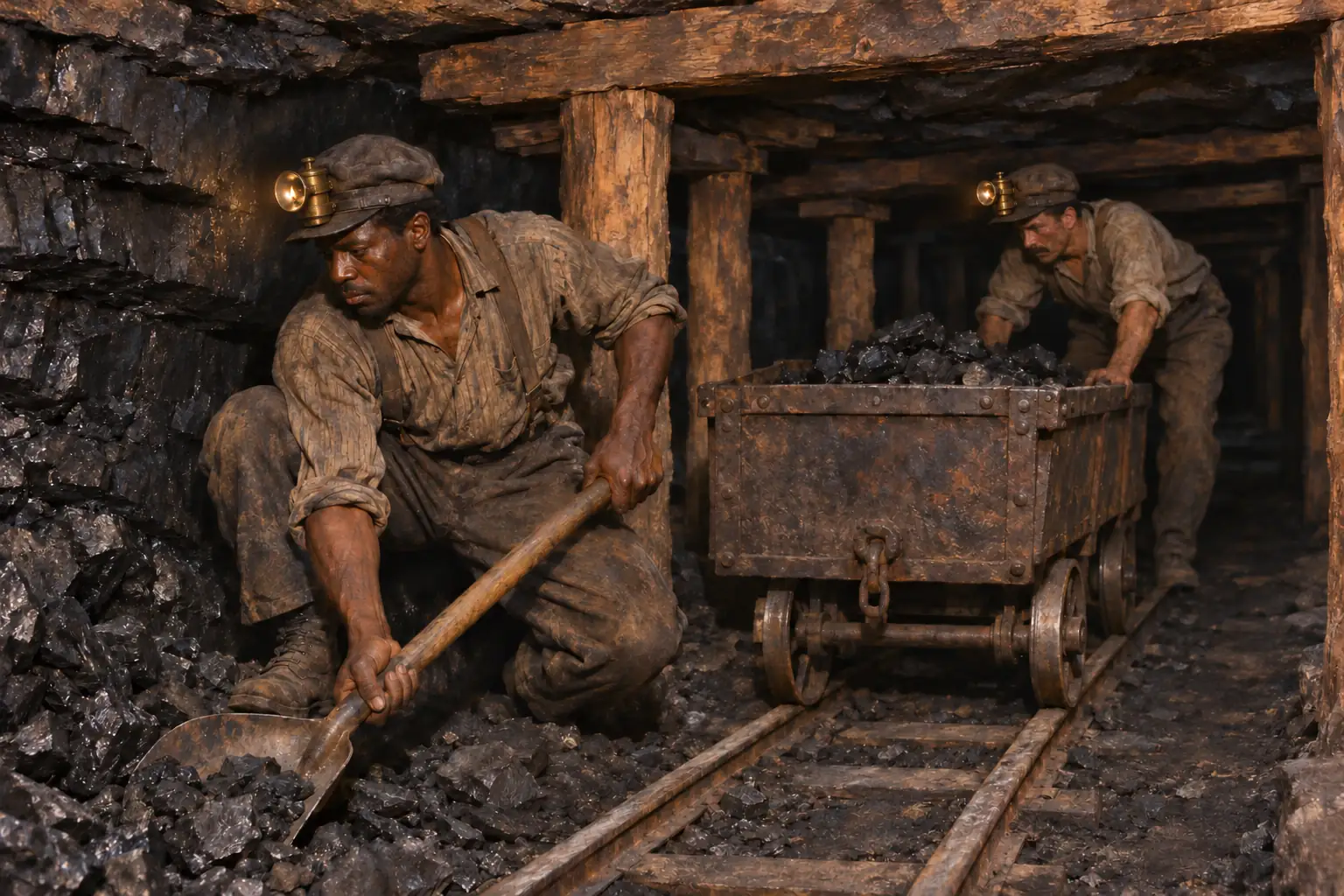
Coal mining jobs in the 1900s included cutting and loading coal, hauling cars, laying track, supporting roofs, and keeping air and water moving through the mine. Some workers earned money by the coal they produced. Others were paid for their time. A working shift depended on both groups.
The jobs below focus on Appalachian mines in the early decades of the twentieth century, with examples from West Virginia’s New River coalfield. Equipment and pay rules differed among mines and changed over time. Following the work through a mine reveals much more than a list of job titles.
Getting to the Coal Face
A miner’s workplace might be well beyond the entrance. At Kaymoor, the mine opened into a hillside above the New River. The community’s haulage system carried people and supplies between the gorge’s upper, middle, and lower levels. Reaching the mine entrance was one stage of the journey.
Inside, workers made their way toward the places where coal was being removed. The exposed surface they worked was called the face. Rooms branched from larger passages, with blocks of coal left between them to help support the roof.
The route mattered. An open passage needed more than enough space for a person to squeeze through. Air had to reach the working area, and coal cars needed a usable way out.
Different Jobs Kept the Same Mine Working
Period records make these divisions clear. A Bureau of Labor Statistics report published in 1926 defined separate jobs in bituminous coal mines, including the following:
| Job | Main work |
|---|---|
| Hand or pick miner | Cut and loosen coal, then load it into cars. |
| Machine cutter | Operate equipment that cut into the coal seam. |
| Hand loader | Load loosened coal with a shovel; sometimes also handle supports and room track. |
| Driver or motorman | Move mine cars using mules or a powered locomotive. |
| Trackman | Lay and repair the rails used by mine cars. |
| Timberman | Fit and set supports inside the mine. |
| Bratticeman | Build partitions that directed ventilation through the workings. |
| Pumpman | Operate and maintain pumps that removed water. |
A title did not describe every task a worker might perform. The same report noted that some hand loaders also did timbering and track work. At Kaymoor, workers outside the tonnage system were known as company men and were paid by the day.
These jobs connected the underground workings to the wider world of Appalachian coal mining, where mines, railroads, and company communities depended on one another.
Cutting and Loading Took More Than Muscle
In hand mining, getting coal loose could be slow, cramped work. Historian Paul H. Rakes describes miners lying on their sides to cut beneath the seam. Standing water could make that position even more miserable. Drilling and blasting were also part of the work, followed by loading the broken coal.
Experience mattered throughout. Rakes explains that young miners often learned from relatives and that skilled workers watched and listened for warning signs in the rock. Familiarity with a seam could help a miner judge the work, but it could not remove the danger.
Once coal was loose, hand loading meant repeated shoveling into a waiting car. The National Park Service’s history of Black miners in southern West Virginia explains that loaders earned tonnage pay. Rock mixed into the load did not earn them money.
That history also describes why some Black miners valued loading work despite its demands. It offered less direct supervision than other jobs, an important difference for people leaving the restrictions of the Jim Crow South. The possibility of working with some independence existed alongside exhausting labor and dependence on the employer.
Coal Mining Tools Had Different Jobs
A collection of old tools becomes easier to understand when each item is connected to a task. The Kentucky Coal Museum’s glossary of equipment used between 1900 and 1940 includes:
- A pick for loosening coal and a broad shovel for loading it.
- A breast auger for boring into the coal face.
- An ax and bucksaw for preparing timber supports.
- A track wrench, rail gauge, and track hammer for work on the mine’s rails.
- A slate bar used when checking overhead rock.
The museum also records kneepads used in low seams and metal lunch buckets that carried food and water. Those everyday objects help show the posture and length of the work, even when a photograph captures only a single moment.
Miners also depended on coal mining lamps to see their work, and different lamp designs brought different risks.
Tools could be a worker’s expense. Rakes notes that hand loaders owned their implements and paid maintenance fees for the company’s blacksmiths. A worn or damaged tool was therefore more than an inconvenience: it affected the work and the household budget.
The Work That Did Not Fill a Coal Car
Some essential tasks produced no coal to weigh. Miners called this dead work. The Park Service’s Helen history describes roof support, ventilation work, and extending the tramway as duties for which a loader could receive no pay.
New River miner R. F. Forren remembered clearing rock to provide room for mules or gathering motors. In his 1980 oral history, he also recalled timbering and other dead work that brought no pay. The recollection explains the term from a worker’s side: necessary effort could disappear from the earnings calculation.
This did not mean that everyone who laid track or set a timber worked unpaid. Mines also employed workers paid by time to do those jobs. The distinction was who performed the task and what the pay arrangement covered.
For a loader paid by production, time spent preparing the workplace could mean less time filling cars. Counting only the coal would miss part of his day.
Keeping Loaded Cars and Empty Cars Moving
At Kaymoor, small electric locomotives called gathering motors moved cars near the working areas. Larger mainline motors pulled strings of cars toward the entrance.
As mining advanced, workers shifted rails into new areas. Canvas curtains helped direct air through the changing passages.
At the surface, a loaded car still had to be checked and weighed. Kaymoor’s dock boss inspected it for unwanted rock. A car with too much could cost its loader that car’s pay. The worker’s identifying tag connected the accepted load to his earnings.
Loading, haulage, inspection, and recordkeeping were separate parts of one job getting done.
Clifford Davis Remembered a Mine Changing Around Him
Machinery did not replace every older practice at once. Clifford Davis, who worked at Kaymoor from 1933, remembered a telling change in the mine’s buildings. In his 1980 interview, he described the old mule barn being adapted into a repair shop for motors. A concrete pit let workers get underneath the equipment.
The building had changed with the work: space once used for animals now served mechanical repairs. Davis also recalled distinct routes for loaded cars, empty cars, and shop traffic. His account shows how much organization lay behind the coal coming out of the mountain.
The Park Service’s mining history records another uneven change at Kaymoor. Cutting machinery operated while miners still shoveled coal by hand. Later conveyor equipment changed loading and pay in the areas where it was installed, without immediately changing the whole mine.
A photograph of a motor or cutting machine therefore cannot tell us that all the heavy handwork had ended. Different stages of the job could belong to different generations of equipment.
A Shift Was More Than Its Paid Hours
The journey back out also took time. Herbert Garten, another New River miner interviewed in 1980, recalled an arrangement in which his working day began at the workplace underground. Travel out of the mine came afterward.
Period payroll research supports the need to separate those measures. The Bureau of Labor Statistics’ study of 1933 reported time at the working place separately from total time inside the mine. It also counted days or parts of days worked, since a long shift did not guarantee a full week of employment.
There is no single clock-in time or daily wage that describes every miner in the 1900s. The mine, year, job, equipment, and pay rules all belong in the picture.
What the records do show is a workplace held together by many kinds of knowledge. Someone had to understand the coal, keep the rails usable, manage the water and air, repair the equipment, and get each load out. The shovel mattered. So did the work that made the next shovelful possible.
Was someone in your family a loader, trackman, motorman, or mine repair worker? Share the job title, mine name, and any known dates through Redneckosity’s contact form. Those details can help turn a family memory into a question the records can answer.
Strong Backs. Red Necks. Deep Roots.

Explore more stories about mountain work, family, and survival in Coal Mining Lives & Labor.
Sources and Further Reading
- U.S. Bureau of Labor Statistics — Hours and Earnings in Anthracite and Bituminous Coal Mining, 1922 and 1924; Bulletin 416 (1926), occupational definitions, pages 90–92
- U.S. Bureau of Labor Statistics — Wages and Hours of Labor in Bituminous-Coal Mining, 1933; Bulletin 601 (1934)
- National Park Service — New River Gorge Mining Oral Histories, including Clifford Davis, R. F. Forren, and Herbert Garten (1980)
- National Park Service — African American Coal Miners: Helen, West Virginia
- Paul H. Rakes, West Virginia Encyclopedia — Mining Methods in the Hand-Loading Era
- Kentucky Coal Museum and Southeast Kentucky Community and Technical College — Coal Education Curriculum, tools glossary, printed pages 18–19 (PDF)
- National Park Service — Kaymoor Mine Walking Tour, historical haulage and pay descriptions
- National Park Service — Coal Mining Methods at Kaymoor