
Battle of Blair Mountain history begins with coal miners trying to reach Mingo County, West Virginia, in 1921. They wanted jailed union supporters freed and a chance to organize. An armed force blocked their route through Logan County. The march became a battle, and federal troops brought it to an end.
One surviving red bandana brings that enormous story down to one young man. Hub Bane carried a rifle, ammunition, and a two-pound bag of flour to the miners’ encampment. He went home before the march. His bandana survived.
Why Did the Miners March Toward Mingo County?
By summer 1921, martial law had tightened the pressure on union miners in Mingo County. A militia that included coal company officials and anti-union men enforced it. Miners faced mass arrests, and anger spread beyond the county.
Then came the killings of Sid Hatfield and Ed Chambers on August 1. Hatfield, Matewan’s police chief, had become a hero to union supporters after the Matewan massacre in 1920. Baldwin-Felts agents killed him and Chambers outside the courthouse in Welch the following year. Their deaths deepened the miners’ belief that local authorities would not protect them.
The march had three closely connected aims:
- Free miners jailed under martial law in Mingo County.
- Support the union struggle there.
- Open the southern coalfields to union organizing.
Those demands grew from everyday problems. The United Mine Workers sought shorter hours, fairer weighing of coal, and support for miners’ widows and orphans. A fight over union rights could also be a fight over a family’s income and security.
How the March Gathered Strength
Thousands assembled around Marmet in the Kanawha Valley. Men arrived from different mining communities, bringing weapons and joining others headed south. Some had served in World War I. The gathering developed supply and medical arrangements, guards, and passwords. Estimates of its size vary widely, so a single exact head count would be misleading.
The march nearly ended before the major fighting. On August 26, federal officer Henry H. Bandholtz warned union leaders Frank Keeney and Fred Mooney that the Army could intervene. They persuaded miners to turn back, and arrangements began to send men home by train.
Then a late-night raid by deputies and state police at Sharples left miners dead. News of the violence brought men back toward the conflict. Some who had been preparing to leave resumed the march. The effort to disperse them had unraveled.
Why Blair Mountain Stood in Their Way
Logan County lay along the route toward Mingo. Its sheriff, Don Chafin, opposed union organizing and had financial backing from coal operators. He assembled deputies, mine guards, and other supporters along Blair Mountain’s ridgeline. The miners would have to get past them to continue.
The wooded slopes became a battlefront in late August and early September. Defenders held high ground and used machine guns against the approaching miners. Private planes associated with Chafin’s side also dropped homemade bombs. That bombing was separate from the later arrival of Army aircraft.
The fighting spread through difficult mountain terrain, rather than taking place in one open field. Records do not establish a reliable final death toll. Estimates of both the forces involved and the casualties differ. The uncertainty deserves to stay visible instead of being replaced by a confident-looking number.
What the Red Bandanas Meant
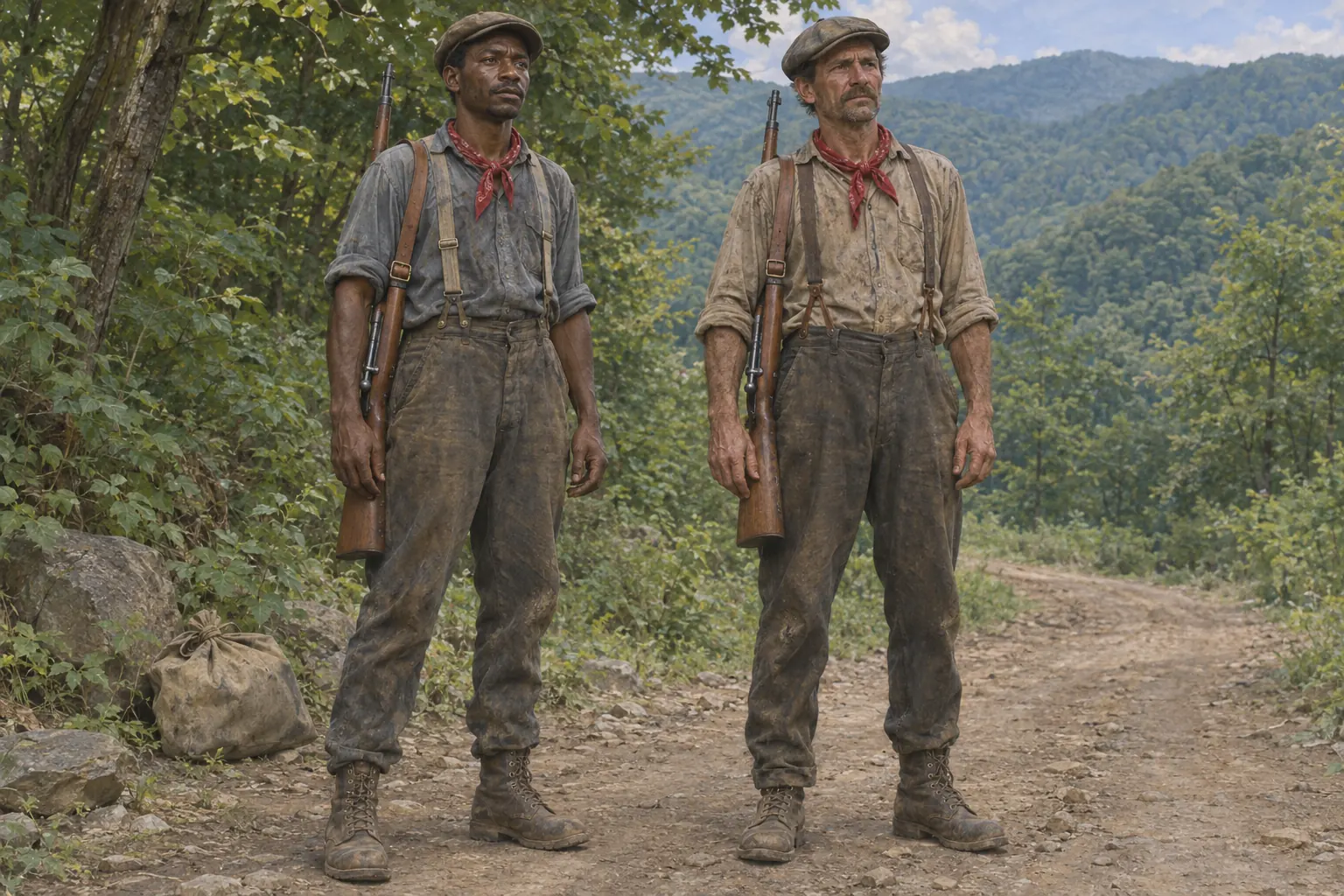
The miners’ red neck cloths served a practical purpose: identifying people on the same side. They also became a sign of solidarity among Black and white miners, including immigrants and men born in the United States. Shared work and shared demands brought people from different backgrounds into the same movement.
A courtroom record gives that clothing choice a direct explanation. In testimony at William Blizzard’s trial, miner Henry F. Crookshanks described being told to buy a red handkerchief. He explained: “Every man on this side was to wear something red so they could tell them from the other side.”
That testimony describes a way to recognize fellow participants during the fighting. A red bandana was more than a colorful detail added to the story afterward. It was something a miner could be instructed to get before going toward the firing line.
Hub Bane’s Bandana and the March He Did Not Make
Hub Bane was 21 during the summer of 1921. He had grown up in Burnwell and experienced the earlier Paint Creek–Cabin Creek conflict. When miners gathered again, he walked to the encampment at Hernshaw wearing his red bandana and carrying his supplies.
According to the West Virginia Mine Wars Museum, Bane returned home instead of continuing with the march. The reason is unknown. His grandson, Eddie Harless, later loaned the bandana to the museum.
That distinction matters. Bane’s bandana connects him to the gathering, but it does not prove that he fought at Blair Mountain. The cloth preserves a real person’s part in the story without requiring us to fill in the rest.
Did Blair Mountain Create the Word Redneck?
No. The red bandanas gave the word a powerful connection to the miners’ movement, but the word was already in print before 1921.
Historian Patrick Huber’s study of the term points to an 1893 account of Mississippi speech that used it for poorer white country people. That earlier usage was a class label, not a reference to the miners’ march in West Virginia.
Blair Mountain therefore belongs in the history of the word’s labor meaning. It should not be presented as the place where the word was first invented. The miners’ bandanas and the older insult are related parts of a longer story, rather than one tidy origin tale.
How Federal Intervention Ended the Fighting
President Warren G. Harding sent federal troops into the coalfields. Their arrival in early September changed the confrontation. Many miners were willing to challenge mine guards and local authorities but unwilling to fight the United States Army.
Army aircraft flew reconnaissance missions, but they did not use their weapons against the miners. Confusing those planes with the private aircraft that dropped bombs turns two different parts of the conflict into an inaccurate account.
Miners surrendered weapons or went home. Some hoped federal involvement would bring attention to their grievances. The armed march ended before reaching its goal in Mingo County. Ending the shooting did not mean that the miners had secured union recognition or relief from company power.
What Happened After Blair Mountain?
The immediate aftermath brought prosecutions and a weaker union movement. Membership fell, and miners returned to work under worse terms. Remembering the march as a proud stand should not hide that immediate defeat.
The court cases did not all end alike. In 1922, union leader William “Bill” Blizzard was tried for treason in Charles Town, in the same courthouse where John Brown had faced trial in 1859. Blizzard was acquitted.
Other defendants had different outcomes. Reverend J. E. Wilburn and his son John were convicted of murder. Walter Allen was convicted of treason, while the treason charges against Frank Keeney were dismissed. Blizzard’s acquittal was a major moment, but it did not erase the consequences for everyone involved.
Blair Mountain holds both a large public struggle and thousands of individual choices. Some miners fought. Some surrendered their weapons. Hub Bane turned home before the march. Keeping those differences in view helps us remember the people who lived the history, along with the red bandanas that came to represent it.
Strong Backs. Red Necks. Deep Roots.

Explore more stories about mountain work, family, and survival in Coal Mining Lives & Labor.
Sources and Further Reading
- National Park Service: The Battle of Blair Mountain
- Kenneth R. Bailey, e-WV: Battle of Blair Mountain
- Clayton D. Laurie, West Virginia History: Army intervention study (1991)
- West Virginia Mine Wars Museum: The miners’ 1921 uprising
- West Virginia Archives: Henry F. Crookshanks’s trial testimony
- West Virginia Mine Wars Museum: Hub Bane’s historic bandana
- Patrick Huber, Southern Cultures: A Short History of Redneck
- Neil Humphrey, Origins: The Battle of Blair Mountain
- Elizabeth James, WVU Libraries: Treason trials and archival records