
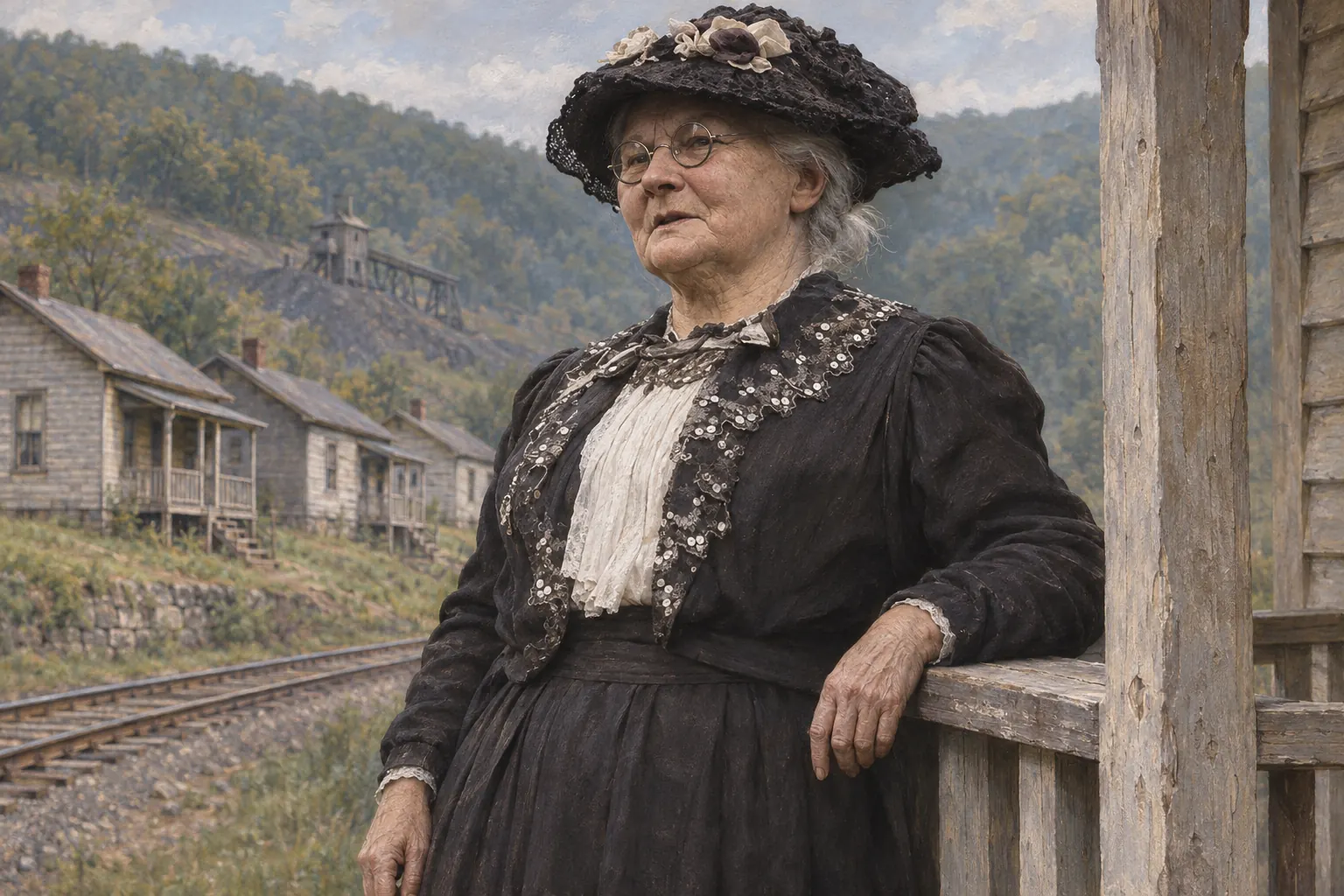
Mother Jones and coal miners built a powerful alliance in the fight for union rights. Mary Harris Jones traveled through mining communities, held meetings, rallied families, and challenged officials who stood in the workers’ way. In West Virginia, that work brought military imprisonment and national attention. It also brought a lasting difficulty: miners who trusted her did not always follow her advice.
A small detail from 1913 brings the famous organizer into focus. When reporter Mrs. Fremont Older finally gained permission to interview Jones during her detention, she found her holding curling tongs. Jones excused herself to finish arranging her white hair, then returned to talk. The interview, published in the San Francisco Bulletin on April 2, shows a woman attending to an ordinary task while refusing to abandon an extraordinary fight.
Mary Harris Jones Before the Coalfield Meetings
Jones was an Irish immigrant who worked as a teacher and dressmaker before becoming a nationally known labor organizer. Her husband, George, and their four children died during the 1867 yellow fever epidemic in Memphis. She later lost her Chicago dressmaking business in the Great Fire of 1871.
By the 1890s, she was active in the labor movement. Her work with the United Mine Workers of America took her into coal communities where joining a union could endanger a person’s job and home. The West Virginia Encyclopedia records her survey of the state’s coalfields in December 1900 and repeated organizing visits afterward.
The name Mother Jones gave that public work a familiar shape. She presented herself as a mother to working people. The name could suggest care and protection, but anyone expecting gentle advice alone was in for a surprise.
What Did Mother Jones Do for Coal Miners?
Organizing meant more than delivering a memorable speech. Someone had to reach workers, find a meeting place, persuade them to join, and help them withstand the consequences. Jones’s work connected those practical steps with a forceful public voice.
Historian James Green describes her Pennsylvania organizing in 1897: she helped gather food donations, brought strikers’ children into parades, and mobilized miners’ wives and daughters against replacement workers. Her audience extended beyond the men on the mine payroll.
Jones also defended West Virginia miners before fellow union members. Green recounts her 1901 appeal against dismissing them as poor union prospects. She urged delegates to consider the conditions they faced and to keep supporting them.
That was an important part of the job. An organizer had to build confidence among workers and persuade the wider movement that those workers deserved its effort. A failed campaign could leave miners exposed and make outside supporters reluctant to try again.
The wider history of why coal miners struck explains the demands behind this work. Jones helped put a face and voice to grievances about pay, company power, and the right to act together.
Why the Whole Family Mattered
PBS’s American Experience describes how Jones used her motherly public image to challenge reluctant miners. In Charleston in 1912, she told them, “If you are too cowardly to fight, I will fight.” Her appeal mixed affection with a sharp challenge to men’s courage.
For mining families, union support carried immediate costs. Evicted strikers could move into union-supported tent colonies, where women continued feeding children, washing clothes, and managing daily life. Keeping a strike going required that household work as well as public protest.
Jones was famous, but the women who sustained those camps were participants in their own right. Some also confronted replacement workers. Their decisions helped determine whether a walkout could last.
Her concern for children reached beyond the coalfields. The Library of Congress describes her 1903 March of the Mill Children, which traveled from Philadelphia toward President Theodore Roosevelt’s home at Oyster Bay, New York. Bringing children into public view made the human cost of industrial work harder to ignore.
Frank Keeney Asked Her to Come
During the Paint Creek–Cabin Creek conflict of 1912, Jones formed an important working relationship with Frank Keeney. According to the National Park Service, Keeney was living with his wife and children in a tent camp for striking miners when he sought her help.
Other union officials were unwilling to go into nearby Cabin Creek. Jones agreed to help. At an August meeting, she drew on memories of her earlier West Virginia work and promised to remain in the struggle. Her reputation mattered because she had returned to a place where organizing had already proved dangerous.
Her 1925 autobiography adds the practical question behind the promise: where could they meet? In her account, company ownership and the threat of arrest for trespassing narrowed their choices. Keeney identified Eskdale as a place where a meeting could be held, and Jones asked for handbills to be circulated.
That remembered exchange makes organizing easier to picture. Before a crowd could hear a speech, people needed somewhere to gather and a way to learn about it. Courage still required arrangements.
A Boarding House Became a Military Prison
In February 1913, authorities arrested Jones in Charleston and took her to Pratt. She faced a military court during a period of martial law. Her confinement included a boarding house used as a prison.
The National Park Service’s history of the prison describes her refusal to accept the military court’s authority over her case. She believed a civilian should be tried in a civilian court. The dispute therefore concerned more than one organizer’s freedom; it raised questions about how the state treated people involved in a labor conflict.
Older’s newspaper interview catches Jones still arguing her position while confined. The reporter, whose account strongly favored the miners, recorded Jones’s complaints about being kept indoors and her refusal to promise to leave West Virginia. The curling tongs belonged to the same person who would not agree to disappear from the coalfields.
In her autobiography, Jones recalled getting a message out with help from a friendly soldier. She said she struck two bottles together to summon him beneath the building, then passed him a telegram through an opening in the floor. This is her later account of how the message traveled, rather than an independently witnessed scene.
Her appeal reached Senator John W. Kern of Indiana. The Library of Congress places her release within the months of confinement and the growing campaign for a federal inquiry. On May 27, 1913, the Senate approved an investigation into conditions in the West Virginia coalfields. Imprisonment had failed to keep her cause out of public view.
The March She Tried to Stop
By August 1921, armed miners were preparing to march through Logan County toward Mingo County. Jones urged them to stop.
According to the West Virginia State Archives, Jones presented a telegram she said came from President Warren G. Harding, offering help if the miners went home. Keeney said he had checked with the White House and the message was false. The archive leaves the truth of those competing claims unresolved.
It would go beyond that evidence to say Jones forged the telegram. Her attempt to halt the miners failed. The march continued toward the confrontation at Blair Mountain.
Keeney later changed his position. After a federal representative warned of possible treason charges, he urged marchers to turn back. Some did; others continued. The disagreement cannot be reduced to one cautious organizer facing leaders who always favored marching.
Loyalty Did Not Mean Agreement
Opposing the march did not end Jones’s concern for those involved. The West Virginia Encyclopedia records that she sought pardons in 1924 for miners imprisoned after the march.
That later effort belongs beside the disagreement. A person could reject a course of action and still work for the people who took it. Likewise, miners could respect years of organizing without giving up their own judgment.
Mother Jones’s place in coalfield history rests on those difficult relationships. She helped people gather, drew attention to their grievances, and kept speaking when authorities tried to silence her. The miners and their families made choices of their own. Remembering both gives us a fuller story than a fearless leader followed by an obedient crowd.
Strong Backs. Red Necks. Deep Roots.

Explore more stories about mountain work, family, and survival in Coal Mining Lives & Labor.
Sources and Further Reading
- Lois C. McLean, The West Virginia Encyclopedia: Mother Jones
- San Francisco Bulletin, April 2, 1913: Mrs. Fremont Older’s interview with Mother Jones, transcribed by West Virginia Archives and History
- James Green: Cork Mother Jones lecture, including her organizing methods and work with West Virginia miners (PDF)
- PBS American Experience: Women in the Mine Towns
- National Park Service: Mother Jones, including her work with Frank Keeney
- Mary Harris Jones: Autobiography of Mother Jones (1925), chapter XVIII, Victory in West Virginia
- National Park Service: Mother Jones Prison, Pratt, West Virginia
- Ellen Terrell, Library of Congress: And She Became Mother Jones
- West Virginia State Archives: West Virginia’s Mine Wars