
Women in coal towns kept families going through work that rarely appeared on a mine payroll. In a 1967 interview, Julia Balassone remembered how her mother had saved money by taking in boarders. During the 1922 strike in West Virginia’s Tucker County, those savings helped feed the children.
Her account connects earning money, caring for a household, and standing through a labor dispute. Those responsibilities often met under one roof. The stories here center on Appalachian coal communities in the early and middle 1900s, especially West Virginia, with examples from Kentucky and Southwest Virginia. Conditions differed between towns, and women did not all have the same choices.
The Mine Shift Reached Into the House
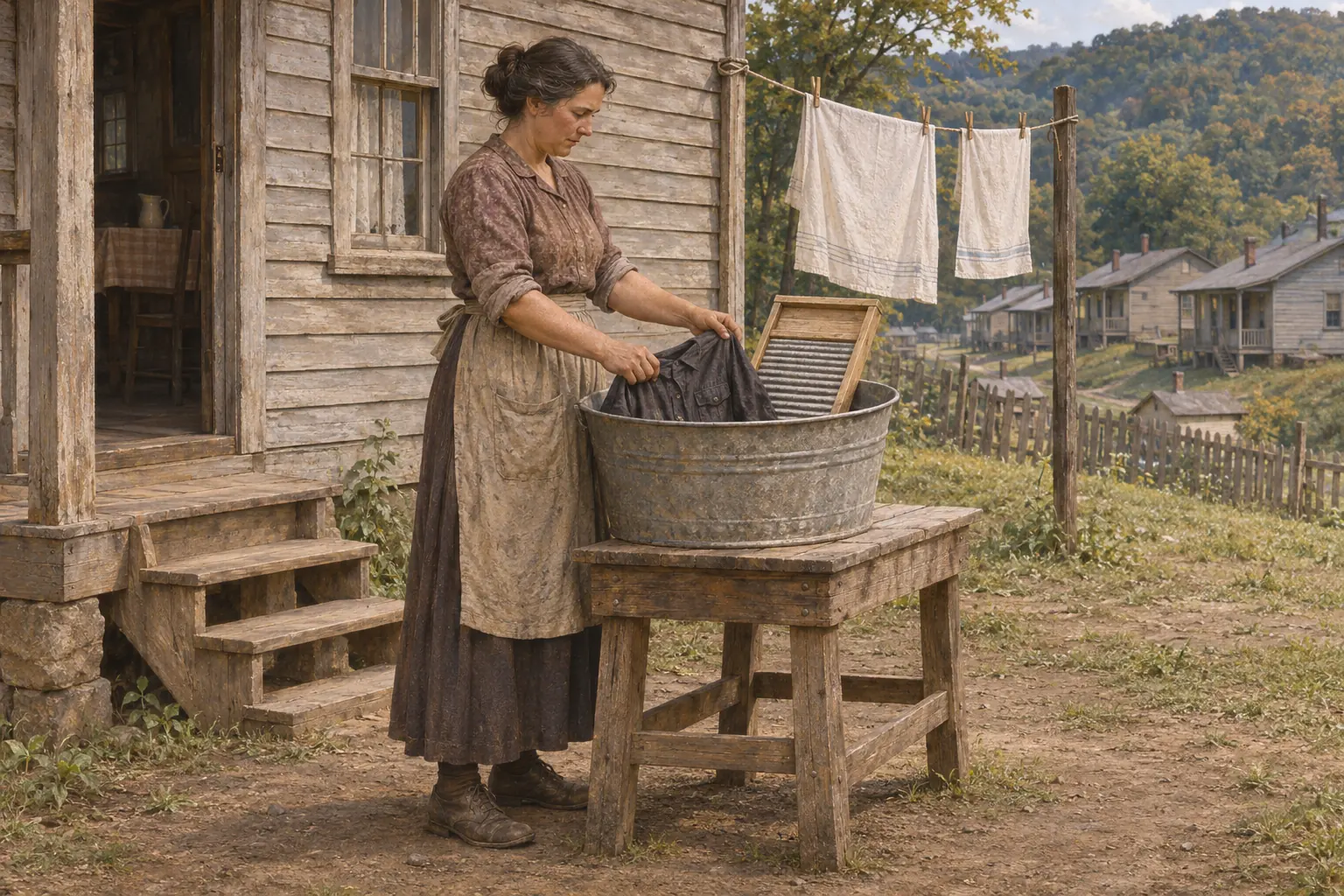
At Blue Heron, Kentucky, a miner’s work schedule helped set the rhythm of the household. The National Park Service describes women packing food and water, sending children to school, washing clothes, and cleaning away coal dust. More cooking and cleaning followed the miner’s return.
Freshly washed clothes could need another wash if dust from the tipple settled on them. Work done carefully in the morning could be undone by the wind.
A miner’s packed meal was one visible result of that labor. The clean shirt, the water ready for washing, and the next meal belonged to the same working day. The mine’s demands reached beyond the person who entered it.
A House Could Make the Work Harder
Historian Janet W. Greene’s study of southern West Virginia coal-camp women shows why the house itself mattered. Gladys Lowe remembered carrying water up seventy-five steps at Boomer in Fayette County. Before washing could begin, someone had to get the water home.
Housing choices were unequal. Greene records Nannie Woodson Jones’s experience of segregated camps and repeated moves as her husband sought better work. A move meant learning another house and another daily routine.
These accounts put a practical question beside an old company-house photograph: how much effort did it take to live there? The distance to water could matter as much to a working household as the number of rooms.
Extra Income Came With Extra Work
Taking in boarders meant more than renting a bed. Greene describes Concetta Quattrone cooking meals, packing lunches, preparing bath water, and washing clothes for single miners at Vivian, West Virginia. She also cared for her own large family. Her earnings and the couple’s savings helped them open an independent grocery store.
That example gives household labor a different ending from mere survival. Paid work at home could help a family build another source of income.
In Southwest Virginia, the Library of Virginia describes women selling butter and eggs while families gardened and preserved food. Its account also notes that coal demand fell in summer, making other earnings important when mining work slowed.
Money coming into the house and food produced there both helped meet household needs. They were different contributions, however. A garden could add to the table; a sale could bring money for something the family could not grow. Neither happened without time and work.
Paid Jobs Depended on Where Women Lived
A 1925 Women’s Bureau report examined employment and living conditions in coal miners’ families, drawing on the Coal Commission’s 1922–23 investigations. It found that remote mining settlements offered women fewer ways to earn money than places near larger towns.
Among employed daughters still living at home in bituminous mining regions, sales and domestic service were prominent. Some worked as teachers or in small factories. In Pennsylvania’s anthracite region, nearby textile mills offered a different range of jobs.
Those regional differences matter. A woman’s options depended on what work existed within reach, as well as the duties waiting at home. It would be misleading to describe all coal-camp women as having one occupation or one path through life.
Community Life Took Work Too
Church gatherings and visits brought people together beyond the daily round of chores. In the National Park Service’s account of Black communities in the New River Gorge, Helen Powell remembered church celebrations at Glen Jean, West Virginia. Families brought dishes for large birthday dinners, and special programs marked Children’s Day and other occasions.
The same account describes food grown, gathered, preserved, and shared within these communities. A household’s work could reach another table.
Closeness was not automatic just because houses stood near one another. Blue Heron’s recorded memories describe less visiting there than in some neighboring camps. Some women valued the quiet; others found camp life confining.
Both kinds of memory deserve room. Community history includes friendship and pleasure, as well as isolation. Remembering the labor behind a gathering does not make the gathering any less joyful.
Strikes Changed the Work Without Ending It
During the early twentieth-century mine wars in southern West Virginia, striking families could lose their company houses. PBS’s American Experience explains how union-supported tent colonies kept families near the mines. Women continued cooking, washing, and raising children in those harder surroundings.
Some also confronted replacement workers. The PBS account includes Grace Jackson’s recollection of armed resistance near a train and Willie Helton’s memory of carrying guns concealed in her dress. These are specific memories of labor conflict, not a description of every woman’s role.
Julia Balassone’s Tucker County interview adds another view of the 1922 strike. She remembered people at her house calling out to replacement workers from the porch. She also recalled union food relief and the money her mother had saved from boarders. Her account places public protest beside the private problem of feeding children.
A strike could be discussed in terms of wages and union recognition. Inside a family’s temporary shelter or home, it also raised the daily question of how to keep going.
Finding Women in Coal-Town History
A payroll can tell us who received a company’s wages. It cannot, by itself, tell us who washed for a boarder, sold eggs, prepared a church dinner, or stretched savings through a strike.
The interviews used here help answer those questions. They are remembered experiences, recorded years later, and should be read with attention to the speaker, place, and date. Julia’s recollection belongs to Tucker County; Blue Heron’s accounts belong to a Kentucky community. Their differences are part of the history.
If your family lived in a coal town, ask about the women by name. Who earned money? Who controlled it? Where did the water come from? Who helped when work stopped? A recipe, a boarding-house account, or a photograph of neighbors may hold clues that a mine employment record leaves out.
Women in coal towns made decisions about money, work, family, and community under difficult conditions. Remembering what they did gives us a fuller account of how those towns lived.
Strong Backs. Red Necks. Deep Roots.

Explore more stories about mountain work, family, and survival in Coal Mining Lives & Labor.
Sources and Further Reading
- Friends of Blackwater, Early Mining Voices: interview excerpts on strikes and unions, including Julia Balassone’s June 12, 1967 interview, page 1 (PDF)
- National Park Service: Women’s Life at Blue Heron, Kentucky, including the exhibit’s oral-history transcript
- Janet W. Greene, West Virginia History: Strategies for Survival—Women’s Work in the Southern West Virginia Coal Camps, volume 49 (1990), pages 37–54
- Library of Virginia: Virginia’s Coal Towns, with links to WPA life histories and archival collections
- U.S. Department of Labor, Women’s Bureau: Home Environment and Employment Opportunities of Women in Coal-Mine Workers’ Families, Bulletin 45 (1925), digitized by FRASER
- National Park Service: Life in an African American Community—Quinnimont Missionary Baptist Church, including Helen Powell’s Glen Jean memories
- PBS American Experience: Women in the Mine Towns, household work, tent colonies, and women’s participation in labor conflicts