
The Matewan massacre was a deadly confrontation on May 19, 1920, between Baldwin-Felts detectives, local officials, and armed miners in Mingo County, West Virginia. Ten people died. The conflict grew from union organizing, evictions from company housing, and a dispute over who had the authority to make arrests. Its consequences spread far beyond the town.
For ten-year-old Marie Cooley, that afternoon began with an errand for the family’s evening meal. Decades later, she recalled passing the railroad depot as shooting broke out. An ordinary trip for groceries had become a race to get home alive.
Why Union Membership Could Cost a Family Its Home
In January 1920, the United Mine Workers of America began a major organizing campaign in southern West Virginia’s nonunion coalfields. Companies fired workers who joined. Because many miners rented company houses, losing a job could also mean losing the family home.
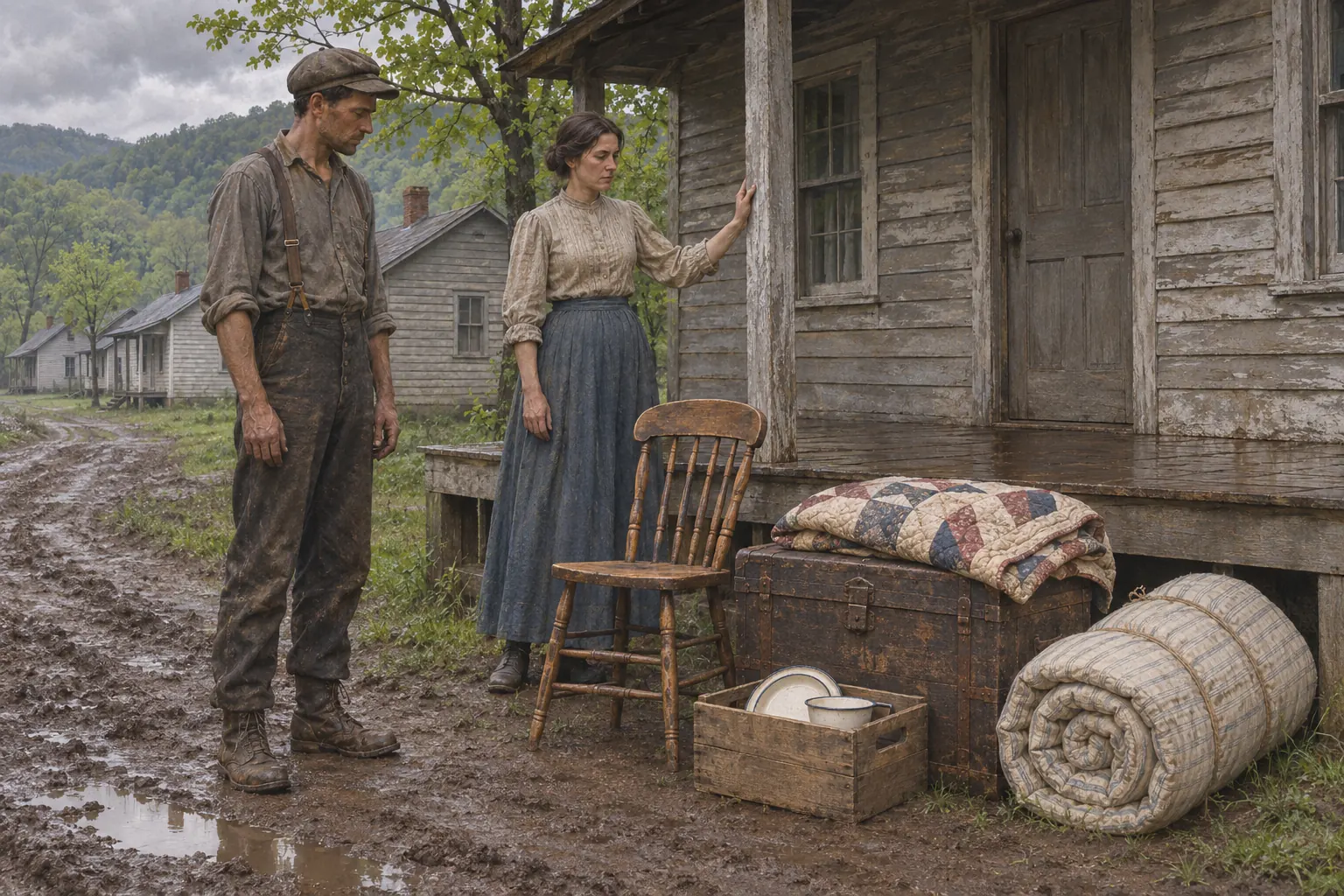
Operators hired Baldwin-Felts detectives to carry out evictions. On May 19, the agents put families out of Stone Mountain Coal Company houses near Matewan. Household belongings ended up outdoors.
Eviction made union membership a decision the whole household had to face. The immediate question was where to sleep and keep the family’s possessions. The larger question was whether workers could organize without being driven out of the community.
The broader history of why coal miners struck helps explain the demands behind the dispute. At Matewan, those demands collided with the power employers held through both work and housing.
The Police Chief, the Mayor, and the Detectives
Three sets of people stood at the center of the confrontation:
- Sid Hatfield was Matewan’s police chief and a former coal miner. Mayor C. C. Testerman had appointed him in 1919. Hatfield supported the union campaign.
- Mayor C. C. Testerman backed Hatfield during the dispute with the detectives. He was also a local storekeeper.
- Albert and Lee Felts were brothers of detective-agency founder Thomas Felts. They were among the Baldwin-Felts men carrying out the evictions for coal companies.
Hatfield challenged the evictions and sought to arrest the detectives. Albert Felts, in turn, claimed authority to arrest Hatfield. Their argument put the town’s officials and company-hired agents in direct conflict.
Those roles matter. Hatfield was a municipal police chief, not the county sheriff. The confrontation involved competing claims of lawful authority as well as opposing sides in a labor dispute.
What Happened in the Streets of Matewan?
After the evictions, the detectives returned to town to catch a train. A crowd gathered near the station and nearby businesses. Hatfield and Albert Felts argued over arresting one another. Then shooting began, drawing in detectives and armed miners.
The death toll included seven Baldwin-Felts men, two miners, and Mayor Testerman. Albert and Lee Felts were among the detectives killed. The Williamson News named the two miners as Bob Mullins and Tot Tinsley.
Testerman did not die instantly in the street. The newspaper’s May 20 report corrected that early claim: he had been taken to a hospital in Welch, where he died late that night.
That correction is a small reminder of how quickly news and rumor traveled together. Even a basic detail about one well-known victim needed to be checked.
Who Fired the First Shot?
The surviving accounts do not give us a first-shot story we can state with certainty. Hatfield admitted firing but maintained that Albert Felts shot first.
An unidentified article preserved in the Logan Coal Operators Association Collection tells a sharply different story. It portrays the evictions as lawful and orderly, then accuses Hatfield of shooting Felts while Testerman examined the warrant. This is an allegation in a partisan account, not a neutral verdict.
Henry Haywood’s statement shows why eyewitness evidence also needs careful reading. Questioned at the prosecuting attorney’s office on June 28, 1921, Haywood said he had been near the hardware-store doorway. Asked who fired first, he answered, “Well, I couldn’t hardly say to save my life.”
He then offered his impression that Hatfield had fired first. But he also said he had not seen the gun and had run when the shooting started. His belief and what he actually saw were not the same thing.
The uncertainty was already apparent the day after the battle. The Williamson News warned that confusion had left even witnesses struggling to describe events. Later retellings can sound more certain than the evidence they rest on.
Why the Violence Did Not End at Matewan
The shootout made Hatfield a hero to many miners. It did not resolve the organizing struggle. Historian Clayton D. Laurie describes strikes beginning across the Tug River Valley on July 1, 1920, followed by more violence involving miners, guards, and detectives.
Federal troops arrived in Mingo County in late August. Their presence could mean different things to different families. Soldiers supplied food, clothing, and shelter to displaced miners, but troops also protected replacement workers. Restoring order did not settle the question of whose interests that order served.
Hatfield and 17 other defendants were tried on murder charges in early 1921 and acquitted. The verdict ended that prosecution without ending the coalfield conflict.
The trial also left a much larger record than the familiar gunfight story suggests. West Virginia University’s collection guide describes an incomplete transcript of roughly 2,000 pages, including testimony from surviving detectives and two Matewan telephone operators. According to the guide, that portion does not contain Hatfield’s own examination.
A court case had to consider people, movements, statements, and competing claims. Remembering that larger record keeps the story from shrinking to a single dramatic exchange on a sidewalk.
Was Sid Hatfield Killed in the Matewan Massacre?
No. Hatfield survived the May 1920 shootout. Baldwin-Felts detectives killed him and Ed Chambers on August 1, 1921, as they approached the McDowell County Courthouse in Welch with their wives.
That was a separate event in a different town, more than a year later. Anger over the killings helped drive the miners’ march that led toward the Battle of Blair Mountain.
Keeping those events separate makes their connection clearer. Matewan helped make Hatfield a symbol of resistance. His later death intensified a struggle that was already continuing around him.
Is the Movie Matewan a True Story?
John Sayles’s 1987 film Matewan draws on the real coalfield conflict, but it is a historical drama. It combines actual people and events with fictional characters.
The West Virginia Encyclopedia identifies organizer Joe Kenehan and young preacher Danny Radnor as fictional. It also notes that the film’s Few Clothes Johnson was based on a real figure associated with an earlier phase of the Mine Wars.
The film can introduce viewers to organizing across racial and ethnic lines and the pressure exerted by company power. Its dialogue and scenes should not be treated as eyewitness testimony about May 19.
A Child’s Way Home
Marie Cooley later became Marie Robinette. In a 2004 Goldenseal interview, she remembered the storekeeper she had visited that afternoon as kind and friendly. That storekeeper was Mayor Testerman.
After leaving his store, she passed the depot. She recalled a bullet striking the railroad ties near her and running home in fear. This was a childhood memory told 84 years later, rather than a statement recorded immediately after the shooting.
Testerman was a public official and someone a child knew across a grocery counter. Around the armed men were neighbors trying to buy food, catch trains, and keep their households going.
The Matewan massacre mattered because a struggle over jobs, homes, and authority became deadly in those shared streets. Remembering the families and bystanders helps us understand what was at stake before anyone fired.
Strong Backs. Red Necks. Deep Roots.

Explore more stories about mountain work, family, and survival in Coal Mining Lives & Labor.
Sources and Further Reading
- Lon Savage, The West Virginia Encyclopedia: Matewan Massacre
- Dallas H. Jude, Goldenseal: Eyewitness—Marie Robinette of Matewan (Winter 2004 excerpt)
- Lon Savage, The West Virginia Encyclopedia: Sid Hatfield
- Williamson News, May 20, 1920: Reports on the Matewan deaths; State Archives transcription
- Unidentified article, Logan Coal Operators Association Collection; State Archives transcription
- Henry Haywood’s statement, June 28, 1921; State Archives transcription
- Clayton D. Laurie, West Virginia History: The U.S. Army and labor-dispute interventions, 1920–1921 (1991)
- WVU West Virginia and Regional History Center: Matewan Trial Transcript collection guide, A&M 3608
- Stephen Lee Fesenmaier, The West Virginia Encyclopedia: Matewan (film)
- The Criterion Collection: Matewan (1987), film and production information