
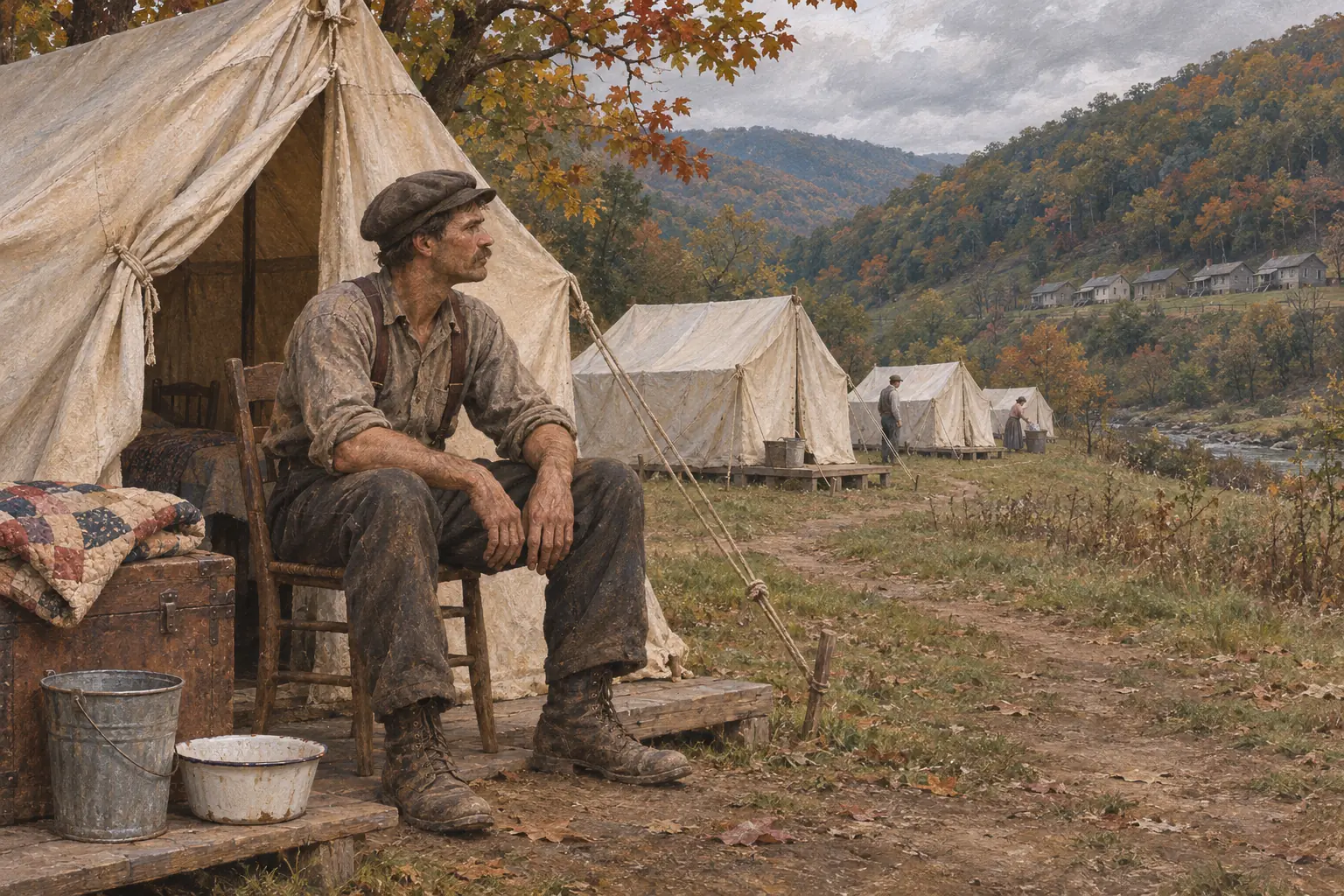
Why did coal miners strike? In Appalachian coalfields, miners stopped work over wages, unfair coal weighing, long hours, dangerous conditions, and the right to organize. Company control over stores and housing could turn a job dispute into a family crisis. The immediate demands differed by place and year, but many conflicts concerned how much say workers had over their lives.
A 1913 newspaper interview makes that connection plain. Writing in the San Francisco Bulletin, reporter Mrs. Fremont Older quoted West Virginia coal operator Quin Morton: “If my men wouldn’t work, they couldn’t live in the houses.” Her account strongly favored the strikers, but the link between employment and shelter was real. The employer could also be the landlord.
A Wage Increase Was Only Part of the Paycheck
A coal loader’s earnings often depended on how much coal he produced. The National Park Service’s history of Helen, West Virginia, describes loaders paid by the ton rather than by the hour. Work needed to reach and support the coal face could produce no paid tonnage.
Miners called some of those tasks dead work. Installing roof supports, maintaining ventilation, and extending track took time and effort, yet the Helen account describes loaders receiving no pay for them. A rate per ton could therefore hide a great deal of labor.
What a family could spend also depended on deductions and access to cash. At the Stearns operations on the Kentucky–Tennessee border, the Park Service records cash paydays every two weeks, with scrip available as an advance. Rent, tools, and scrip charges could be deducted from earnings.
That example shows why the details matter. Miners did not all receive their entire wages in company tokens. A useful question is how much money remained after deductions, and how freely the household could spend it.
Who Measured the Coal Could Matter as Much as the Rate
If pay depended on production, the measuring system mattered. The West Virginia State Archives describes cribbing: enlarging cars so workers loaded more coal than the amount credited to them. Deductions for rock mixed with the coal created another point of dispute.
A higher rate offered little comfort if a miner believed the company counted his output unfairly. Workers wanted scales and a checkweighman of their own choosing to watch the weighing on their behalf.
Those demands appeared in the Paint Creek–Cabin Creek conflict of 1912–1913. They were practical attempts to make earnings open to inspection. The central question was simple: could the worker check the calculation that determined his pay?
Danger and Long Hours Added to the Pressure
Roof falls, explosions, and fires were part of the background to these disputes. Historian Rachel Donaldson’s National Park Service overview describes severe dangers in early twentieth-century West Virginia mines, along with weak safety protections and enforcement.
Long working hours added another grievance. Pay, time, and safety belonged together because they shaped both the shift underground and the household waiting above it. A demand for a shorter day could matter even if the rate of pay stayed the same.
Still, the cause of a particular walkout needs its own evidence. A dangerous industry did not make every strike a protest triggered by one accident. At Paint Creek in 1912, the immediate wage dispute concerned pay equal to that received at other mines in the region.
The Right to Organize Was a Demand of Its Own
The United Mine Workers of America, formed in 1890, sought to help miners negotiate together. Union recognition meant that the employer would deal with their chosen organization.
Mother Jones helped coal miners turn their demands into public meetings, organizing campaigns, and appeals to government officials.
The West Virginia State Archives lists organizing rights, free speech and assembly, an end to blacklisting, and removal of mine guards among the demands in the 1912 conflict. Miners also wanted alternatives to company stores.
These demands fit together. A worker could hardly bargain freely if attending a meeting threatened his next job. Being allowed to join an organization meant more when its members could meet, choose representatives, and raise complaints without being driven out.
The conflict drew federal attention. A Senate committee report dated May 26, 1913, recommended investigating conditions in the Paint Creek district. Its proposed questions included whether people were being held in forced labor through debt and whether arrests and trials violated federal law or the Constitution.
That document set out matters to investigate; it was not a finding that every allegation was true. It shows how far the controversy had reached beyond the wage scale.
A Company House Could Become a Union Tent
Morton’s reported remarks about housing give the dispute a household scale. In the same April 3, 1913 article, Older recorded him saying that he needed houses for replacement workers. Housing served the mine’s need for labor, while the family living there depended on it for shelter.
Modern histories confirm that eviction was a major part of the conflict. PBS’s American Experience describes striking families removed from company homes and housed in union-supported tent colonies on land near the mines.
The union’s help made it possible to remain nearby during a strike. Yet a tent did not remove the work of feeding children, washing clothes, and keeping a household going. Those jobs continued in harder surroundings.
The history of women in coal towns shows how much that daily effort mattered. A strike depended on what happened around the cooking pot and washbasin as well as what happened at a meeting.
Eviction also raised the cost of holding out. Returning to work could promise income and shelter; continuing the strike meant trying to win terms that might make life more secure. Families faced those choices with different savings, support, and prospects.
A Short Timeline of the West Virginia Mine Wars
The West Virginia Mine Wars developed through separate disputes and confrontations. A short sequence helps keep the causes in view:
- In 1912–1913, the Paint Creek–Cabin Creek conflict grew from a wage dispute into a wider struggle involving organizing, mine guards, and evictions.
- In May 1920, the confrontation at Matewan followed organizing efforts and evictions in Mingo County. The shootout became part of a continuing regional labor struggle.
- In 1921, the miners’ march toward Mingo County led to fighting at Blair Mountain. The marchers sought to aid arrested striking miners; federal troops eventually ended the confrontation.
A strike is a refusal to work. An armed march, an eviction, and a gunfight are different events, even when connected to the same labor struggle. Keeping that distinction makes it easier to understand what miners demanded before violence took over the story.
What Strikers Hoped to Change
Stopping work put pressure on an operator by interrupting production. But that pressure weakened when replacement workers kept coal moving, while strikers still needed food and shelter. PBS’s account of the tent colonies explains why supporting families was part of sustaining the walkout.
The demands reveal the kind of change workers sought: a paycheck they could verify, working conditions they could challenge, and representatives the employer would hear. A wage increase alone could not answer every one of those concerns.
Morton’s reported statement about company houses brings the stakes back into focus. The dispute could reach from a coal car on the scales to a family’s place to sleep. Understanding why miners struck means understanding both ends of that connection.
Strong Backs. Red Necks. Deep Roots.

Explore more stories about mountain work, family, and survival in Coal Mining Lives & Labor.
Sources and Further Reading
- Rachel Donaldson, National Park Service: Introduction to the West Virginia Mine Wars
- National Park Service: African American Coal Miners—Helen, WV, including tonnage pay and dead work
- National Park Service: Scrip—A Coal Miner’s Credit Card, including Stearns pay and credit practices
- West Virginia State Archives: West Virginia’s Mine Wars, including weighing disputes and organizing demands
- San Francisco Bulletin, April 3, 1913: Mrs. Fremont Older’s interview with Quin Morton, transcribed by West Virginia Archives and History
- PBS American Experience: Women in the Mine Towns, including evictions and tent colonies
- U.S. Senate, Report 63-52, May 26, 1913: proposed investigation of conditions in the Paint Creek district (PDF)
- National Park Service: Paint Creek and Cabin Creek Strikes
- National Park Service: Matewan Massacre